Crapemyrtle (Lagerstroemia indica) – Description & Uses
CONTENTS ⌵
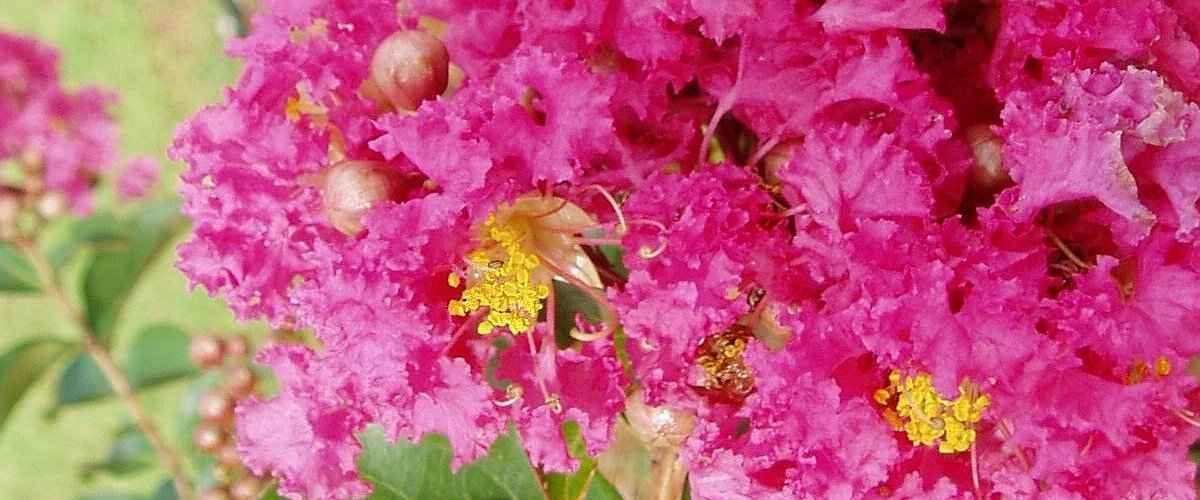
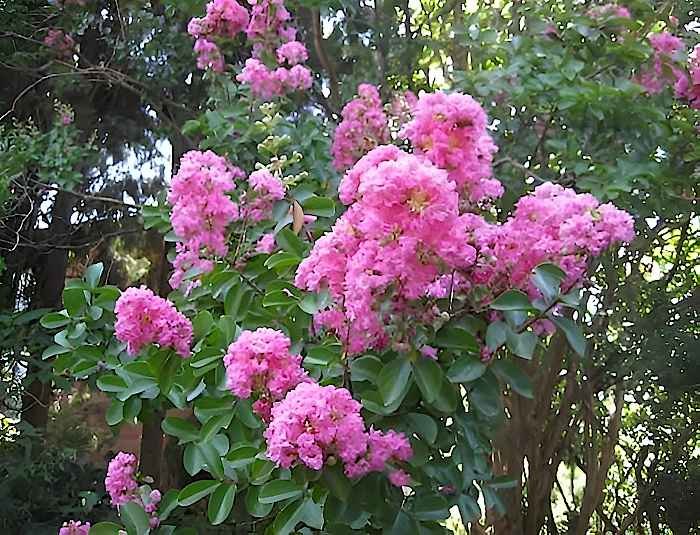
The Crapemyrtle (Lagerstroemia indica), which belongs to the family Lythraceae, is a large-growing shrub or small tree with several interesting features, dominated by its long-lasting, rich and attractive summer flowering with pink flowers for the typical species.
Originally from the Far East (just a stone’s throw from India), it became known in the West through the English aristocrat Hugh, Duke of Northumberland, who introduced it in 1759 CE.
In the 20th century CE, and for more than 4 decades, it had been the subject of a systematic breeding effort that have yielded numerous varieties, enriching the plant’s color palette with red, white, fuchsia, and purple flowers, while differences in the shape and size of the varieties are now also notable – since purely dwarf Crapemyrtles are now offered.
The Lagerstroemia indica is today a flowering plant with planetary spread and is the main subject of this article, as the entire editorial team of “Kalliergeia” boldly assures – unless they have made some fundamental error.
Crapemyrtle (Lagerstroemia indica) – Description & Uses
Crape Myrtle Origin
Crapemyrtle (Lagerstroemia indica) – Description & Uses
Crapemyrtle (Lagerstroemia indica) - Brief Description
Family: Lythraceae
Genus: Lagerstroemia
Scientific Name: Lagerstroemia indica L. Pers.
Common Name: Cranesbill Myrtle, Crapemyrtle, Crape Myrtle, Crepe Myrtle, Crepeflower, Pride of India, Queen Crape Myrtle, Queen of Flowers, Queen of Shrubs, Queen’s Flower
General Characteristics
Leaf Persistence
Deciduous
Form
Shrub or Small Tree
Texture
Medium
Growth Rate
Moderate
Flowering Period (Northern Hemisphere)
June – September
Fruiting Period
Autumn – Winter
Height
8-15 m (26-50 ft)
Diameter
5-8 m (16-26 ft)
Shapes and Colors
Leaves Shape
Ovate, Obovate
Foliage Colour
Green
Autumn Foliage Colour
Yellow, Redish Orange, Red
Flowers Shape
Tubular with Crepe Petals
Flowers Colour
Pink
Fruit
Brown Capsule
Plantation
Soil Type: Excellent drainage, moist, heavy loam to clay
Soil pH: 5-7.5
Watering: Moderate
Exposure: Sun
Hardiness: −17 °C (0 °F – USDA Hardiness Zone 7a)
Uses
Specimen, hedges, mixed hedges, urban planting, tree rows, pots and containers
Crapemyrtle (Lagerstroemia indica) – Description & Uses
Crapemyrtle (Lagerstroemia indica) - Etymology
Etymology of the Genus Name
The name of the genus Lagerstroemia is the Neo-Latin version of the Swedish surname Lagerström. Magnus von Lagerström (1696-1759) was a friend of Charles Linnaeus, but also the director of the Swedish East India Company.
Thanks to this position, he was able to supply the great Swedish botanist with numerous new plant species, expanding his systematic scope of study.
Although Lagerström himself never traveled to personally collect new and rare plant species for the then Western World, this did not prevent Charles Linnaeus from giving his friend’s surname to the genus.
Etymology of the Species Name
The name of the species indica, is a Neo-Latin word whose meaning is from India, Indian.
It is probably given by mistake, as either Charles Linnaeus believed that all the plants supplied to him by his friend – hence Lagerstroemia – came only from the Indian Subcontinent, which is not the case, because in fact they were collected and from other parts of the wider Far East, or that the species originates from India, which is also not the case, as it does not reflect the actual birthplace of the plant.
However, it is worth noting at this point that the great systematist Carl Linnaeus was sufficiently geographically illiterate, as it is well known that he had a vague idea of China’s geographical location, since, according to him, it often coincided with that of India.
And in this regard -unfortunately- he resembled the great adventurer and navigator Christopher Columbus, son of Domenico and Susanna.
Crapemyrtle (Lagerstroemia indica) – Description & Uses
Crapemyrtle (Lagerstroemia indica) - Origin & Life Span
Origin
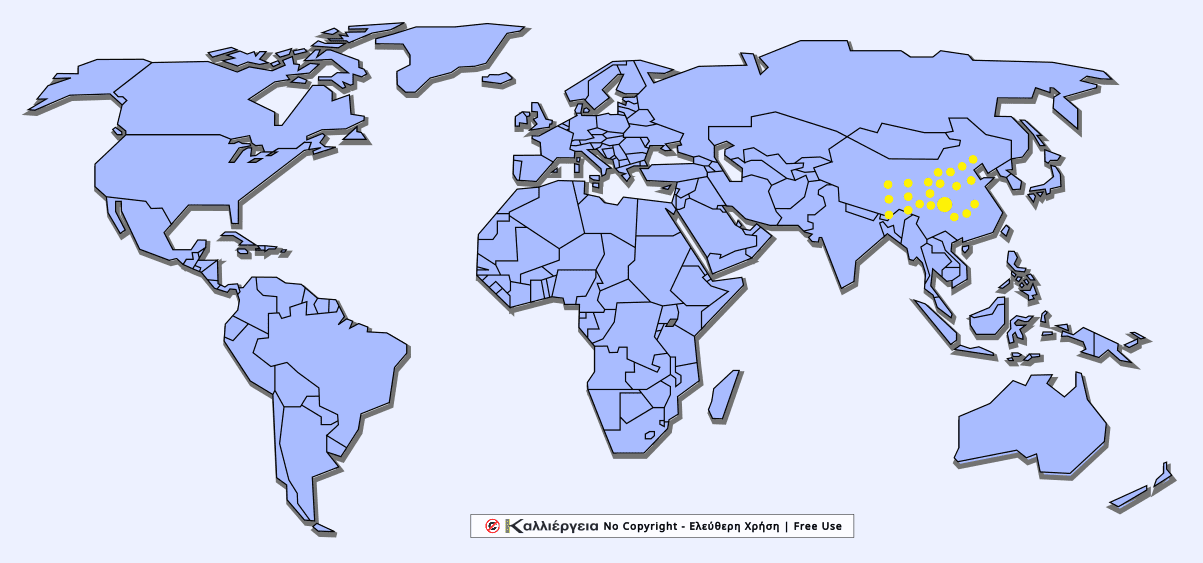
Far from India, the roots – metaphorically speaking – of the species are located in China and Korea. From there it spread to many areas of the temperate, tropical and subtropical zone either naturally or thanks to the plant lovers who appreciated the exceptional beauty of the plant and spread it.
The Crapemyrtle in its natural habitats grows in wooded areas and semishaded places, on forest edges, along rivers, in areas of bush vegetation, as well as in grasslands.
It is found in a variety of climatic types, which include both tropical and steppe areas, where the mean annual rainfall is between 1200 to 2400 mm, while the mean annual temperature is between 5 and 28 °C (41-82 °F).
In terms of altitude, its populations are located from quite low up to 1500 m.
Invasiveness
The plant sometimes proves a great invasive ability and therefore we must not fail to mention here, that the joy for the spread of the species was not shared by all in all areas where it was grown as an ornamental.
Among those who did not enjoy it were all those states that have declared it an extremely invasive plant, including South Africa, Belize, Cuba, Puerto Rico and the Virgin Islands.
Life Span
Despite rumors and whispering that Lagerstroemia indica lives only 50 years, in fact the plant, under ideal conditions, can live up to a century and a half.
Crapemyrtle (Lagerstroemia indica) – Description & Uses
Crapemyrtle (Lagerstroemia indica) - Landscape Attributes
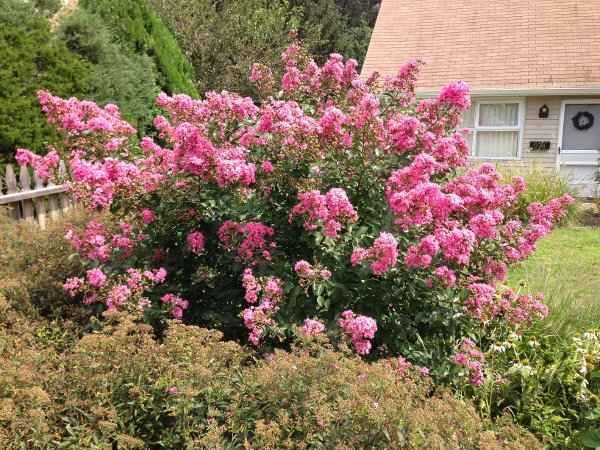
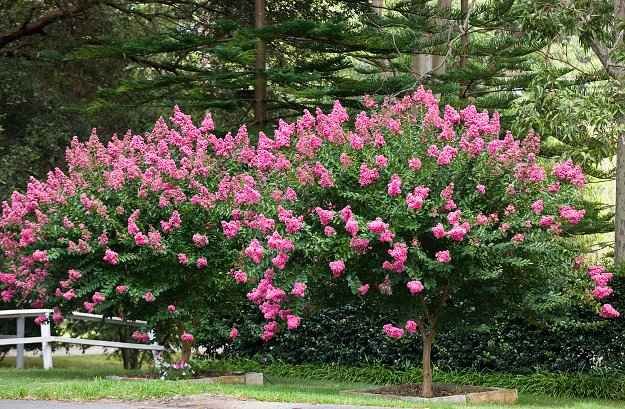
The Crapemyrtle is a perennial deciduous shrub or small tree of moderate growth rate and vase-shaped or inverted cone.
It develops multiple shoots from the base which show medium dense branches, where in the typical species they are more erect, giving an upright habit to the plant, while in the varieties the form can be either upright or more spreading.
It has a symmetrical canopy with regular outline and foliage that is characterized as medium texture, and the height of the plant reaches 15 m and its diameter 8 m, dimensions which it acquires within a period of about 20 years.
The plant’s most striking decorative feature is its flowers, which bloom for an extended period, ranging from 60 to 120 days, beginning in early summer and ending in early fall.
Of course, in its natural range, the flowering period can be much longer, as the plant often remains in bloom for nearly the entire growing season.
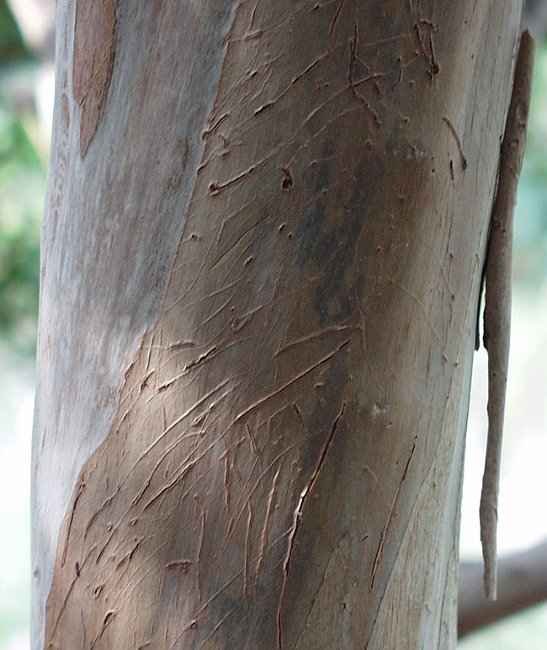
Another decorative feature of the plant is the bark of the trunk or trunks, which often exfoliates in thin flakes, revealing on the trunks an orange-brown inner bark of particular decorative value.
Crapemyrtle (Lagerstroemia indica) – Description & Uses
Crapemyrtle (Lagerstroemia indica) - Botanical Description
Trunk
The trunk or trunks are covered by a thin bark with a smooth to slightly coarse texture and a grayish-brown color. It often exfoliates in thin flakes, revealing on the trunks an orange-brown inner bark – although it sometimes appears in other colors, such as grayish, gray-green, brown, and purple.
Branches & Twigs
The twigs are covered with very fine pubescence which is lost as they mature, they are thin, square or subalate, and they have a reddish or green color, which later becomes brownish-green.
The branches are glabrescent, have a grayish-brown color, are quite strong and do not break easily.
Leaves
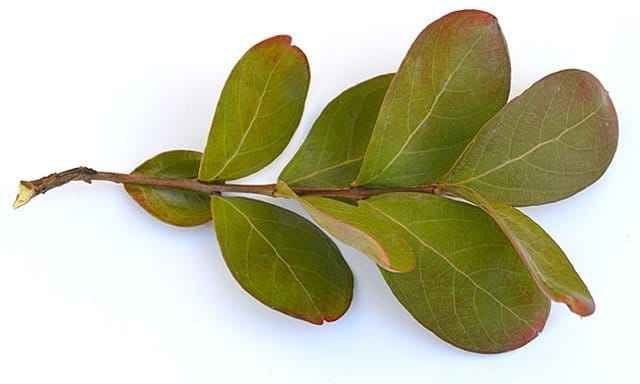
The leaves of Crapemyrtle are entire, oblong, elliptic or obovate, they are acute in apex, while in the base are broadly cuneate up to rounded, and sessile or with petiole 2 mm long. The lamina has a slightly leathery or papery texture and is glabrous or with slight indumentum on veins abaxially.
The leaves, which have very small deciduous stipules, are arranged in the shoots opposite and rarely alternate, take a dark green color, while in autumn they acquire yellow, orange-red and red hues, of remarkable intensity.
In terms of dimensions, their length is between 2.5 and 7 cm and their width is between 1.5 and 4 cm.
Inflorescences
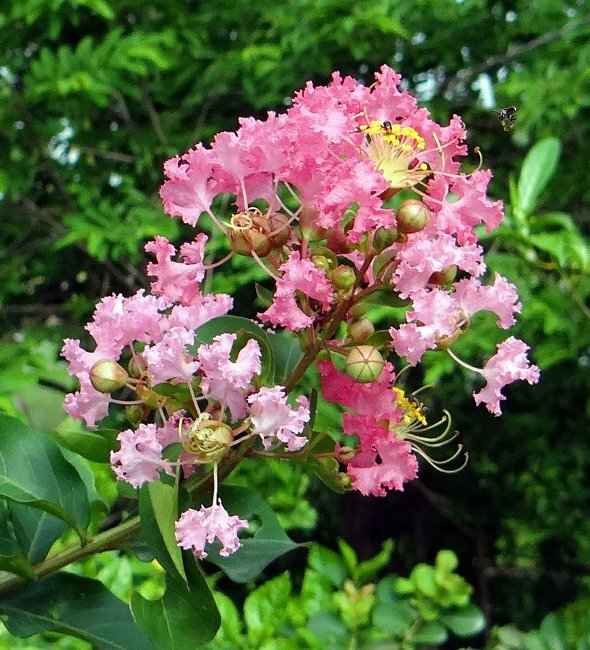
The pedicellate flowers of Crapemyrtle are borne terminally on the annual shoots, on erect, dense, conical – subpyramidal, puberulous panicles inflorescences, 7 to 20 cm (3-8 in) long and 10 to 15 cm (4-6 in) wide.
Flowers
The flowers are hermaphrodite, actinomorphic, and six-merous, with a diameter of 3 to 4 cm. The receptacle (or hypanthium), 7 to 11 mm long, is tubular in shape, glabrous and leathery, smooth or possibly bearing 6 ridges.
The calyx consists of 6 triangular lobes of fused sepals, which are glabrous, spreading or erect, ranging in length from 3.5 to 5.5 mm. An annulus (ridge) runs along the inner base of the lobes. The 6 lobed petals, 1.2 to 2 cm in diameter, are orbicular, clawed, with slender claws 6–9 mm long.
The exserted stamens, usually 36 to 42 in number, are dimorphic. Of these, 6 solitary stamens located externally, opposite the petals, have thick, colored filaments and bear relatively large anthers. The rest, which grow internally in clusters, have filiform filaments, are white in color, and bear noticeably smaller anthers.
The pistil is 1, with a gynoecium syncarpus, consisting of 6 carpels. The 6-locular ovary is superior, glabrous, with numerous ovules per locule. The long and exserted style, which sometimes appears straight and at other times curved or coiled, bears a capitate stigma.
The flowers of the typical species are pink, but the varieties come in red, violet, purple, and white, and there are also exceptionally interesting varieties with bicoloration on each individual flower.
Pollination
The pollination of the plant is carried out with insects (entomophilous species).
Fruit & Seeds
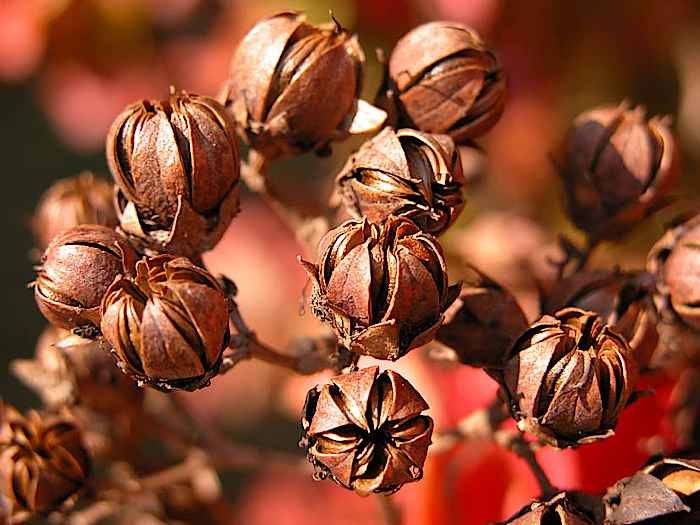
The fruit of the plant is a dehiscent capsule with 4 to 6 valves, it has a brown color and an ellipsoid shape, and its dimensions are 0.7 to 1.2 cm in length and 1 to 1.3 cm in diameter.
The seeds are winged, have a length of 7 to 8 mm, brown-green color and are disc-shaped.
Crapemyrtle (Lagerstroemia indica) – Description & Uses
Crapemyrtle (Lagerstroemia indica) - Climate and Soil
The Lagerstroemia indica grows in a wide range of climates and in a variety of soil environments. In relation to the climatic types, the following are mentioned, among others:
- Af – Tropical rainforest climate
- Am – Tropical monsoon climate
- As – Tropical savanna climate with dry summer
- Aw – Tropical wet and dry savanna climate
- BS – Steppe climate
(Köppen–Geiger Climate Classification System)
Temperature
The Crapemyrtle is a highly adaptive and hardy plant. In relation to temperatures, the minimum limit ranges between -15 to -17 °C (5-1.4 °F), but established plants with a south orientation can withstand up to -21 °C (-5.8 °F).
Frost does not affect it, whether it is late spring or early autumn.
With high temperatures it does not face a problem, as long as its roots are adequately protected by cover from direct sun exposure and the plant is watered normally until the age of 3 to 4 years.
Soil and pH
In relation to the soil, it grows in various types, however it thrives in medium to heavy loamy soils, which are cool and drain.
In terms of nutrients, it seems to respond better to those of medium fertility while in terms of pH it prefers acidic to slightly alkaline reaction soils, with optimum values ranging between 5 and 6.5.
Exposure
Although Crapemyrtles tolerate partial shade, in order to show rich flowering they require at least 6 hours a day of direct sun exposure.
Crapemyrtle (Lagerstroemia indica) – Description & Uses

Crapemyrtle (Lagerstroemia indica) - Pests & Diseases
Sometimes the Crapemyrtles can cause problems from pests and diseases.
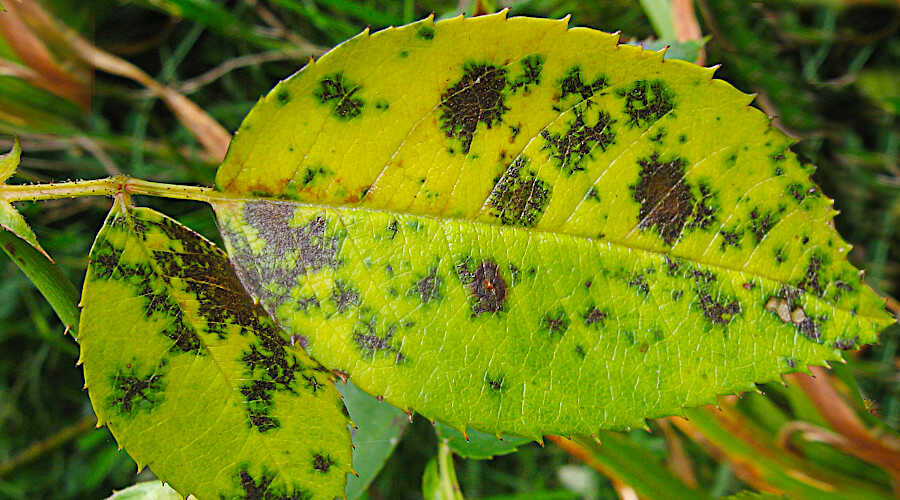
Of the diseases, the most important is powdery mildew, which is caused by the fungus Erysiphe lagerstroemia. The disease occurs when the days are hot and the nights are cold while the relative humidity is low. It is also frequent to be infected by Cercospora leaf spot caused by the fungus Cercospora lythracearum.
None of these two diseases destroys the plant, however the aesthetic damage can be very big. To deal with them, the appropriate formulations are used, while the selection of resistant varieties is an even better solution.
The same applies to entomological infestations, mainly by aphids (Tinocallis kahawaluokalani), which are sometimes a major problem.
Pests
Immediately below are recorded the most important pests of Lagerstroemia indica.
Various Insects
- Adoretus versutus (Rose Beetle)
- Altica spp.
- Anoplophora chinensis (Black And White Citrus Longhorn)
- Chaetocnema basalis
- Chaetocnema indica
- Halyomorpha halys (Brown Marmorated Stink Bug)
- Heliothrips haemorrhoidalis (Black Tea Thrips)
- Homalodisca vitripennis (Glassy Winged Sharpshooter)
- Pteroma plagiophleps
- Popillia japonica (Japanese Beetle)
- Retithrips syriacus (Black Vine Thrips)
- Xylosandrus crassiusculus (Granulate Ambrosia Beetle)
- Dialeurodes citri (Citrus Whitefly)
Aphids
- Monellia caryella (Blackmargined Aphid)
- Sarucallis kahawaluokalani – syn. Tinocallis kahawaluokalani (Crapemyrtle Aphid)
Scales
- Acanthococcus lagerstroemiae (Crapemyrtle Bark Scale)
- Ceroplastes ceriferus (Indian Wax Scale)
- Ceroplastes floridensis (Soft Scale)
- Eriococcus lagerostroemia
- Selenaspidus articulatus (West Indian Red Scale)
Mealybags
- Phenacoccus solenopsis (Cotton Mealybug)
Nematodes
- Paratrichodorus porosus
- Rotylenchulus reniformis (Reniform Nematode)
► By using the appropriate insecticides, their treatment is from satisfactory to difficult, except for nematodes, which are very difficult to control.
Diseases
After the pests, the recording of the diseases follows.
Fungi
- Armillaria tabescens (Armillaria Root Rot)
- Botryosphaeria obtusa
- Cercospora lythracearum
- Cryphonectria cubensis (Eucalyptus Canker)
- Erysiphe australiana – syn. Erysiphe lagerstroemiae (Powdery Mildew)
- Fomitiporia mediterranea (Esca Disease)
- Phyllactinia guttata – syn. Phyllactinia corylea
- Phyllosticta lagerstroemiae (Tip Blight of Crape-Myrtle)
- Phymatotrichum omnivorum
- Pseudocercospora lythracearum – syn. Cercospora lythracearum
- Rhizoctonia ramicola
Bacteria
- Xanthomonas sp. (Bacterial Leaf Spot)
► By using the appropriate fungicides the treatment of the former is from satisfactory to difficult, while the bacterium of the plant is extremely difficult to control.
Crapemyrtle (Lagerstroemia indica) – Description & Uses
Crapemyrtle (Lagerstroemia indica) - Toxicity & Allergenic Pollen
Toxicity
The Lagerstroemia indica is not toxic to humans and pets.
Allergenic Pollen
There are no reports or indications that Crapemyrtles causes allergic reactions.
Crapemyrtle (Lagerstroemia indica) – Description & Uses
Crapemyrtle (Lagerstroemia indica) - Cultivars and Varieties
Being an extremely beloved ornamental plant, the Crapemyrtle counts hundreds of varieties and hybrids. Their characteristics vary, offering a wide range of plant appearance and height, resistant to disease and insect attacks, as well as an endless range of flower color options.
Lagerstroemia indica Varieties
Some of the most important varieties are:
- Lagerstroemia indica ‘Coccinea’
- Lagerstroemia indica ‘Jinhuang’
- Lagerstroemia indica ‘Nivea’
- Lagerstroemia indica ‘Red Imperator’
- Lagerstroemia indica ‘Rosea’
- Lagerstroemia indica ‘Rosea Nova’
- Lagerstroemia indica ‘Rubra Magnifica’
- Lagerstroemia indica ‘Superviolacea’
Some of the most important Crapemyrtle hybrids are:
- Lagerstroemia indica x fauriei ‘Acoma’
- Lagerstroemia indica x fauriei ‘Apalachee’
- Lagerstroemia indica x fauriei ‘Cherokee’
- Lagerstroemia indica x fauriei ‘Natchez’
- Lagerstroemia indica x fauriei ‘Muskogee’
- Lagerstroemia indica x fauriei ‘Powhatan’
- Lagerstroemia indica x fauriei ‘Tuscarora’
- Lagerstroemia indica x speciosa ‘Monia’
- Lagerstroemia indica x speciosa ‘Princes’
- Lagerstroemia (indica × fauriei × limii) ‘Arapaho’
- Lagerstroemia (indica × fauriei × limii) ‘Cheyenne’
Crapemyrtle (Lagerstroemia indica) – Description & Uses
Crapemyrtle (Lagerstroemia indica) - Use
The Lagerstroemia indica has not only ornamental but also medicinal as well as ethnobotanical value. All these aspects of the plant are briefly discussed immediately below.
Medicinal
The Crapemyrtle, according to a number of studies, contains various alkaloids, cardiac glycosides, tannins, saponins, sterols, triterpenes, anthraquinones, reducing compounds, flavonoids and phenolic glycosides.
In experimental work it has shown anti-inflammatory, analgesic, antipyretic, antioxidant, anticancer, antimicrobial, antidiabetic, hepatoprotective, antithrombin and anti-Alzheimer’s effect.
Ethnobotany
The plant has a long tradition of ethnobotanical exploitation by many human communities. The roots, bark, leaves and flowers of the plant are used therapeutically.
For example, decoctions from the bark as well as from the leaves are administered as laxatives, while its seeds are given against insomnia and as narcotic.
The plant is generally used as an analgesic, to control cholesterol levels, to control blood pressure, against urinary dysfunctions, to treat diarrhea, to facilitate bowel movement and to treat diabetes.
Use in Garden and Landscape
The Crapemyrtle, as it is highly adaptable to different environments, is utilized in many ways:
- Planted in pots and planters – especially small varieties
- As a plant that can withstand the pollution, the harsh atmosphere of cities, it is planted in parks and squares
- In the form of a tree, it creates beautiful tree lines on wide sidewalks or other similar spaces.
- Its drought resistance makes it suitable for island and other areas where water for irrigation is scarce.
- It is planted as a small shade tree in the lawns or in the flower beds of the gardens
- Can be planted in outdoor living rooms as well as in patios
- Combines with other plants in group plantings, such as Junipers (Juniperus x media ‘Pfitzeriana Glauca’), Pink Rock-Roses (Cistus creticus), Purple Japanese Barberries (Berberis thunbergii ‘Atropurpurea’), and White Gauras (Oenothera lindheimeri – syn. Gaura lindheimeri)
References
One of Crapemyrtle’s most important improvement projects took place in the U.S. National Arboretum, under the supervision of Dr. Donald Roy Egolf. Each of the hybrids created was given the name of a Native Americans Tribe.
However, neither Donald Roy Egolf nor any other Crape Myrtles breeder gave the name of Princess Pocachontas of the Native American Powhatan to any of the hybrids. Neil Young did it – but in one song.
The Neil Young’s song Pocahontas is heard through the divine voice of the great Johnny Cash, as a conclusion to another concise article of “Kalliergeia”.
Johnny Cash – Pocahontas
- Al-Snafi, A. (2019). A Review on Lagerstroemia Indica: A Potential Medicinal Plant. IOSR Journal Of Pharmacy, 9(6), 36-42.
- Bagust, H. (Ed.). (2001). The Hutchinson Dictionary of Plant Names: Common and Botanical. Helicon.
- Bayton, R. (2020). The Gardener’s Botanical. Princeton University Press.
- Byers, M. D. (1997). Crapemyrtle: A Grower’s Thoughts. Owl Bay Pub.
- Bretschneider, E. (1962). History of European Botanical Discoveries in China. (Originally published 1898).
- Coombes, A. J. (2012). The A to Z of Plant Names: A Quick Reference Guide to 4000 Garden Plants. Timber Press.
- Coombes, A. J., & Debreczy, Z. (2010). The Book of Leaves, A Leaf-by-Leaf Guide to Six Hundred of the World’s Great Trees. University of Chicago Press.
- Dirr, M. (2002). Dirr’s Trees and Shrubs for Warm Climates – An Illustrated Encyclopedia. Timber Press.
- Dirr, M. (1983). Manual of Woody Landscape Plants: Their Identification, Ornamental Characteristics, Culture, Propagation and Uses (3rd ed.). Stipes Publishing, LLC.
- Dirr, M. A. (2011). Dirr’s Encyclopedia of Trees and Shrubs. Timber Press, Inc.
- Dirr, M. A., & Warren, K. S. (2019). The Tree Book: Superior Selections for Landscapes, Streetscapes, and Gardens. Timber Press (OR).
- Egolf, D. R., & Andrick, A. O. (1978). The Lagerstroemia Handbook/Checklist: A Guide to Crapemyrtle Cultivars. American Association of Botanical Gardens and Arboreta, Inc.
- Idžojtić, M. (2019). Dendrology: Cones, Flowers, Fruits and Seeds. Academic Press.
- Lagerstroemia. (2006). In A. Cheifetz, C. Double, L. Barnard, & D. Imwold (Eds.), Botanica’s Pocket Trees & Shrubs (1st ed., p. 493). Tandem Verlag GmbH.
- Llamas, K. A. (2003). Tropical Flowering Plants: A Guide to Identification and Cultivation. Timber Press (OR).
- Mills-Hicks, J. (Ed.). (2007). Botanica’s Pocket Gardening Encyclopedia: Over 1000 Pages & 2000 Plants Listed. H. F. Ullmann.
- Perry, B. (2010). Landscape Plants for California Gardens: An Illustrated Reference of Plants for California Landscapes. Land Design Pub.
- Pirone, P. P. (1978). Diseases and Pests of Ornamental Plants. John Wiley & Sons.
- Pooler, M. (2007). Crapemyrtle, Lagerstroemia indica. In N. O. Anderson (Ed.), Flower Breeding and Genetics: Issues, Challenges and Opportunities for the 21st Century (pp. 439-458). Springer Science & Business Media.
- Pooler, M. R. (2006). ‘Arapaho’ and ‘Cheyenne’ Lagerstroemia. HortScience, 41(3), 855–856.
- Pounders, C., Rinehart, T., & Sakhanokho, H. (2007). Evaluation of Interspecific Hybrids between Lagerstroemia indica and L. speciosa. HortScience, 42, 1317–1322.
- Sinclair, W. A., Lyon, H. H., & Johnson, W. T. (1987). Diseases of Trees and Shrubs. Cornell University Press.
- Westcott, C., & Horst, R. K. (Eds.). (2008). Westcott’s Plant Disease Handbook. Springer Science & Business Media.
- Κανταρτζής, Ν. (1999). Ανθοκομία 6. Φυλλοβόλοι Καλλωπιστικοί Θάμνοι [Deciduous Ornamental Shrubs].
- Crapemyrtle: Virginia Tech Dendrology
- Crapemyrtle (Lagerstroemia indica): University of Georgia – Center for Invasive Species and Ecosystem Health
Clarification
Of course, it is needless to say – but we will emphasize it – that in this handmade website, no article has been and will not be written with recourse to Artificial intelligence (AI). Natural Intelligence, that is, as much of it as we have and for as long as we are allowed to have it, is enough for us.
Sharing
The use of the material, where third-party rights are not mentioned or implied (such as photos or audiovisual files - with the exception of those belonging to "Kalliergeia"), is absolutely free. Its sharing, possibly, useful.