Introduction
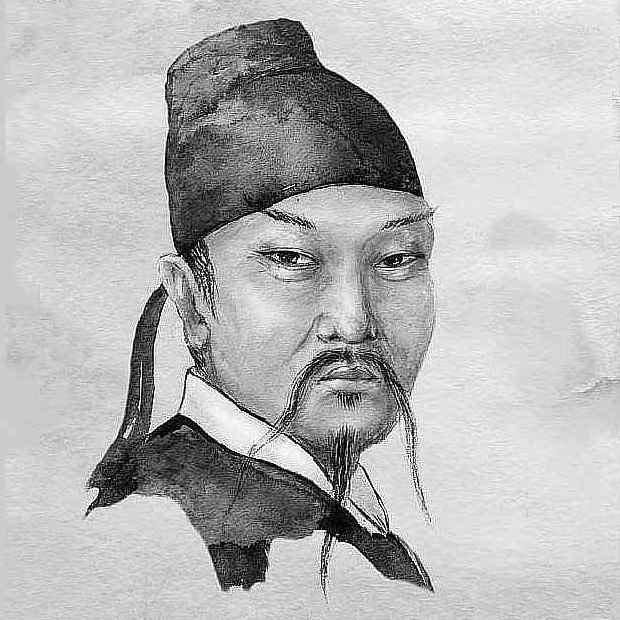
The poem entitled A Vindication by Chinese poet Li Po or Li Bai (李白) or Qīnglián Jūshì (青蓮居⼠) – as was his art name (hao) – is included in the book The Works of Li Po, the Chinese Poet by Shigeyoshi Obata, published in 1922 by the British publishing house J. M. Dent & Sons.
Li Po (701-762 CE) is considered one of the greatest Chinese poets of all time, and as Shigeyoshi Obata (1888-1971 CE), his book is the first attempt to introduce the English-speaking world to the work of a single poet from this country.
Of course, excerpts from his poems had been published in the 19th century, while Joseph Edkins (1823-1905 CE) fairly claims, through his 1888 work On Li Tai-po, which was published in the Journal of the Peking Oriental Society in 1990, to be the first outside China to focus specifically on the personality and art of Li Po.
The Life of Li Bai Until the Imperial Court
The Chinese poet Li Bai was born in 701 CE. His place of birth remained uncertain for a long time, but it is now considered certain that he was born in the city of Suyab (or Suiye 碎葉) in modern-day Kyrgyzstan. For reasons unknown, his family was exiled to that remote corner of the Chinese empire, but his father managed to secretly return them all to Sichuan province, where they settled near the capital Chengdu.
The young Li Bai received a broad education, and before he was even 10 years old, he had already begun to compose poems successfully. He immersed himself in Taoism (or Daoism), preferring the philosophical teachings of Laozi to those of Confucius (Kong Qiu), which determined his later life. His interests in his early youth included horse riding, hunting, traveling, helping the poor with money and weapons, and swordsmanship.
Having a highly chivalrous spirit, he managed, in a completely unpoetic way, to kill several opponents in official duels by the age of twenty.
He claimed to be of imperial descent and sought to be appointed to a government position, but in a somewhat unorthodox manner: he did not want to take exams but rather provide recommendations, and these came from various government officials and people with power and influence.
However, it was his apprenticeship alongside Taoist hermits and his intermittent solitary life as a Taoist recluse, along with his reputation as a poet and sage, that brought results: after the actions of the monk Wu Yun, Emperor Xuanzong invited him to the court, hired him as a translator, and appointed him a member of the Hanlin Academy.
However, his love of wine, which could easily led him to cirrhosis of the liver, and internal rivalries in the emperor’s close circle brought his career at court to an inglorious end.
After the Imperial Court
After leaving the emperor’s court, he continued his wandering life. And probably in the summer of 744 CE, he met Du Fu or Tu Fu (712-770 CE), the later renowned poet of political and social protest. The two giants of Chinese literature built a lifelong friendship. For their contribution to the art of poetry -which took place during the so-called “Golden Age of Chinese Poetry” during the Tang dynasty- the “Banished Immortal” Li Bai (as the poet He Zhizhang called him) and the “Poetry Sage” Du Fu, remained in the collective memory as “Li Du.”
In 755 CE, Li Bai took part in the brutal suppression of An Lushan’s rebellion, alongside Prince Yong Li Lin. He was initially honored but then arrested because, in the meantime, Emperor Xuanzong had abdicated in favor of his brother, Prince Suzong, which did not please the former, so he moved against the latter, but lost not only the battle but also his life, as he was executed.
Li Po would have suffered the same fate if the death penalty imposed on him had not been commuted to exile, thanks to the intervention of his powerful friends.
In 759 CE, due to a severe drought in the Guangdong region, he took advantage of the general amnesty granted by the palace to exiles and was released, once again entrusting his livelihood to others.
However, his days were numbered: he died in 762 CE, having been married four times and leaving behind between three and ten children, as well as approximately 1,000 poems (including the poem A Vindication, which follows below) and essays.
Personality & Poetic Character
Indeed, Li Bai was great in every way: great in his arrogance, great in his egocentricity, great in his reclusiveness, great in his adventurous, great in his wanderlust, great in his idleness, great in his drinking, and, of course, great in his poetry.
His poetry reflects a myriad of images, ranging from Taoist contemplation to feelings of friendship, love, love of nature, and worship of wine.
Without having brought anything radically new to the art of his time, the skill of his lyrics remains contemporary and relevant to this day – and therefore classic and great.
For us, he is a drunken companion of the ancient Greek poet Anacreon (≈ 572 / ≈ 485 BCE) with whom he speaks the “same” basic language, possibly drinking excessively from the “same” wine in essence. Of course, Anacreon passed away at an advanced age, while Li Po died relatively young, but not before becoming a legend.
So even the manner of his death could not escape legend – a legend worthy of a great poet: while drunk, he drowned after falling from his boat into the waters of the Yangtze River while trying to catch the reflection of the moon.
We do not know exactly when the poem A Vindication, quoted below, was written. What we do know is that it continues to flourish to this day. And it will continue to flourish as long as wine is produced and drinkers sink into ecstasy. Even if some of them sometimes drown, trying to catch the reflection of the moon in the waters of the Yangtze River.
Li Po - A Vindication
If heaven loved not the wine,
A Wine Star would not be in heaven;
If earth loved not the wine,
The Wine Spring would not be on the earth.
Since heaven and earth love the wine,
Need a tippling mortal be ashamed?
The transparent wine, I hear,
Has the soothing virtue of a sage,
While the turgid is rich, they say,
As the fertile mind of the wise.
Both the sage and the wise were drinkers,
Why seek for peers among gods and goblins?
Three cups open the grand door to bliss;
Take a jugful, the universe is yours.
Such is the rapture of the wine,
That the sober shall never inherit.
天若不爱酒/ 酒星不在天。
天若不爱酒
酒星不在天。
地若不爱酒
地应无酒泉。
天地既爱酒
爱酒不愧天。
已闻清比圣
复道浊如贤。
贤圣既已饮
何必求神仙?
三杯通大道
一斗合自然。
但得醉中趣
勿为醒者传。
English & Chinese Text
The poem A Vindication is included in the book ‘The Works of Li Po, the Chinese Poet‘ and is a free-verse translation by Shigeyoshi Obata
Ha Jin Talks About the Poet and His Book "The Banished Immortal: The Life of Li Bai"
As part of our National Book Festival Presents series for June, “Connecting the World With Words,” National Book Award winner Ha Jin discusses his new book, “The Banished Immortal: A Life of Li Bai,” in which he draws on a range of historical and literary sources to weave the life story of the eighth-century Chinese poet Li Bai.
- Jin, H. (2019). The Banished Immortal: A Life of Li Bai. New York, NY: Pantheon Books.
- Li, B. (2007). The Works of Li Po, the Chinese Poet (S. Obata, Trans.). Whitefish, Mont.: Kessinger Publishing Rare Reprints.
- Owen, S. (1981). The Great Age of Chinese Poetry: The High Tang. New Haven, CT: Yale University Press.
- Po, L. (2011). The Works of Li Po. NY: Digireads.Com-Neeland Media LLC.
- Waley, A. (1950). The Poetry & Career of Li Po. New York, NY: Macmillan.
- Li Bai: Quotes (Wikiquote)
Clarification
Of course, it is needless to say – but we will emphasize it – that in this handmade website, no article has been and will not be written with recourse to Artificial intelligence (AI). Natural Intelligence, that is, as much of it as we have and for as long as we are allowed to have it, is enough for us.
Sharing
The use of the material, where third-party rights are not mentioned or implied (such as photos or audiovisual files - with the exception of those belonging to "Kalliergeia"), is absolutely free. Its sharing, possibly, useful.