Home » PLANTS & CROPS »
The Management of Peach Leaf Curl (Taphrina deformans)
CONTENTS ⌵
The Management of Peach Leaf Curl Disease (Taphrina deformans) is the main subject of this article, which paradoxically could be considered the logical continuation of a previous article dedicated to the biology and ecology of the ascomycete.
An ascomycete which, as we wrote in that article – and we see no reason not to repeat it in this one – causes considerable damage to the trees and crops it infects.
We therefore believe that the more the commercial grower and the amateur farmer knows about its biological cycle and the epidemiology of the disease it causes, the more they will be able to make use of the existing resources and control it.
Because the good news is that both Peach Leaf Curl and other Exoascus are treated extremely effectively and are controled by timely interventions – mainly of a preventive nature – of various plant protection products.
Now whether and to what extent this fact relieves the commercial growers of Peach and other fruit trees, who will benefit from the preference of the Exoascus, the editorial team of “Kalliergeia” declares with boldness, its cautious optimism.
… It could, of course, also declare its unrestrained optimism, but it restrains itself – and in its corect opinion it is right to do so.
The Management of Peach Leaf Curl (Taphrina deformans)
The Epidemiology of Peach Leaf Curl Disease
The Peach Leaf Curl occurs early in the spring. In the past, it was supposed that the trees were affected by mycelium which remained on the twigs until the following spring, and from there the inocula settled on the leaves at the opening of the buds of the tree.
It is now generally accepted that this is not the case. Infection occurs with the spores of the fungus, probably conidia, which have overwintered either in the bud scales or other plant tissues or even in the orchard soil.
Conditions for the Development of the Pathogen
In a laboratory environment, the optimum temperature for fungal growth is 20 °C (68 °F), while appropriate temperatures are those where the minimum is at 8.9 °C (48 °F), and the maximum ranges between 26 °C (79 °F) and 30.5 °C (87 °F).
For bud-conidia budding, high relative humidity of 95% or higher is required.
In the orchard, temperatures below 16 °C (61 °F) require at least 3 mm of rain and 12.5 hours for infection to occur, as long as the affected tissues remain wet.
If the tissues remain fully moistened for 2 or more days then the intensity of infestation is high.
If the temperature remains constant above 20.5 °C (69 °F) it is very likely that the symptoms of the infestation will not observed.
Also, when the minimum temperature is below 7.2 °C (45 °F), the maximum exceeds 30.5 °C (87 °F) and the humidity is low, then the intensity of the attack is reduced and /or the infection ceases.
Pathogen Growth
Infection occurs with the opening of the host’s buds, and before the differentiation of new vegetation tissues.
Ascospores and conidia of Taphrina deformans, by their germ tubes, pass through the leaves stomata or penetrate directly the cuticle and initially grow within the cuticular layer. From there they send the hypha to the intercellular spaces of the parenchyma and the epidermis cells, where they are finally established as mycelium.
With the development of its intercellular mycelium, the pathogen releases various substances, such as cytokines, auxins and enzymes, which cause changes in the size, shape and structure of the cells of the affected tissues.
It is typically reported that the release of cytokines results in an increased flow of nutrients to the affected tissue, which the fungus benefits from.
Eventually cellular dysfunction becomes clearly visible from the hyperplasia and enlargement of the host cells, which give the characteristic symptoms of the disease on the leaves and other susceptible plant tissues.
The Management of Peach Leaf Curl (Taphrina deformans)
Symptoms of Taphrina deformans Infestation
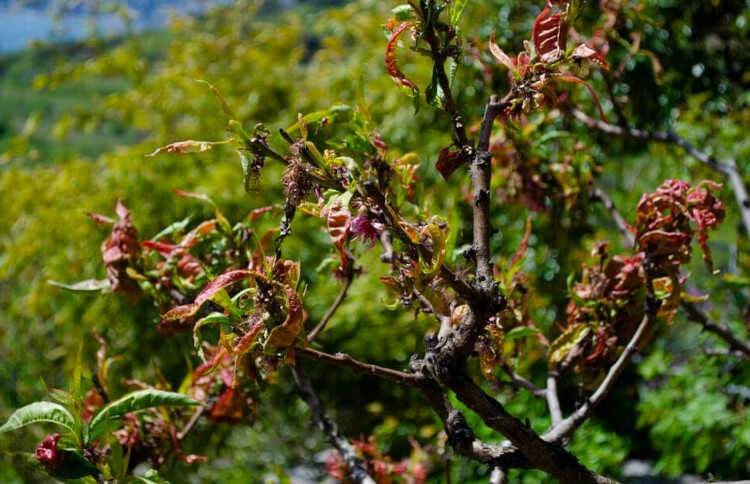
The Peach Leaf Curl infects many of the overground vegetation, but not to the same extent. Thus the disease occurs first on the leaves, and then on the fruits, on the twigs, and sometimes even on the flowers.
Leaves
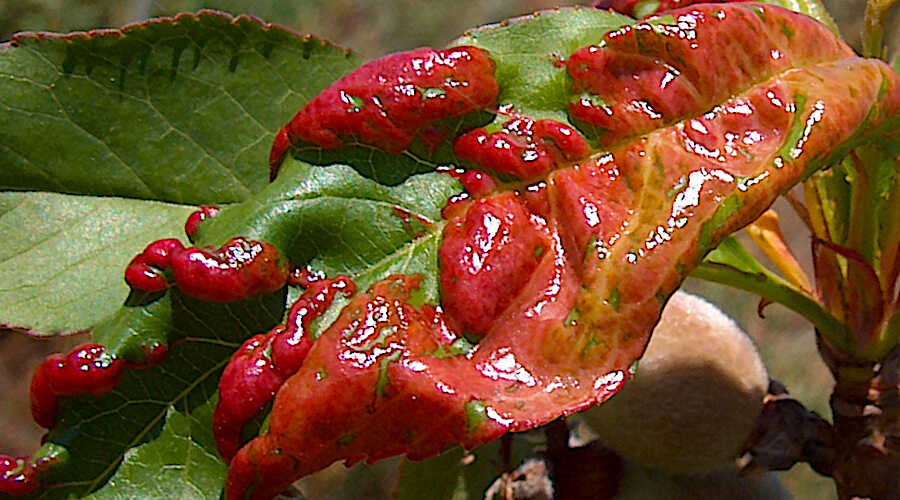
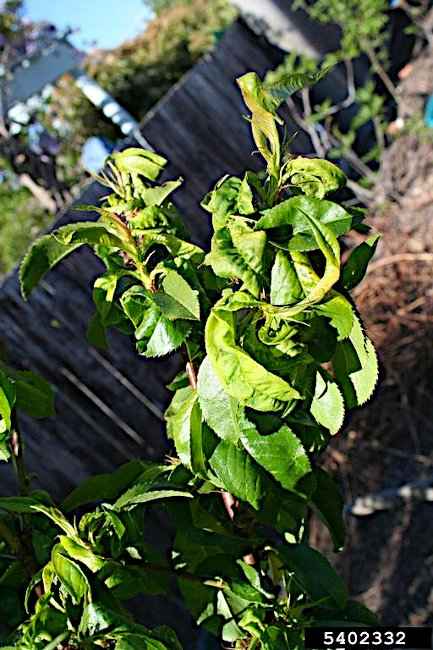
Depending on the severity of the infection by Taphrina deformans, the disease is found either on a few leaves or on the whole foliage. Its typical manifestation is distortion.
The distortion of the leaves is due to the intense cellular hyperplasia, which is caused by abnormal function of the parenchymal tissues and is macroscopically manifested by local or total abnormal thickening of the lamina and their curling.
Moreover, the affected parts of the leaves become softer than the correspondingly intact.
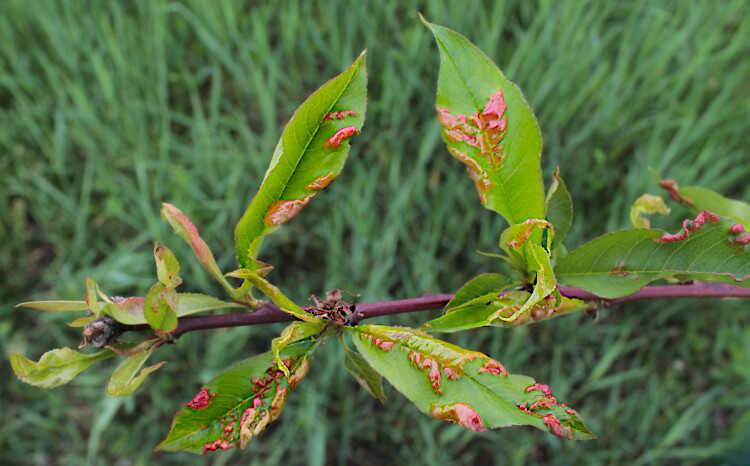
The manifestation of the phenomenon also involves the discoloration of the leaf surface. The leaves first become chlorotic, then violet – red or purple, and then reddish yellow or yellow – ash.
During the reproduction period of the fungus, the ascospores of the pathogen appears in the swollen areas, giving the leaves powdery ash or velvety appearance.
At the final stage of infestation, the leaves become brown, gradually wither, dry, and then fall, in late spring with early summer.
In conditions of high disease severity extensive defoliation is observed, and the first spring vegetation wave can be completely destroyed. This is followed by the second vegetative wave, which strangely not affected by the fungus, but its growth greatly affects the tree. The consequence is the inevitably significantly reduced production.
Young Twigs
The Peach Leaf Curl infects the young twigs. In infected twigs, their color changes to light green or yellow, they become thicker, and observed growth retardation, distortion, and sometimes gum secretion is observed. Very often, as a result of the action of the pathogen, they are completely dried.
Fruits
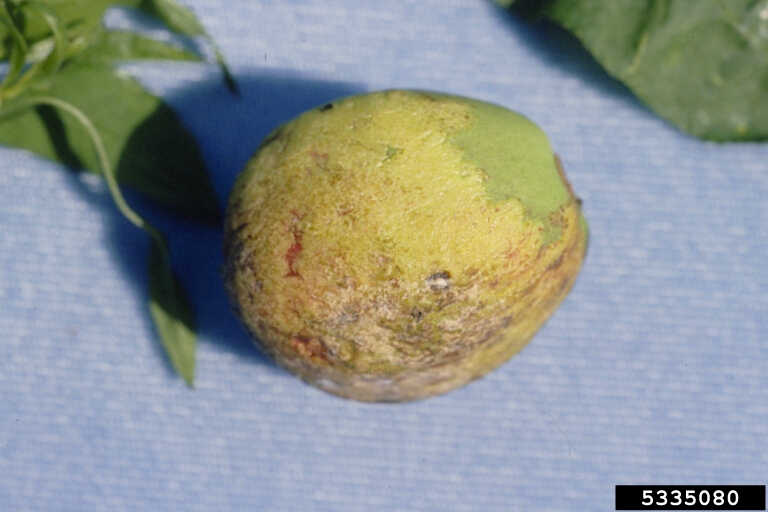
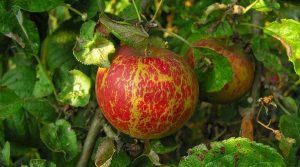
Infected fruits show irregular and swollen colored areas on the surface.
These areas are usually wrinkled, without the usual health fuzz – when it comes to peach fruit – their color is yellowish-red, and look like they have been polished. Later, they acquire corky texture and tend to open.
Affected fruits rarely remain on the tree for long.
The Management of Peach Leaf Curl (Taphrina deformans)
Preventive Treatment of the Peach Leaf Curl
Peach Leaf Curl can be treated in a variety of ways and means, both preventive and suppressive.
Preventive treatment refers to the selection of those varieties of Peaches and Nectarines that show resistance or complete immunity to phytopathogenic fungus. Some of these are listed below.
Resistance Cultivars of Peach
- Frost
- Indian Free
- Muir
- Q-1-8
Note: The Frost Peach variety needs preventive sprays the first 2 to 3 years after its establishment.
Resistance Cultivars of Nectarine
- Kreibich
The Management of Peach Leaf Curl (Taphrina deformans)
Cultural Practices
The cultural practices to assist in the management of the Peach Leaf Curl include:
- Autumn pruning, to reduce the population of inoculumon trees (Spring pruning of the affected twwigs and branches is not effective)
- Enhanced nitrogen fertilization of seriously affected trees
- Increasing irrigation
- The thinning of the fruits depending on the remain leaf surface of the trees
The Management of Peach Leaf Curl (Taphrina deformans)
Biological Control
Preparations containing the bacterium Bacillus subtilis strain QST 713 are used for the biological control of the Peach Leaf Curl.
Light infestations require an early spring application and two applications in case of severe attack.
The Management of Peach Leaf Curl (Taphrina deformans)
Chemical Control of the Peach Leaf Curl
The Peach Leaf Curl is effectively treated with a timely, mainly preventive spray. The most favorable period for dealing with the pathogen is from late autumn, with 90% of the leaves falling, until the end of winter just before the buds swell.
However, therapeutic sprays can be applied in the spring, after the pathogen is installed.
The following are active substances that can be used to control Taphrina deformans.
➤ Those active substances with the indication [E] are authorized for use in Greece (and most European Union countries) at the time of writing this article.
Active Substances
Conventional Farming
- Bordeaux mixture [Ε]
- Captan [Ε]
- Dodine [Ε]
- Chlorothalonil
- Copper oxychloride [Ε]
- Copper hydroxide [Ε]
- Copper oxide [Ε]
- Difenoconazole
- Ferbam
- Hexaconazole (Therapeutic, Spring, 3 applications / ten days)
- Mancozeb [Ε]
- Tebuconazole [Ε]
- Thiram
- Trifloxystrobin [Ε]
- Ziram [Ε]
Organic Farming
- Bordeaux mixture
- Copper oxychloride
- Copper hydroxide
- Copper oxide
Absolutely Necessary Reminder
The reference to the active substances that can be used against Taphrina deformans is for purely informative reasons. Under no circumstances is their use implied or encouraged without the approval of the local agronomist.
The Management of Peach Leaf Curl (Taphrina deformans)
References
The References of the article with the shockingly ingenious title The Management of Peach Leaf Curl (Taphrina deformans) are presented by the London Symphony Orchestra, under the musical direction of conductor Sir Colin Rex Davis, with Op. 15, 3rd movement – also called Apothéose – from the symphonic work Grande Symphonie Funèbre et Triomphale by the great French composer Hector Berlioz.
- Agrios, G. N. (2005). Plant Pathology. Amsterdam, Netherlands: Elsevier.
- Khosla, K., & Bhardwaj, S. (2010). Control of Peach Leaf Curl by Pre-Bloom and Post Infection Applications of Fungicides. Plant Disease Research, (25), 66-68.
- Kurtzman, C., Fell, J., & Boekhout, T. (2011). The Yeasts: A Taxonomic Study. Amsterdam, Netherlands: Elsevier.
- Mason, P. G., & Gillespie, D. R. (2013). Biological Control Programmes in Canada 2001-2012. Wallingford, England: CABI.
- Oliver, R. P., & Hewitt, H. G. (2014). Fungicides in Crop Protection(2nd ed.). CABI.
- Ogawa, J. M., & English, H. (1991). Diseases of Temperate Zone Tree Fruit and Nut Crops. UCANR Publications.
- Ownley, B. H., & Trigiano, R. N. (2016). Plant Pathology Concepts and Laboratory Exercises (3rd ed.). CRC Press.
- Vidhyasekaran, P. (2004). Concise Encyclopedia of Plant Pathology. CRC Press.
- Παναγόπουλος, Χ. Γ. (1987). Ασθένειες Καρποφόρων Δένδρων & Αμπέλου [Diseases of Fruiting Trees & Vines]. Αθήνα: Καραμπερόπουλος Α.Ε.
- Taphrina deformans (Berk.) Tul. 1866: Media-Encyclopedia of Life (EOL)
Clarification
Of course, it is needless to say – but we will emphasize it – that in this handmade website, no article has been and will not be written with recourse to Artificial intelligence (AI). Natural Intelligence, that is, as much of it as we have and for as long as we are allowed to have it, is enough for us.
Sharing
The use of the material, where third-party rights are not mentioned or implied (such as photos or audiovisual files - with the exception of those belonging to "Kalliergeia"), is absolutely free. Its sharing, possibly, useful.