Home » PLANTS & GARDEN »
The Care of ZZ Plant (Zamioculcas zamiifolia)
CONTENTS ⌵
With The Care of ZZ Plant (Zamioculcas zamiifolia), we move on to the second part of the “Kaliergeia” tribute to this wonderful plant.
Where, in this second part, its untiring editors – after examining them in depth – present issues and topics, whose purpose is to let ZZ Plant friends know that by applying them, they will make plant life easier, whether it is in a planter or on the garden soil.
Thus, and among the topics they investigated, they do not hesitate to highlight the importance of the environment of establishment and living of the plant, to draw attention to the necessary works that must be done for its maintenance, while in addition they do not also neglect to give a rather idyllic picture regarding plant’s protection from the (few) pests and the (fewer – that is, only one) diseases.
With the wish to soon complete the writing of the third part of the tribute to ZZ Plant, which in all probability will refer to the propagation methods, the untiring editors give the steering wheel of this article to the reader and keep for themselves only the most beautiful memories of its writing.
The Care of ZZ Plant (Zamioculcas zamiifolia)
Environment of ZZ Plant’s Establishment
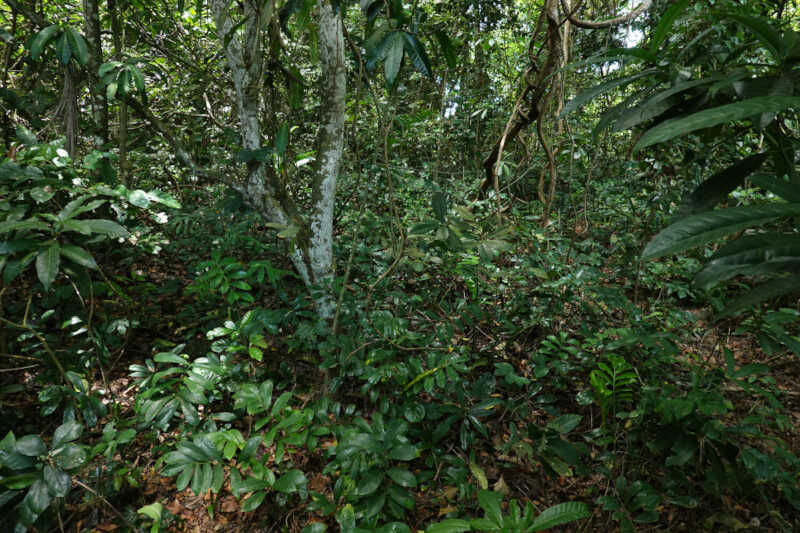
It happens to all indoor plants – why must be ZZ Plant (Zamioculcas zamiifolia) an exception? The environment of establishment must meet the minimum requirements, so that the plants can grow, fulfilling in the best possible way their often multidimensional role.
From the elements of the establishment environment, at least three of them have a decisive contribution in terms of creating favorable or unfavorable conditions for the normal growth of plants:
- The temperature
- The humidity
- And the lighting
Each of these factors and their effect on ZZ Plant is discussed immediately below.
The Care of ZZ Plant (Zamioculcas zamiifolia)
The Effect of Temperature on the Development of Zamioculcas zamiifolia
The ZZ Plant flourishes, thrives and lengthen its days in the usual temperatures that prevail in the tropics – where it comes from.
These generally range from 18 to 32 °C, however the optimum temperature range for plant growth is between 18 and 24 °C.
The lower the temperature, the greater the problems for ZZ Plant. From 16 °C and below its growth retarding, while at 7 °C stops completely and chilling injury may occur.
But there are worse: near 0 °C it loses all its aerial part. Of course, as long as the temperature does not drops below -6 °C, which is the lower limit of plant tolerance, next spring the rhizome will sprout again.
With high temperatures, there is a retarding or even cessation of plant growth. This is nothing particularly serious in relation to its appearance, except perhaps sunscalds.
Sunscalds is observed in the Zanzibar Gem plants, due to the coincidence of various adverse factors. Among others, the following are mentioned:
- The ZZ Plants are fully exposed to the direct sun
- Temperatures reach those of heat
- The plants nutritional status is not the best
- They are in circumstances of prolonged drought
The preventive spray with zeolite, gives a satisfactory degree of protection.
Sunscalds are also observed on those plants that are planted in pots and are located indoors.
The Care of ZZ Plant (Zamioculcas zamiifolia)
The Effect of Humidity
If the plant lover takes into account that:
- For the professional production of Zanzibar Gem, the relative humidity in the shaded production greenhouses is between 50 and 100%
- The origin of the plant from the tropics, sometimes refers tovery high percentages of relative atmospheric humidity
- Appropriate relative humidity values for residential areas – homes, offices, etc. – range between 30 and 50%
Then it is easily concluded that the ZZ Plant probably mistakenly decorates these places.
Fortunately in practice this is not true. Almost always, the usual average humidity of a residential area is enough for the normal growth of the plant.
Moreover, the increase of humidity, wherever necessary, is easy to achieve, by modifying the microclimate around the pot or planter, and by means such as the humidifier, or the regular wetting of the foliage, or even by placing the pot or planter in areas of increased relative humidity such as the bathroom.
The increased relative humidity is beneficial for ZZ Plant during the winter period, because, among other things, it can become a deterrent to various pests infestation.
The lack of moisture on the other hand becomes apparent, since in such a case the tips of the leaves turn brown.
For Zanzibar Gems that are well-planted and well-established in the garden usually do not need care. Exceptions are sometimes during periods of extreme weather phenomena (eg in summer heatwaves).
The Care of ZZ Plant (Zamioculcas zamiifolia)
Lighting Conditions & ZZ Plant
A prominent feature of the ZZ Plant is its amazing adaptation to conditions of minimal, very low light intensity. Being in such conditions, it certainly does not grow but, on the other hand, it is not damaged in the slightest.
In fact, relevant research has shown its resistance to low levels of indoor lighting, ranging from 4 µmol · m⁻²·s⁻1 to 16µmol · m⁻²·s⁻1 for a period of 4 months and in addition without the administration of water, where from this treatment, the only obvious change in the plant, is the appearance of a very deep green color on the leaves.
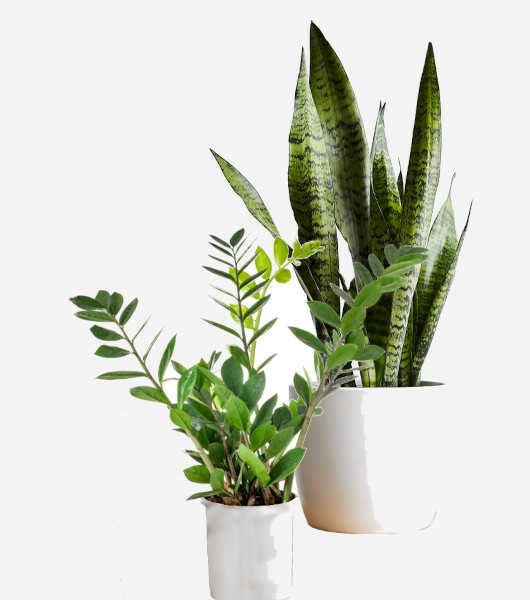
The above performance rightly recognizes the plant as one of the most valuable indoor and outdoor – along with Cast Iron Plant (Aspidistra elatior) and Snake Plants (Sansevieria sp.) – for its ability to exploit semi-shade, shady and almost dark places.
Also noteworthy is the behavior of Zanzibar Gem in windowless spaces, whose only light source is artificial: the plant grows seamlessly receiving normal or high intensity light from various artificial sources, such as fluorescent lamps.
In terms of natural light, the plant is favored by placing in places of intense and diffused lighting. Also, placing it in sites where it uses the direct morning or afternoon light is not a problem, but its direct exposure to the midday strong sunlight should be avoided, because it is very likely to show symptoms of sunscald on the leaves.
The Care of ZZ Plant (Zamioculcas zamiifolia)
ZZ Plant Necessary Maintenance Works
In the area of the care of ZZ Plant, some works on the part of the plantlover is necessary in order for the plant to be in the best possible condition.
They include first and foremost watering, fertilizing, overwintering and cleaning the leaves of the plant, and secondarily pruning.
All this is discussed immediately below.
The Care of ZZ Plant (Zamioculcas zamiifolia)
The Watering of ZZ Plant & its Drought Tolerance
The Watering
The ZZ Plant is also distinguished for its excellent tolerance to lack of water. It can survive in drought conditions, under certain prerequisites, up to 4 months, while for a period ranging from 1 to 2 months, it can cope with the lack of water without showing yellow or necrotic leaves.
Of course for the normal growth of the plant, water deprivation is not the right method. Respectively, the frequent watering of ZZ Plant, which can lead to root rot and necrosis of the plant (the number 1 cause of death in cultivation conditions), is not equally good practice.
The safest and most favorable watering technique for the Zanzibar Gem is the existence of little or no moisture in the soil growth medium, with a completely dry surface between two irrigations.
The interval depends on many factors, however in general it could be said that:
- Watering of ZZ Plant is more frequent in summer, while in winter it is more infrequent
- From late spring to early autumn the plant can be watered once a week – the rest of the year every 15 to 20 days
- Watering of Zanzibar Gem is recommended to be done in such a way that no waterlogged is observed
It is understandable that the current conditions – hot or cold weather, potted plant or plant in garden, etc. – determine more precisely the frequency of ZZ Plant watering.
What may not be understood is the excellent adaptation of the plant to water deprivation, to drought. For this and immediately below an attempt is made to give an interpretation to the phenomenon.
The Causes of ZZ Plant's Drought Tolerance
The causes of ZZ Plant’s great drought tolerance must be traced back to the recent past, specifically just a few million years after the dinosaurs became extinct – and the mammals party that followed.
Then, during the Neogene and Quaternary Periods, African flora was severely tested by protracted, century-long drought.
The evolutionary selection pressure exerted on the plant organisms of ZZ Plant cradle was great. Thus, as everything shows, the circumstances of that time had as an evolutionary consequence the growth from the plant of its waxy and shiny leaves, of its fleshy texture stems and of its thick rhizomes.
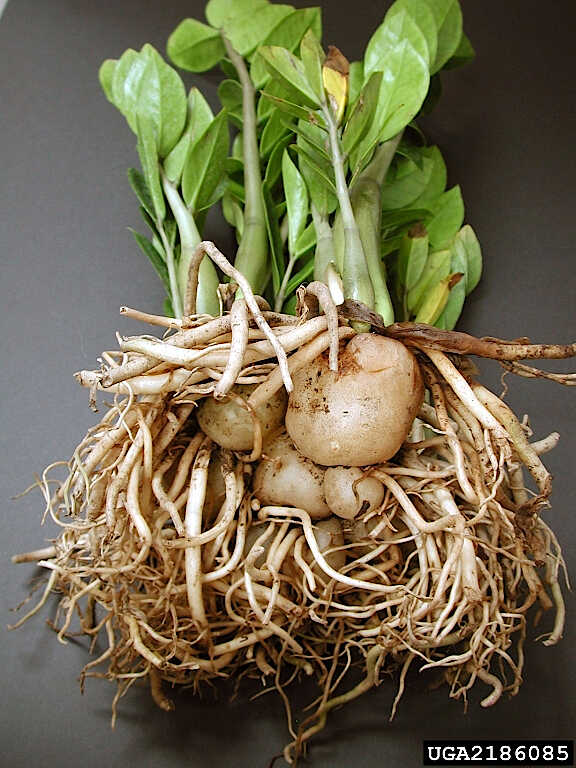
And its leaves now show extremely low rates of transpiration, and the rhizomes store such amounts of water, which are able to support the plant to withstand many months of drought.
As for mammals, the party goes on – in the absence of dinosaurs.
The Care of ZZ Plant (Zamioculcas zamiifolia)


Tactics and Methods of Fertilization of Zamioculcas zamiifolia
The ZZ Plant lives an abstinent life, as it grows slowly and does not require large amounts of nutrients. However, this fact does not mean that the plant should be deprived of fertilization, on the contrary, if the plantlover wants it to thrive, she/he should strengthen it nutritionally.
The fertilization of ZZ Plant is recommended to start from the middle of March and to be completed in the middle of September, applied once a month.
Any fertilizer of balanced title (e.g. 10-10-10) is suitable and preferably in liquid form. Immediately after the application of the fertilizer, watering should follow.
For ZZ Plants planted in garden soil, the addition of compost (which is not fertilizer), along with reduced amounts of monthly liquid fertilizer, has wonderful results.
And in this case, immediately after the application of the fertilizer should follow the watering of the plant.
The Care of ZZ Plant (Zamioculcas zamiifolia)
Care for the Proper Overwintering of the Plant
For ZZ Pants that are in pots in the garden, on the balcony or in the yard, and in areas where winter temperatures are not suitable for their perfect appearance, it is recommended to be transferred indoors and receive the same treatment as those of Zanzibar Gem plants may already adorn areas of the house.
There they should be tried not to be exposed to temperatures lower than 15 to 16 °C, in order to spend the winter without damage.
Of course, in addition to controlling the temperatures, special attention should still be paid to the humidity of the soil medium, as although the watering is infrequent, it is desirable not to allow the root to dry out.
With the onset of the growth period, all plants that came from or are intended for outdoor use can be transferred, and both for them and those that will remain indoors, the ZZ Pant care cycle begins, as described – with maximum ambiguity – in previous sections.
The Care of ZZ Plant (Zamioculcas zamiifolia)
Pruning
Pruning belongs to that category of work for the ZZ Plant care that will not particularly concern the plantlover.
Sometimes it may be necessary to remove a stem from the base, which has either grown large enough or disturbed the balance of the foliage, thus spoiling the overall appearance of the plant.
Others may need to rid the plant of yellow or diseased leaves, which may appear again at the base of the stems.
And that is all.
The Care of ZZ Plant (Zamioculcas zamiifolia)
The Shine & Cleaning of ZZ Plant Leaves
ZZ Plant and The Shine of its Leaves
There is no need for scientific documentation to establish that dust sometimes settles on the leaves of the plant. The dust on the surface of the ZZ Plant’s leaves, but also on plants in general, not only reduces their appearance aesthetically but also creates problems in their physiology, since it also reduces the photosynthetic surface.
To address this issue, plant lover can employ various methods, which we will discuss in detail below, as well as a couple of approaches that are not recommended, which we will mention here.
The use of leaf shine should be avoided because it is either a temporary solution, or it is temporary and harmful as it can clog the pores and stomata of the leaves.
For the same reason, the homemade mayonnaise leaf shine, alone or mixed, should not be used – but only to accompany or taste the food.
Moreover, Zamioculcas zamiifolia has by nature leathery and shiny leaves and does not need artificial polishes in order to shine, but only cleaning.
The ZZ Plant in the Shower
One method of cleaning the ZZ Plant leaves is that of a lukewarm shower. It can be successfully applied to small or large plants that are in pots, which are easily removable.
With this method, the plants are transferred to the sink or bathroom, where there is no use of the shower but a simple low pressure sprayer or a small hand concentrate sprayer.
The use of such sprayer specifications is important, because otherwise the violent ejection or dynamic water supply to the plant foliage will result in the breaking, injuring or cutting off the leaf or leaves.
Also, the water in the sprayer should be lukewarm – neither hot nor cold – so as not to cause any kind of shock to the plant, affecting the leaves or the root system.
After the shower – spray, ZZ Plant is allowed to dry out. And when this happens then it can be watered, according to what has been said above about watering the plant.
The ZZ Plant in Bucket or Wash Tub
If the ZZ Plants are small, and generally easy to handle by hand, then a second method of cleaning the leaves is by immersing the plant in a bucket or tub, always with lukewarm water.
According to this method, the pot is fliped upside down, since with the other hand the soil substrate is held in place, and the foliage is dunking in water and then swished back and forth.
The foliage moves carefully back and forth, in a gentle way so that here too no problems occur, such as the breaking of ZZ Plant stems.
The plant is then fliped again and allowed to dry well.
It is recommended that before attempting to clean the leaves of the plant with this method, it should be preceded by watering, which facilitates the retention of the soil substrate in place.
The ZZ Plant, the Damp Cloth And Zen
Of course the most classic method of cleaning the leaves, not only of ZZ Plant but also of most indoor plants, is the wipe down with a damp cloth – and patience.
This method, which can be easily combined with Zen practices, consists of passing with the cloth of each individual leaf.
Prior to use, the cloth should be sufficiently moistened and squeezed to remove excess water. And with the addition of a drop of dishwashing detergent, it should be suitable for cleaning the leaves.
One point where it is desirable to pay special attention when applying this method, concerns the support of each individual leaf with the free hand: its role is to prevent any unintentional injury or cracking of the leaves of the plant, when on the other hand they are cleaned.
The Care of ZZ Plant (Zamioculcas zamiifolia)
… And Yet It (Must) Turns
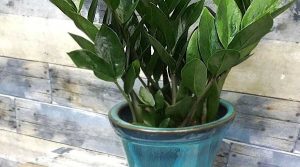
When the main source of light is the sun and the plant is indoors and in a pot, then it should not remain stationary. However, to avoid any misunderstanding, it will be said here, that no one means that Zamioculcas zamiifolia’s plant lover should take him along e.g. for walking or cycling three times a week – which is extremely beneficial for the plant lover – but something else:
Like all plants, ZZ Plant orients the growth of its above-ground vegetative parts towards the light source, directing them towards it, and in this case to the sun (heliotropism).
If the plant, being indoors, remains motionless and does not turn, then its growth will be one-sided, a fact that is negative and not only for aesthetic reasons.
Therefore, for its healthy and balanced growth, but also for its perfect appearance, it should be turned at regular intervals.
The Care of ZZ Plant (Zamioculcas zamiifolia)
Pests and Diseases
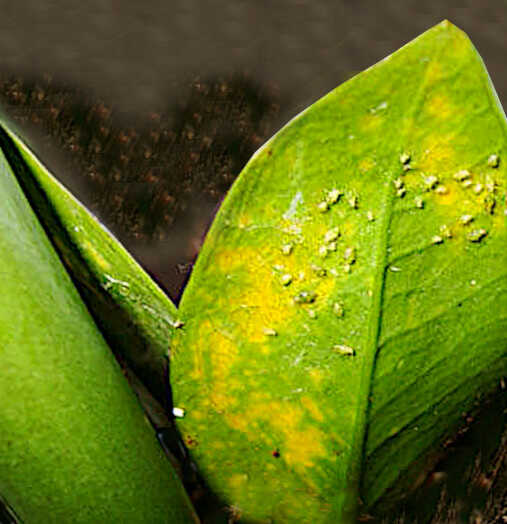
It is a fact that ZZ Plant does not face particular problems from pests and diseases. Occasionally, however, it may catch the attention of certain parasites, such as from insects, aphids and scales, and from acari, the spider mites.
Both the former and the latter are relatively easy to treat with either special insecticides and acaricides. But frequently and the home remedies, when their populations are small, do the job.
Aphids, for example, can be controlled by spraying the plant or wiping the leaves with a solution of soap and warm water.
The scales are controlled by rubbing alcohol and a cotton swab.
As for the spider mites, which usually infect the plant when it is in a dry environment, here more spectacular measures are needed:
After washing the plant by pouring water on it vigorously, it is enclosed as tightly as possible in a transparent bag, and then exposed to a very bright place.
After two or three days either the spider mites will be dead or they will have enjoyed a cool bath, so now the use of an acaricide will be one way.
Of the ZZ Plant diseases, the most serious is root rot, which is due to excessive watering or the inability of the soil medium to get rid of excess water.
If root rot does occur then treating it is extremely difficult to impossible.
The Care of ZZ Plant (Zamioculcas zamiifolia)
Potential Issues - Symptoms, Causes & Treatment
The following table lists various potential problems, their possible causes and their treatment within the framework of care of Zamioculcas zamiifolia.
Symptom | Cause | Treatment |
|---|---|---|
Root rot | Phytophthora spp. growth due to excessive watering or poor drainage | Green leaves drooping |
Green leaves drooping | Excess water, overwatering | Watering control, pot drainage checking |
Older leaves chlorotic, greenish-yellow | Nitrogen deficiency | Nitrogen application |
Older leaves yellow spots | Potassium deficiency | Potassium application |
Older leaves turn yellow | Excess water, overwatering | Watering control |
Leaf curling and peripheral browning | Excessive direct sun exposure, combined with poor watering | New location with diffused light and watering correction |
Weak stems of plants in planters | Cramped rhizomes in pots & planters | New potting mix or repotting |
The Care of ZZ Plant (Zamioculcas zamiifolia)
References
For one more article, which has the unique ingenuity title The Care of Zamioculcas (Zamioculcas zamiifolia), the References are presented by the unique ZZ Top band with their excellent song Gimme All Your Lovin’.
- Graf, A. B. (2003). Tropica: Color Cyclopedia of Exotic Plants and Trees for Warm-region Horticulture, in Cool Climate, the Summer Garden, or Sheltered Indoors. Roehrs Co; Revised, Enlarged edition (December 1, 2003).
- Group of Horticultural Experts. (1990). The Wise Garden Encyclopedia. Harpercollins.
- Hinsdale, E. L. (2022). What Is My Plant Telling Me?: An Illustrated Guide to Houseplants and How to Keep Them Alive. Simon & Schuster.
- Perrone, J. (2023). Legends of the Leaf: Unearthing the Secrets to Help your Plants Thrive.Unbound Publishing.
- Thomas, A., & Australia, Y. (2018). Yates Top 50 Indoor Plants and How not to Kill Them!
- Zamioculcas zamiifolia (Lodd.) Engl.: Plantnet
Clarification
Of course, it is needless to say – but we will emphasize it – that in this handmade website, no article has been and will not be written with recourse to Artificial intelligence (AI). Natural Intelligence, that is, as much of it as we have and for as long as we are allowed to have it, is enough for us.
Sharing
The use of the material, where third-party rights are not mentioned or implied (such as photos or audiovisual files - with the exception of those belonging to "Kalliergeia"), is absolutely free. Its sharing, possibly, useful.