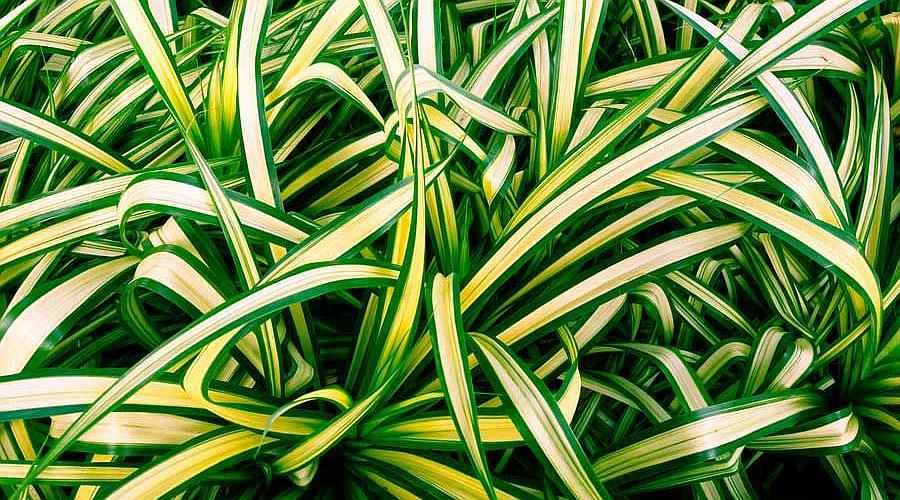
Spider Plant (Chlorophytum comosum) is one of the most useful and highly ornamental plants – mainly indoor.
Actually not exactly that, but some of its variegated leaves varieties, of which the most common and recognizable of all is Chlorophytum comosum ‘Variegatum’.
However, the following article is dedicated to Chlorophytum comosum Neat and not to Chlorophytum comosum ‘Variegatum’.
This is because the botanical description and the other characteristics of the plants are largely common – with the exception of some small details, such as the colour of the leaves.
But being the whole editorial team of ‘Kalliergeia’ bleeding heart – apart from the well-known one – and in order not to leave the variety ‘Variegatum’ complaining, we make a comprehensive report on it too.
Spider Plant (Chlorophytum comosum) – Description and Uses
Spider Plant Origin

Spider Plant (Chlorophytum comosum) – Description and Uses
Spider Plant (Chlorophytum comosum) - Brief Description
Family: Asparagaceae
Genus: Chlorophytum
Scientific Name: Chlorophytum comosum (Thunb.) Jacques
Common Name: Spider Plant, Airplane Plant, St. Bernard’s Lily, Spider Ivy, Ribbon Plant, Hen and Chickens
General Characteristics
Leaf Persistence
Evergreen
Form
Herbaceous Perenial
Texture
Fine
Growth Rate
Fast / Indoors: Moderate
Flowering Period (Tropics)
Sporadically through the year
Fruiting Period
Sporadically through the year
Height
0.40-0.50 m (1.3-1.6 ft) Indoors: 0.40-0.50 m (1.3-1.6 ft)
Diameter
0.40-0.50 m (1.3-1.6 ft)
Shapes and Colours
Leaves Shape
Linear
Foliage Colour
Green
Autumn Foliage Colour
Green
Flowers Shape
Stellate
Flowers Colour
White
Fruit
Capsule
Plantation
Soil Type: Well-drained, sand, loam, clay
Exposure: Half-shade
Soil pH: 5.5-7.5
Watering: Low
Hardiness: -3.9 °C (25 °F – USDA Hardiness Zone 9b)
Uses
In parks, squares, gardens, pots, and planters, both indoors and outdoors
Spider Plant (Chlorophytum comosum) – Description and Uses
Spider Plant (Chlorophytum comosum) - Etymology
Etymology of the Genus Name
The name of the genus Chlorophytum is a compound Neo-Latin word that comes from Ancient Greek ‘χλωρός‘ (pale green) and ‘φυτόν‘ (plant). Both have an Indo-European root, the first being *ǵʰelh₃-, which means ‘the green of new growth‘ and the second is *bʰuH-, which means ‘to appear, become, rise up‘.
Etymology of the Species Name
The name of the species comosum has a literally ornamental hue: it is the Neo-Latin version of the Ancient Greek word ‘κόμη‘ which means ‘the hair‘.
And of course it is easy understandable that such a name excellently attributes the Spider Plant’s ‘tuft’ distinctive habit.
Spider Plant (Chlorophytum comosum) – Description and Uses
Spider Plant (Chlorophytum comosum) - Origin, Invasiveness & Life Span
Origin
Central and South Africa are the cradle of Spider Plant. More precisely, the tropical and subtropical zone of the continent, which includes from west Liberia, Côte d’Ivoire, Nigeria and Cameroon and to the east almost all countries from Ethiopia to South Africa.
It occurs in a variety of environments ranging from sea level up to 1000 m and on sedimentary or volcanic soils, which are derived from granite, dolerite, shale and sandstone. In its natural niches the average annual rainfall is between 500 and 2000 mm.
Invasiveness
The Chlorophytum comosum is highly adaptable to environments suitable for its development. It has been fully naturalised in Ecuador, Tunisia, Bangladesh, Myanmar, the Korean Peninsula, and Western and Eastern Australia. Especially in Australia it has even been classified as invasive – weed.
Life Span
The Spider Plant, thanks to the regeneration capability offered by its runners, could be described as an immortal plant – Highlander. A Highlander who lives for about 25 years, however, under conditions of growing in a pot is recommended to renew it every 3 to 5 years.
Spider Plant (Chlorophytum comosum) – Description and Uses
Spider Plant (Chlorophytum comosum) - Landscape Attributes
Spider Plant is an evergreen, perennial plant with tuberous roots and tuft appearance. At height and diameter it does not exceed 50 cm, but it can be spread on the ground and cover a considerable area. Its foliage is of medium density, and has a fine texture.
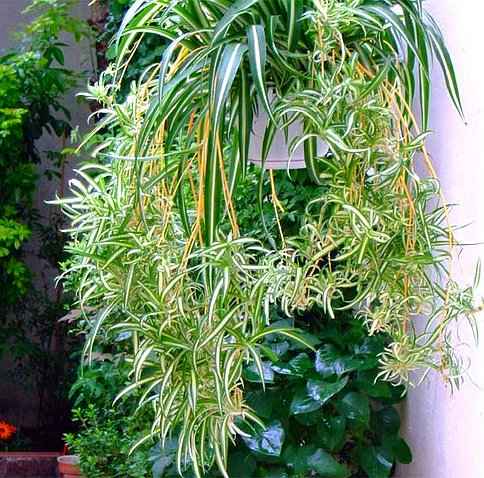
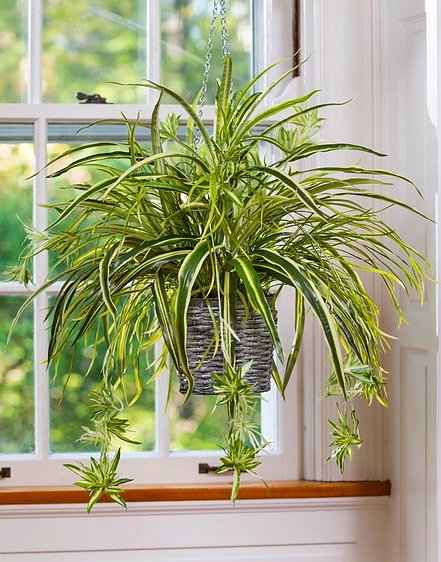
As a pot or indoor plant may have an attractive appearance of hanging form. In the garden it makes an excellent ground cover plant.
Spider Plant (Chlorophytum comosum) – Description and Uses
Spider Plant (Chlorophytum comosum) - Botanical Description
Roots
Spider Plant has a dense root system consisting of thickened elongated white fleshy tubers and fine roots. The tubers have a conical shape at both ends, their length being between 5 and 10 cm (2-4 in) and their diameter between 0.5 and 1 cm (0.2-0.4 in).
Runners
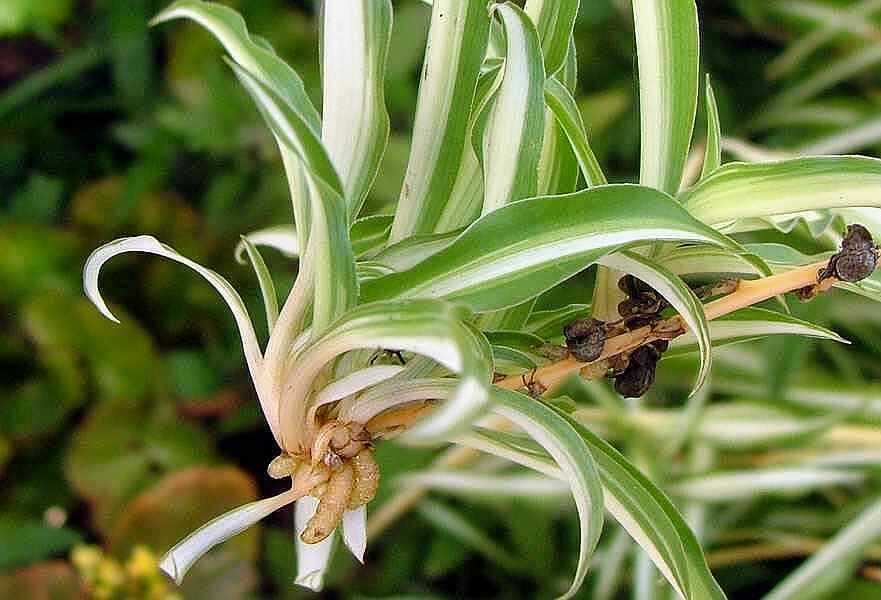
They are the characteristic shoots of Spider Plant that grow sideways. From each nobe of the runner, the spiderettes form leaves and roots. With spiderettes the plant spreads vegetatively and it is a way without difficulty to propagate the Spider Plant.
Leaves
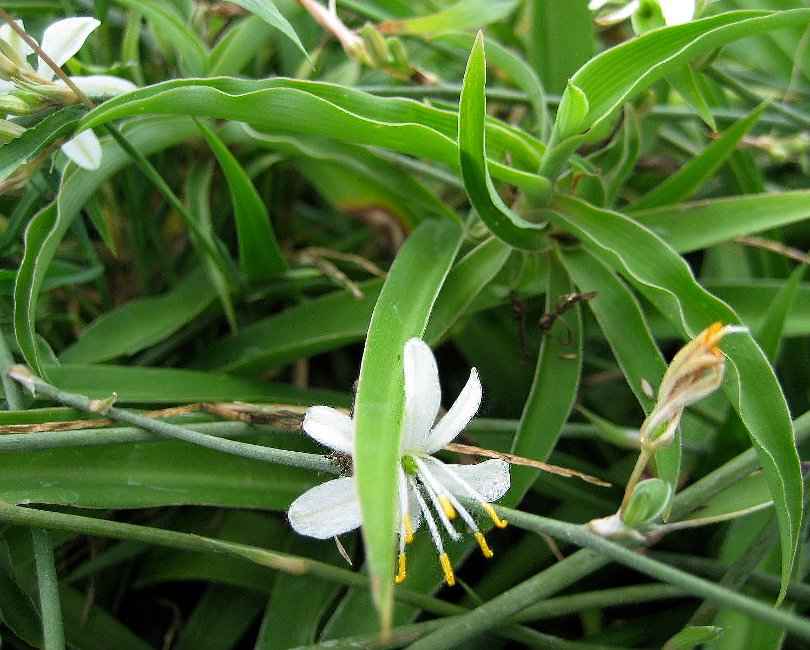
Rise directly from the rhizome to form a rosette. They are simple, without petiole, linear-lanceolate, of alternate arrangement and have a deep green color. The lamina is flat, with parallel ribs, entire or slightly undulate margined, leading to a pointed tip. The dimensions of the leaves vary in length between 20 and 45 cm (7.8-17.7 in) and in the width between 0.6 and 2.5 cm (0.23-0.98 in).
Flowers
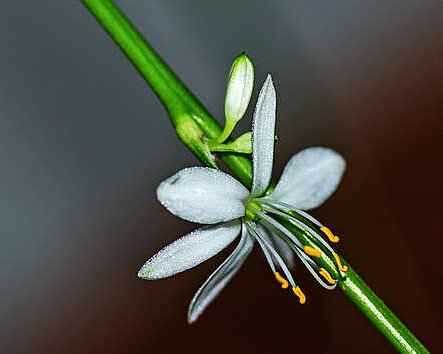
The flowers are monoecious (hermaphrodite) and complete their biological cycle within a few hours. They are brought 1 to 6 together on a paniculate inflorescence, the axis of which is initially erect, but in full growth curves, forming an arc of 30 to 75 cm (11-30 in) in length. Where the inflorescence touches the ground leafy plantlets and roots are produced.
Each individual flower has a star-like shape, diameter of 1.8 to 2 cm (0.7-0.8 in) and consists of 3 elongated sepals and 3 petals 0.6 to 1 cm (0.23-0.4 in) long. Stamens are 6, with fine filament of 0.3 to 0.5 cm (0.11-0.2 in) in length, with an anther of 0.3 to 0.35 cm (0.11-0.14 in) long. The style is short and smooth with a tiny and capitate stigma.
Pollination
The Chlorophytum comosum pollination is carried out by insects (entomophilous species)
Fruit & Seeds
The fruit is a three-cell capsule containing 9 to 45 smooth and flat black seeds.
Spider Plant (Chlorophytum comosum) – Description and Uses
Spider Plant (Chlorophytum comosum) - Climate and Soil
Temperature
Spider Plant can not withstand the frost. The minimum temperatures, which are also the lowest strength limit, range between -1.1 and -3.9 °C. At temperatures between 0 and -3.9 °C (32-25 °F), its overground part is completely destroyed, but in the spring the plant regrows.
With high temperatures it does not encounter any problems, while the most suitable temperatures for its development are those between 18 and 32 °C (64.4-89.6 °F).
Soil and pH
Spider Plant grows in almost all soil types, even in high salinity soils, provided they drain well. Furthermore, fully installed plants show remarkably high drought tolerance.
In terms of pH, it grows over a wide range of values, ranging from 5.5 to 7.5, but thrives on slightly acidic soils with values ranging from 6 to 6.5.
Exposure
Spider Plants can be planted or placed in half-shaded sites. However, when grown as indoor plants it is recommended to always place them in extremely bright places – especially the highly decorative variegated leaves varieties.
Spider Plant (Chlorophytum comosum) – Description and Uses


Spider Plant (Chlorophytum comosum) - Pests & Diseases
Spider Plant does not face serious problems from pests and diseases. However, it does not fall short of other plants on parasites, because it may be immortal, but it is not invulnerable.
Pests
Immediately below are recorded the most important pests of Chlorophytum comosum.
Various Insects
- Hercinothrips femoralis (Banded Greenhouse Thrips)
Acari
- Tetranychus urticae (Red Spider Mite)
- Panonychus ulmi (European Red Mite)
Nematodes
- Pratylenchus penetrans (Northern Root Lesion)
- Rotylenchulus reniformis (Reniform Nematode)
► By using the appropriate insecticides and acaricides the treatment is satisfactory, except for nematodes whose populations are difficult to control.
Diseases
After the pests, the recording of the diseases follows.
Fungi
-
Alternaria alternata (Alternaria Leaf Spot)
-
Thielaviopsis basicola – syn. Chalara elegans (Black Root Rot)
-
Cercospora sp.
-
Fusarium sp.
-
Pythium splendens
-
Athelia rolfsii (Sclerotium Rot)
-
Rhizoctonia solani
Bacteria
- Erwinia carotovora
- Pseudomonas cichorii (Bacterial Blight of Endive)
► By using the appropriate fungicides their treatment is satisfactory for fungi, while the bacteria are extremely difficult to control.
Spider Plant (Chlorophytum comosum) – Description and Uses
Spider Plant (Chlorophytum comosum) - Toxicity & Allergenic Pollen
Toxicity
No part of Spider Plant is toxic to humans or pets.
Allergenic Pollen
People with sensitivity may be allergic to the pollen of the male part of the flower.
Spider Plant (Chlorophytum comosum) – Description and Uses
Spider Plant (Chlorophytum comosum) - Varieties & Cultivars
Spider Plant is one of the most popular ornamental plants with worldwide demand. This results in the creation of dozens of varieties, some of the most important of which are listed below.
Varieties & Cultivars
Chlorophytum comosum ‘Variegatum’
It is the most widespread variety of the plant. Its leaves have green margins and a characteristic white strip in the middle. It is extremely drought-tolerant and moderately salt-tolerant. It grows better in moderate textured sandyloam or loamysand soils as well as sandy.
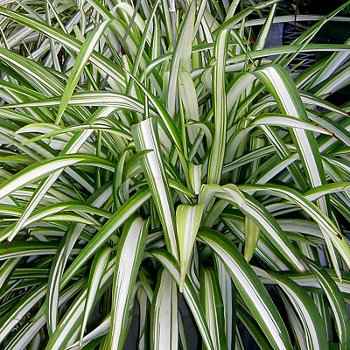
Chlorophytum comosum ‘Reverse Variegatum’
It differs from the previous one in that its leaves are green inside and the margins are white. For the rest, it has similar properties and requirements to that one.
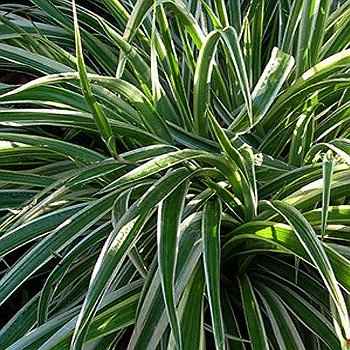
Chlorophytum comosum ‘Ocean’
It is of less growth than the typical species. It has narrower leaves with a larger width, stronger green in the middle and white margins.
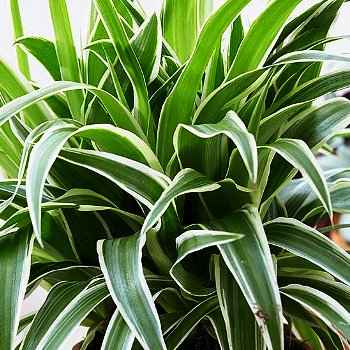
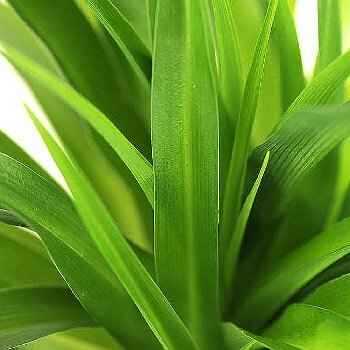
Chlorophytum comosum ‘Lemon’
Extremely interesting variety with attractive hues green leaves. It has similar characteristics and requirements to those of the typical species.
Spider Plant (Chlorophytum comosum) – Description and Uses

Spider Plant (Chlorophytum comosum) - Use
Spider Plant’s value is not only ornamental but also medicinal. However, another aspect of it was highlighted by NASA‘s famous research on indoor air-purifying plants, including Chlorophytum comosum.
Ethnobotany
In ethnobotany, the plant is used in various traditional medical systems around the world. In Chinese Traditional Medicine, the tubular roots are given for the treatment of bronchitis, burns, and for bone fractures.
Use as Indoor Plant
Spider Plant is also an excellent choice for interior design of both home and professional spaces. Additionally, over decorative it also has functional value, because because as mentioned above it cleans the indoor air from the dangerous toxic substances formaldehyde, xylene and toluene. For air filtration to be effective, 1 plant per 10 m² (100 ft) is needed.
Use in Garden and Landscape
In areas suitable for its growth, it can be planted both on the ground and in pots but always at half-shade exposures.
Thus, it could be said that Spider Plant is being exploited:
-
As a ground cover plant
-
In plantings to protect the soil from erosion
-
In mass planting of gardens or parks
-
As an intensive or extensive green roofs plant
-
In combination with other plants, such as Bush Lilies (Clivia miniata), Cape Jasmines (Gardenia jasminoides), Dwarf Umbrella Trees (Schefflera arboricola ‘Variegata’) and Roses of Sharon (Hibiscus syriacus)
References
The References of the gossamer article bearing the African-originated title Chlorophytum comosum – Description and Use are presented by the the great Jamaican singer & musician Burning Spear with its song Slavery Days.
- Braria, A., Ahmad, S., & S L, H. (2014). Chlorophytum Comosum (Thunberg) Jacques: A Review. International Research Journal of Pharmacy, 5(7), 546-549.
- Griffith, L. P. (1998). Tropical Foliage Plants: A Grower’s Guide. Batavia, IL: Ball Pub.
- Miyamoto, S. & Martinez, I. & Padilla, M. & Portillo, A. & Ornelas, D. (2004). Landscape Plant Lists for Salt Tolerance Assessment.
- Quattrocchi, U. (1999). Chlorophytum Ker Gawl. Anthericaceae (Liliaceae). In CRC World Dictionary of Plant Names: Common Names, Scientific Names, Eponyms, Synonyms, and Etymology (Vol. 1, p. 522).
- Steinkopf, L. E. (2019). Houseplants: A Guide to Choosing and Caring for Indoor Plants. Cool Springs Press.
- Stone, B. C. (1970). The Flora of Guam: A Manual for the Identification of the Vascular Plants of the Island. University of Guam.
- Wolverton, B. C. (2008). How to Grow Fresh Air: 50 Houseplants that Purify Your Home or Office. London: Weidenfeld & Nicolson.
- Chlorophytum comosum (Thunb.) Jacques: Encyclopedia of Life (EOL)
Clarification
Of course, it is needless to say – but we will emphasize it – that in this handmade website, no article has been and will not be written with recourse to Artificial intelligence (AI). Natural Intelligence, that is, as much of it as we have and for as long as we are allowed to have it, is enough for us.
Sharing
The use of the material, where third-party rights are not mentioned or implied (such as photos or audiovisual files - with the exception of those belonging to "Kalliergeia"), is absolutely free. Its sharing, possibly, useful.