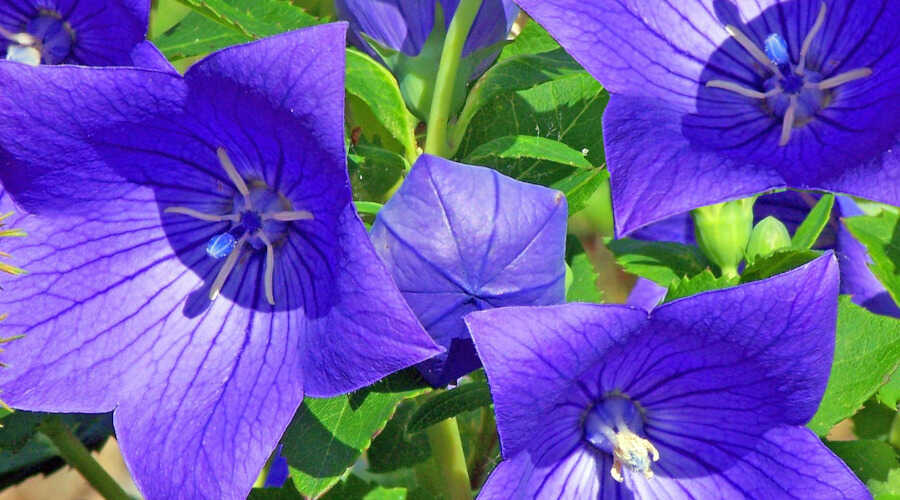
The plant Platycodon grandiflorus (Balloon Flower) is a special ornamental species – and not only -, with wonderful appearance flowers, both during the phase of their formation and in their full growth.
It is the only member of the genus Platycodon (monotypic), being known in the Far East for hundreds of years, where it is utilized in various ways, which we hope, look forward to and seek (unjustly) to record in this article.
It became known in the West through the Scottish botanist Robert Fortune (September 16, 1812 – April 13, 1880), who introduced Platycodon plants on behalf of the Royal Horticultural Society (RHS) to its garden in Chiswick – now a district of west London.
Fortune collected the plants after a systematic expedition to the coast of China, and Balloon Flower, being a garden attraction for Londoners, gained great popularity, which over time contributed to its global spread.
… But more about the plant immediately after.
Platycodon grandiflorus (Balloon Flower) – Description & Uses
Balloon Flower Origin
Platycodon grandiflorus (Balloon Flower) – Description & Uses
Platycodon grandiflorus (Balloon Flower) - Brief Description
Family: Campanulaceae
Genus: Platycodon
Scientific Name: Platycodon grandiflorus (Jacq.) A.DC.
Common Name: Balloon Flower, Chinese Bellflower, Common Balloon Flower, Japanese Bellflower
General Characteristics
Leaf Persistence
Deciduous
Form
Upright / Round
Texture
Medium
Growth Rate
Moderate
Flowering Period
Summer to Early Autumn
Fruiting Period
August – October
Height
0.3-1 m (1-3.5 ft)
Diameter
0.15-0.45 m (0.5-1.5 ft)
Shapes and Colours
Leaves Shape
Ovate
Foliage Colour
Green
Autumn Foliage Colour
Purple or Yellow-Purple
Flowers Shape
Bell-Shaped
Flowers Colour
Blue
Fruit
Capsule
Plantation
Soil Type: Well-drained, sandy, loamy
Exposure: Sun
Soil pH: 5.6-7.3
Watering: Moderate
Hardiness: −31 °C (-25 °F – USDA Hardiness Zone 4b)
Uses
In parks, squares, gardens, pots and containers
Platycodon grandiflorus (Balloon Flower) – Description & Uses
Platycodon grandiflorus (Balloon Flower) - Etymology
Etymology of the Genus Name
The genus name is a compound Neo-Latin word. The first part of it, the platy- prefix, comes from the Ancient Greek word πλατύς (platús), which means flat, but also wide, broad and level, and which originates from the Proto-Indo-Europeans *pléth₂us < *pleth₂-, where the meaning of the latter is flat.
The second part codon comes from the also Ancient Greek word κώδων (kṓdōn) which means bell. It is unknown further etymology, since it is most likely to have Pre-Greek origin.
Etymology of the Species Name
And the name of the species is a compound Neo-Latin word, consisting of the Latin grandis + flōs.
The first of these, grandis, which means large, great, grand, and powerful, mentioned to have come from the Proto-Indo-European *gʰer-, which is interpreted as rub, grind.
The second word flōs comes from the Proto-Italic *flōs, whose distant origin – not mentioned but in fact – goes back to the Proto-Indo-European root * bʰleh₃-, which means bloom, and flower.
In conclusion, it could be said that the name of the plant Platycodon grandiflorus is one of the most successful botanically, as it demonstrates its basic characteristics – while thrills of excitement, due to this great event, penetrate all through its entire editorial team of “Kalliergeia“.
Platycodon grandiflorus (Balloon Flower) – Description & Uses
Platycodon grandiflorus (Balloon Flower) - Origin & Life Span
Origin
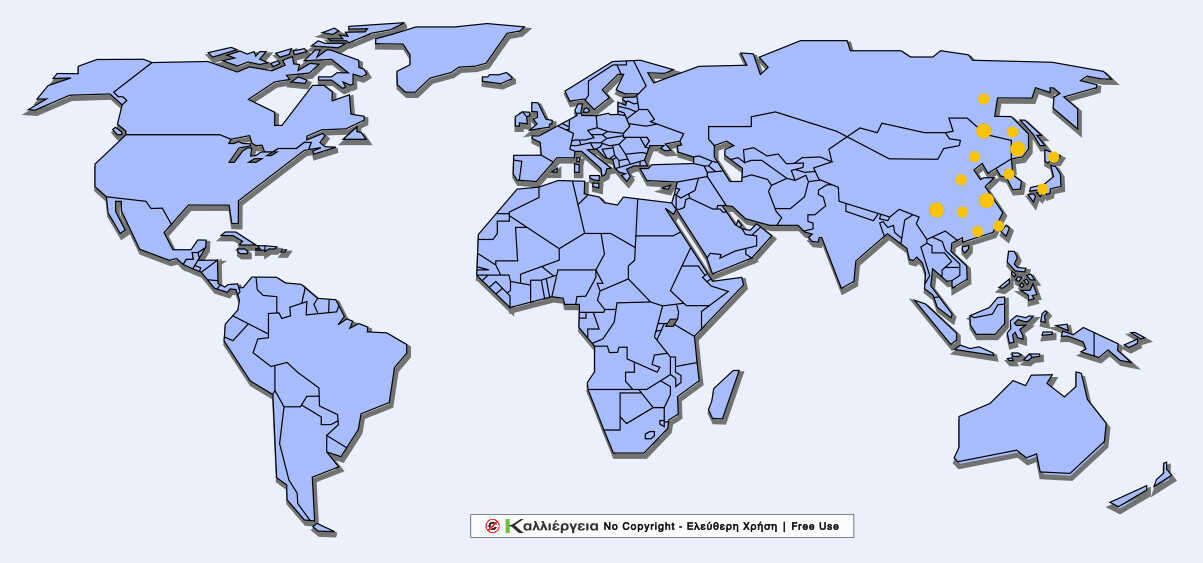
The place of origin of Chinese Bellflower is located in a wide area of the Far East including:
- Southeastern Siberia
- Korea (North and South)
- Japan
- Central, eastern, northeastern and southwestern China
- And Taiwan – which is also the southernmost part of the plant’s natural distribution range (along with Hong Kong)
Its natural populations thrive in sunny grasslands and steppes, where they form plant communities mainly together with other herbaceous plants, while they are not absent – although rarely found – from the forest glades. Its altitude distribution is large, since it starts from sea level and reaches up to 2,000 m.
Life Span
Chinese Bellflower is included in the long-lived herbaceous perennials, having a rather encouraging for the plant lovers life span, which reaches 20 or more years.
Platycodon grandiflorus (Balloon Flower) – Description & Uses
Platycodon grandiflorus (Balloon Flower) - Landscape Attributes
Chinese Bellflower is a herbaceous perennial deciduous plant, small to medium in size and moderate growth rate.
It usually has an erect habit and a globose shape, with medium density and textured foliage, and mostly normal outline.
The main decorative element of the plant are its extremely beautiful bell-shaped blue flowers, even in the phase of their formation, when they appear as peculiar greenish “balloons”.
The long and abundant flowering of Platykodon makes it particularly useful, since under suitable conditions it lasts from 90 to 120 days.
Platycodon grandiflorus (Balloon Flower) – Description & Uses
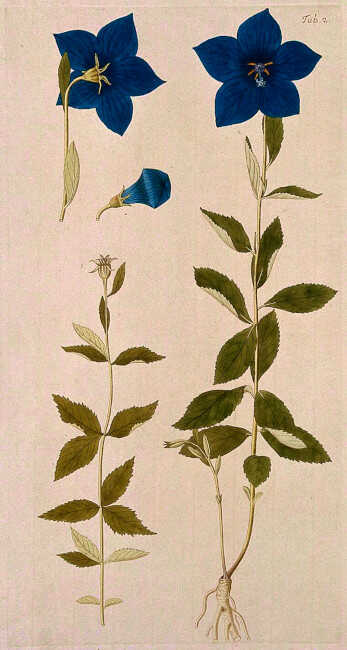
Platycodon grandiflorus (Balloon Flower) - Botanical Description
Root
The plant has a taproot, which is conical or cylindrical in shape and is white in color. Its dimensions range between 5 to 20 cm in length, and 1 to 2 cm in diameter.
Its anthropomorphic appearance is a special feature, somewhat reminiscent the root of species of the genus Mandragora (Mandragora spp.).
Stems
The stems of the plant are erect, glabrous, or rarely densely puberulent as well as branched at the top. They have a green or yellowish-green color, and their length starts from 20 cm, sometimes reaching up to 120 cm.
If a stem is cut, white juice flows out.
Leaves
The leaves of Balloon Flower are simple and have ovate, elliptic, ovate-elliptic, or lanceolate shape, with a length ranging between 2 to 7 cm and a width ranging between 0.5 and 3.5 cm.
The rather thick lamina is adaxially green and has a glabrous surface, while abaxially it is glaucous and has a mostly glabrous surface, although sometimes appeared puberulent along the veins.
The leaves end at an acute or acuminate apex, the margins are serrate, and the base is broadly cuneate or rounded.
They are exstipulate, and sessile, emerging directly from the stems, on which they appear in worled or alternate arrangement.
Flowers
The flowers are simple, pentamerous, hermaphrodite, perigynous and protandrous.
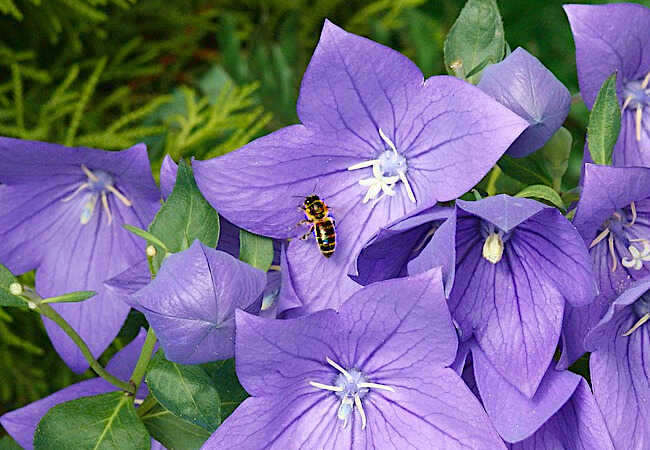
The bell-shaped corolla consisting of 5 triangular-shaped petals, the colour of which is blue (rarely white or pink), and its length is between 2.5 and 4 cm, and the diameter between 2 and 7 cm.
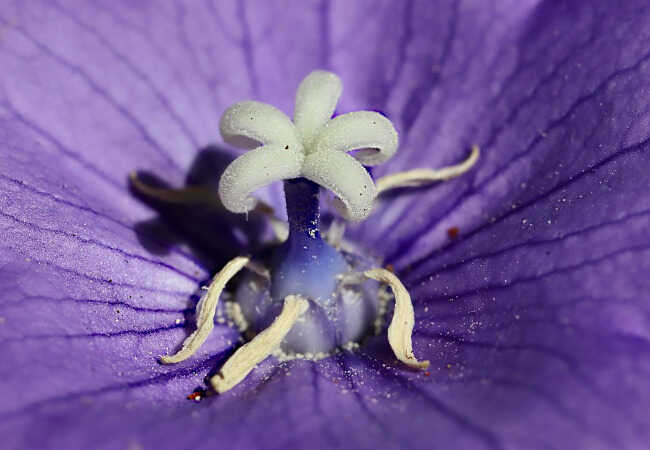
The stamens are 5, have light blue filaments, obvious flattened at the base and pubescent, while they have long pale yellow anthers. The 5-carpelate ovary is half-inferior and 5 locular, initially having a short blue style, which then becomes elongated-filamentous, having at the top of the 5-lobed white stigma.
The glabrous, glaucous-green calyx consists of 5 sepals (rarely 6), joined to about half their length, where they then show a triangular shape, curving slightly outwards.
Pollination
Pollination is carried out mainly by insects (entomophilous species). However, through a wonderful process, although the plant is protandrous (ie the male portion of the flower matures first), if the flower is not pollinated, then the receptive surfaces of the stigma, thanks to the curle back of its lobes, come in contact with the pollen that remains in the puberulent part of the style, and in this way the flower is self-pollinated.
Fruit & Seeds
The brown fruit is a five-valved type capsule, globose, sub-globose or obovoid in shape, with a length ranging between 0.7 and 2.5 cm and a diameter ranging between 0.7 and 1.5 cm.
Numerous black seeds are oval, flattened, have a narrow wing, and are smooth and shiny. In terms of dimensions, their length is between 2 and 2.5 mm, and their width is between 1 and 1.5 mm.
Platycodon grandiflorus (Balloon Flower) – Description & Uses
Platycodon grandiflorus (Balloon Flower) - Climate & Soil
Temperature
The plant adapts to a remarkably wide range of temperatures.
The lowest to which it can be exposed, without showing damage, are between −28.9 and −31.7 °C (−20 to −25 °F).
Its defence against the freezing conditions is organized with the loss of entire overground part during the winter period, to regrowth next spring.
On the other hand, high temperatures up to 36 °C (96.8 °F) do not affect it in the slightest.
Soil and pH
Facilitating the plant lovers, Platykodon established in several soil types, with the exception of heavy and wet soils.
The light and medium textured, in turn, facilitate the plant to grow – that is, the sandy and clayey, which retain the necessary moisture and at the same time show excellent drainage.
As for the reaction of the soil, the soil pH, this can be moderately acidic to slightly alkaline, taking values between 5.6 and 7.3. However, the optimum pH range for plant cultivation is between 6 and 6.5.
Exposure
Chinese Bellflower seeks sunny places, for its smooth growth and normal flowering. But if the plant is to be planted in areas where summer temperatures are extremely high, then it is advisable to install it in partial shade.
Platycodon grandiflorus (Balloon Flower) – Description & Uses

Platycodon grandiflorus (Balloon Flower) - Pests & Diseases
Obviously having excellent public relations, Balloon Flower does not face problems from pests or diseases. And the few parasites mentioned here, for the most part, also do public relations, so as not to be accused of discrimination against other plant species. As for the Snails and Slugs, they prove once again that they completely lack aesthetic criteria.
Pests
Just below are recorded the most important pests of the Platycodon grandiflorus.
Various Insects
- Frankliniella occidentalis (Strawberry Whitefly)
- Trialeurodes vaporariorum (Western Flower Thrips)
- Trialeurodes vaporariorum (Glasshouse Whitefly)
Nematodes
- Pratylenchus penetrans (Northern Root Lesion)
► By using the appropriate insecticides, their treatment is satisfactory, while the control of the nematodes is extremely difficult to impossible.
Diseases
After the pests, the recording of the diseases follows.
Fungi
- Botrytis cinerea (Damping-Off)
- Fusarium spp.
- Verticillium dahliae (Verticillium Wilt)
- Stemphylium platycodontis (Leaf Blight of Tomato)
Viruses
-
TSWV – Tomato Spotted Wilt Orthotospovirus (Tomato Spotted Wilt)
► By the timely use of appropriate fungicides, the treatment of fungi is satisfactory, while the control of the virus is rather impossible.
Platycodon grandiflorus (Balloon Flower) – Description & Uses
Platycodon grandiflorus (Balloon Flower) - Toxicity & Allergenic Pollen
Toxicity
Both the root and the older leaves of Balloon Flower, and especially those near its base, are toxic. This is slightly paradoxical for a plant that consumes both of its above-mentioned toxic parts as food – but it is not at all paradoxical that simple techniques have been developed to neutralize their toxicity before being eaten.
Allergenic Pollen
The plant, as entomophilous, it does not cause allergic reactions by its pollen.
Platycodon grandiflorus (Balloon Flower) – Description & Uses
Platycodon grandiflorus (Balloon Flower) - Varieties & Cultivars
A fairly widespread planetary plant, has given the opportunity to breeders to present numerous new varieties.
Thus, next to the single flowers of the typical species with the blue colors, they have appeared double ones, while at the same time the color palette of the flowers has expanded, now having differentiated blue, blue-purple, purple, pink and white.
Even the size of the flowers offered increased, as the diameter of some of them reaches up to 9 cm.
Immediately below are listed some of the most interesting varieties of Chinese Bellflower.
Varieties & Cultivars of the Species
Platycodon grandiflorus 'Astra Double Blue'
Extremely interesting variety, ‘Astra Double Blue’ has large double flowers with a diameter of about 7 cm, the color of which is pale purple (lavender). Characteristic of the plant is that it is a dwarf, as its height does not exceed 20 cm.
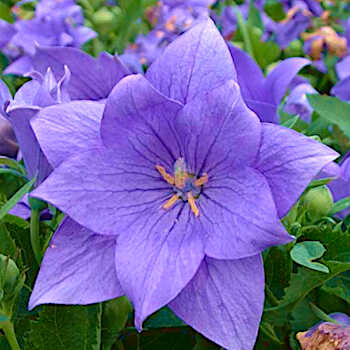
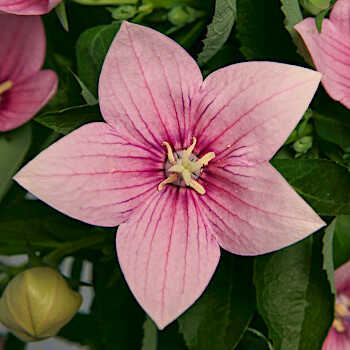
Platycodon grandiflorus 'Astra Pink'
The ‘Astra Pink’ variety has single flowers of light pink color, with a size that reaches about 7 cm. As for the size of the plant itself, it is also a dwarf since it does not exceed 20 cm in height and diameter.
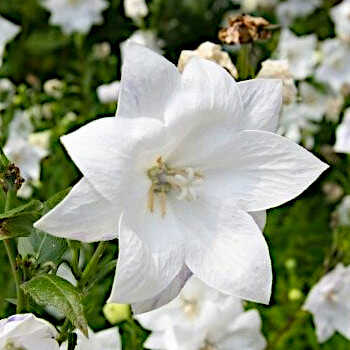
Platycodon grandiflorus 'Hakone White'
‘Hakone White’ variety is a large plant, with a height between 0.8 and 1 m. Its double and white color flower is also large, since its diameter reaches up to 8 cm.
Platycodon grandiflorus (Balloon Flower) – Description & Uses
Platycodon grandiflorus (Balloon Flower) - Uses
Ethnobotany
The ethnobotanical use of the plant is reflected in traditional medical systems, such as Chinese and Korean.
Therapeutically, the root is used as an anthelmintic, antiasthmatic, anticholesterolemic, antiphlogistic, antitussive, astringent, carminative, expectorant, haemolytic, hypoglycaemic, sedative, tonic and vermifuge.
In Korea, 4-year-old roots are given to treat bronchitis, asthma, pulmonary tuberculosis, diabetes and various inflammatory diseases.
In China it is used as an expectorant and antitussive to treat coughs, colds, sore throats, tonsillitis and chest congestion.
Pharmaceutical
The traditional therapeutic use of the plant was justified by modern pharmacological research. The roots of Platykodon contain the substances Platikodin – a form of Saponins. Platikodine show action:
- Antioxidant
- Anticancer
- Antiobese and Hypolipidemic
- Antiallergic
- Antimicrobial
- Neuroprotective (in Alzheimer’s disease -AD, and in all types of dementia)
Ornamental Use in Garden and Landscape
The balloon flower is is extremely interesting in gardening and landscape architecture – using both its typical species and its numerous varieties.
- In particular, it is utilized:
- As a potted plant, in gardens, courtyards and balconies
- In mixed borders
- In groups or in mass plantings in gardens, parks, squares
- Combined with other ornamental plants such as Flat Sea Holly (Eryngium planum), Red Hot Poker (Kniphofia uvaria), Orange Coneflower (Rudbeckia fulgida) and Getty White Agapanthus (Agapanthus praecox ‘Getty White’)
References
The References to the article with the radically distinct and jealous title Platycodon grandiflorus (Balloon Flower) – Description & Uses are presented by an unidentified Korean musical ensemble, with the country’s traditional song “Doraji Taryeong” or simply 도라지 – which is translated as the “Song of the Platykodon“.
- Brickell, C. (2019). RHS Encyclopedia Of Plants And Flowers. Dorling Kindersley.
- Ellis, B. (2000). Taylor’s Guide to Growing North America’s Favorite Plants: Proven Perennials, Annuals, Flowering Trees, Shrubs, & Vines for Every Garden. Houghton Mifflin Harcourt.
- Kadereit, J. W., & Jeffrey, C. (2007). Flowering Plants. Eudicots: Asterales. In The Families and Genera of Vascular Plants (Vol. VIII , p. 44).
- Nyakudya, E., Jeong, J. H., Lee, N. K., & Jeong, Y. (2014). Platycosides from the Roots of Platycodon grandiflorum & Their Health Benefits. Preventive Nutrition and Food Science, 19(2), 59-68.
- Oh, Y., Kang, O., Choi, J., Lee, Y., Brice, O., Jung, H. J., … Kwon, D. (2010). Anti-allergic Activity of a Platycodon Root Ethanol Extract. International Journal of Molecular Sciences, 11(7), 2746-2758.
- Perry, L. P. (1998). Herbaceous Perennials Production: A Guide from Propagation to Marketing. Natural Resources.
- Balloon Flower (Platycodon grandiflorus): Texas Tech University
- Platycodon grandiflorus (Jacq.) A. DC.: Tsuyuzaki Shiro (Plant Ecology · Environmental Conservation) – Hokkaido University
Clarification
Of course, it is needless to say – but we will emphasize it – that in this handmade website, no article has been and will not be written with recourse to Artificial intelligence (AI). Natural Intelligence, that is, as much of it as we have and for as long as we are allowed to have it, is enough for us.
Sharing
The use of the material, where third-party rights are not mentioned or implied (such as photos or audiovisual files - with the exception of those belonging to "Kalliergeia"), is absolutely free. Its sharing, possibly, useful.