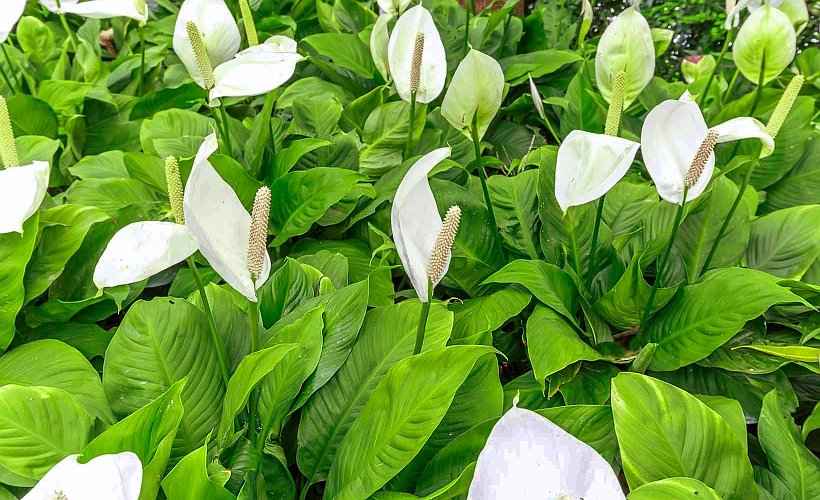
Spathiphyllum is a genus of about 40 species, including among others and the Spathiphyllum wallisii or Peace Lily.
The Peace Lily is, therefore, an exceptionally widespread world-wide flower plant that embellishes both interior and exterior spaces and which in extend will be briefly discussed in the following article.
Introductory only here, at this point, is that the editorial team of ‘Kalliergeia’ has the undeniable need to state the obvious that the name Peace Lily for the Spathiphyllum is as that the Desert Storm for the Arabs: a short joke or one of the detrimental health consequences of smoking (guns).
Because its common name is diametrically opposed (and unsuccessful) to the (successful) botanical one – as the etymology of the genus name will proof-, or in other words a Sword (-leaf) cannot and is neither a Lily nor a Daisy of Peace.
Peace Lily (Spathiphyllum wallisii) – Description and Uses
Peace Lily Origin

Peace Lily (Spathiphyllum wallisii) – Description and Uses
Peace Lily (Spathiphyllum wallisii) - Brief Description
Family: Araceae
Genus: Spathiphyllum
Scientific name: Spathiphyllum wallisii Regel
Common name: Dwarf Peace Lily, White Sails, Spathe Flower
General Characteristics
Leaf Persistence
Evergreen
Form
Shrub of Round Shape
Texture
Medium
Growth Rate
Slow
Flowering Period (Tropics)
Repeatedly throughout the year
Fruiting Period
Repeatedly throughout the year
Height
0.30-0.45 up to 0.60 m (1-1.5 up to 2 ft)
Diameter
0.30-0.45 up to 0.60 m (1-1.5 up to 2 ft)
Shapes and Colours
Leaves Shape
Ovate to Elliptic
Foliage Colour
Green
Autumn Foliage Colour
Green
Flowers Shape
Compound Spadix surrounding by Spathe
Flowers Colour
White
Fruit
Berries
Plantation
Soil Type: Well-drained, sand, loam
Exposure: Half-shade, Shade
Soil pH: 5.8-7
Watering: Moderate
Hardiness: 1.7 °C (35 °F – USDA Hardiness Zone 10b)
Uses
In gardens as well as in pots, planters and containers indoors and outdoors
Peace Lily (Spathiphyllum wallisii) – Description and Uses
Peace Lily (Spathiphyllum wallisii) - Etymology
Etymology of the Genus Name
The name of the genus Spathiphyllum is the highly vivid Neo-Latin version of two words of Ancient Greek language, ‘σπάθη’ (Indo-European root *sph₂-dʰ–), means sword and ‘φύλλον’, means leaf – aptly describing the special shape of the flowers.
… Is it enough obvious that a sword can not be a Peace Lily?
Etymology of the Species Name
The name of the species wallisii was given in honor of the German plant collector Gustav Wallis (1830-1878), who has introduced more than 1000 species of plants in Europe, including many orchids.
Peace Lily (Spathiphyllum wallisii) – Description and Uses
Peace Lily (Spathiphyllum wallisii) - Origin & Life Span
Origin
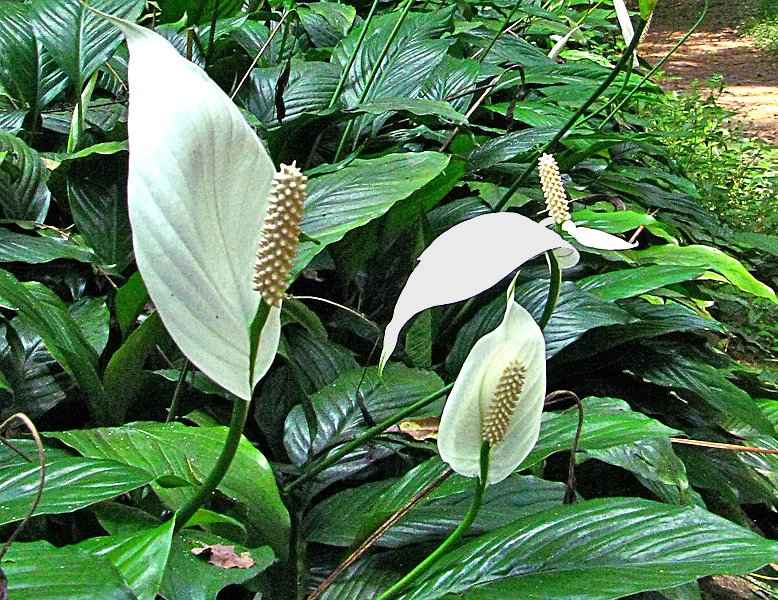
Spathiphyllum wallisii cradle is the tropical zone of South America, namely Colombia, where most of its natural populations, as well as Venezuela, are found. Its natural ecosystems are the shady areas of rainforests usually found in wet habitats.
Life Span
The Spathiphyllum wallisii lives for 3 to 5 years, but sometimes it is reported to be over 10 years.
Peace Lily (Spathiphyllum wallisii) – Description and Uses
Peace Lily (Spathiphyllum wallisii) - Landscape Attributes
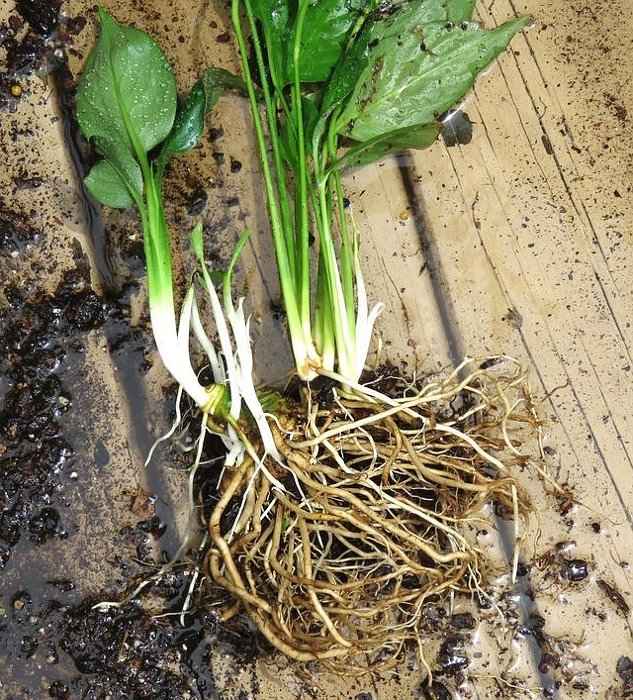
Spathiphyllum wallisii is a perennial, evergreen rhizomatous herbaceous flower plant of spherical shape and upright in form. Its extremely attractive foliage is symmetrical, of coarse texture and moderate density. If it is planted on the garden soil it shows remarkable spreading growth, covering spaces.
Peace Lily (Spathiphyllum wallisii) – Description and Uses
Peace Lily (Spathiphyllum wallisii) - Botanical Description
Leaves
The leaves are large, simple, intensely green in color, which arching away from the underground rhizome. They are oval or ellipsoidal in shape, end in a acute peak and are carried on long stalks of 14 to 15 cm (5.5-6 in) in length. They are leathery and glossy, particularly decorative and have a length of between 12 and 15 cm (4.7-6 in) and a width of 6 to 8 cm (2.3-3 in).
Flowers
The Peace Lily flowers appears from centres of leaf clusters. They are hermaphrodite that grow in spadix inflorescence.
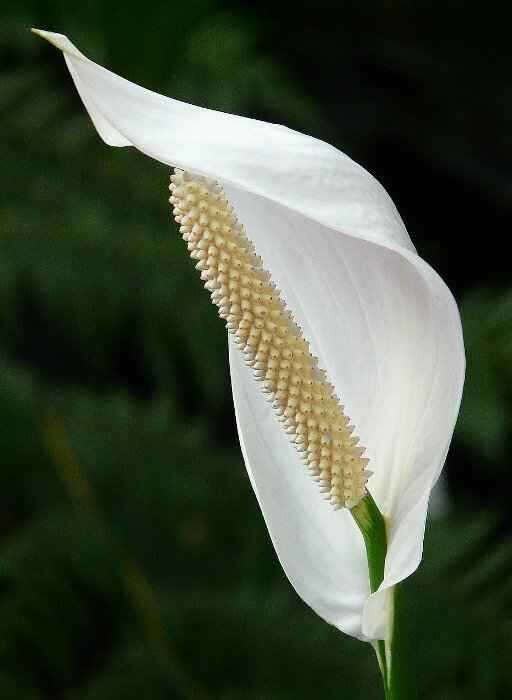
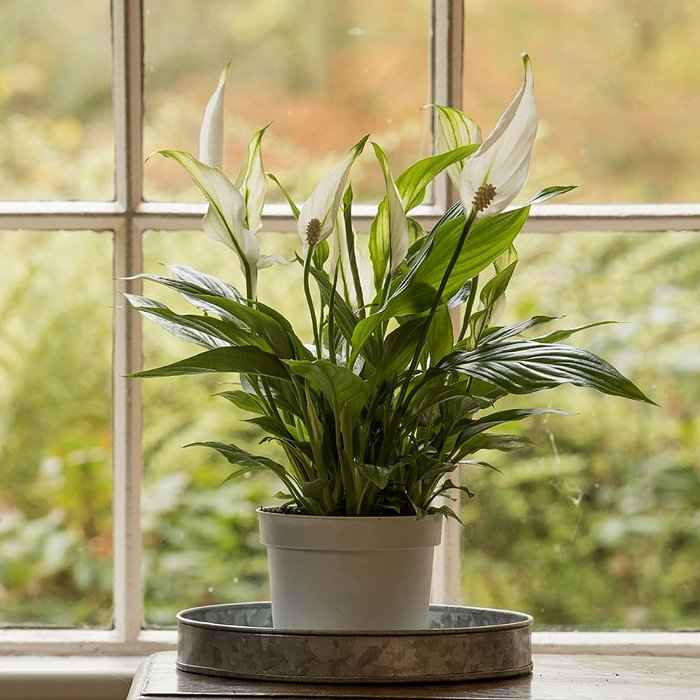
The spadix is erect, has a creamy color and a length of between 5 and 7 cm (2-2.5 in). The spadix of the Spathiphyllum wallisii surrounded by the the spathe, which although it looks like a large ‘petal’ flower is only one or often two bract leaves.
The spathe has an oval shape and ends at a acute peak. Its color is initially white with open green nerves and then over time it turns green. The dimensions of the spathe are 7 to 10 cm (2.5-4 in) long and 5 to 7 cm (2-2.5 in) wide.
Pollination
Pollination takes place with insects, which are attracted by the light fragrant of the flowers, which its varieties unfortunately lack.
Fruit
The fruit of Spathiphyllum wallisii is spherical in shape and is carried in a berry seed head. It is smooth, has a white color and a diameter of between 1 and 1.3 cm (0.4-0.5 in).
Peace Lily (Spathiphyllum wallisii) – Description and Uses
Peace Lily (Spathiphyllum wallisii) - Climate and Soil
Temperature
The Peace Lily, as a plant of the tropical regions, is cold intolerance. The minimum temperatures, which are also the lowest tolerance limit, range between 4 and 1.7 °C (40-35 °F). With high temperatures, Spathiphyllum wallisii‘s behavior is excellent as it does not have particular problems if it – in addition – develops in an environment with high atmospheric humidity.
Soil and pH
The Spathiphyllum wallisii grows in a variety of soil types, except heavy clay soils, provided they drain well but at the same time retain the necessary moisture.
As for pH, it grows in a range of between 5.8 and 7, but it thrives in acidic to slightly acidic soils with values ranging from 5.8 to 6.5.
Exposure
Peace Lily grows in half-shade or full shade (the warmer the area is). Still, when grown as an indoor plant, luminous places should be selected but its direct exposure to sunlight should be avoided, as it can cause leaf burns.
Peace Lily (Spathiphyllum wallisii) – Description and Uses
Peace Lily (Spathiphyllum wallisii) - Pests & Diseases
Spathiphyllum wallisii generally does not face serious problems from pests and diseases. However, and this plant -strange as it may seem- is not invulnerable.
Pests
The most common pests include Whiteflies, Aphids, Caterpillars, Mealybugs and Scales.
Immediately below are recorded some of the most important of them.
Various Insects
-
Eupanacra splendens
-
Frankliniella occidentalis (Western Flower Thrips)
- Hercinothrips femoralis (Banded Greenhouse Thrips)
Scales
- Coccus longulus (Long Brown Scale)
- Saissetia oleae (Black Scale)
Acari
- Tetranychus urticae (Red Spider Mite)
► By the timely using of the appropriate insecticides and acaricides their treatment is satisfactory.
Diseases
Aerial Blight (Phytophthora sp.), Cylindrocladium root rot (Cylindrocladium spathiphylli) and Pythium root rot (Pythium sp.) are some of the common diseases of the plant.
Immediately below are the most important diseases of the plant recorded.
Fungi
- Alternaria alternata (Alternaria Leaf Spot)
- Botrytis cinerea (Grey Mould)
- Cylindrocladium spathiphylli (Root and Petiole Rot)
- Myrothecium roridum
- Phytophthora sp. (Aerial Blight)
- Phytophthora nicotianae var. parasitica (Phytophthora Blight)
- Pythium sp.
Bacteria
- Pectobacterium carotovorum subsp. carotovorum (Bacterial Leaf Rot)
Viruses
-
DMV (Dasheen Mosaic Virus)
-
INVS (Impatiens Necrotic Spot Virus)
-
TSWV (Tomato Spotted Wilt Virus)
► By using the appropriate fungicides their treatment is satisfactory, while the bacteriosis is difficult to treat. For viruses, only preventive measures can be taken as they are not treated with pesticides.
Peace Lily (Spathiphyllum wallisii) – Description and Uses
Peace Lily (Spathiphyllum wallisii) - Toxicity & Allergenic Pollen
Toxicity
The Peace Lily contains calcium oxalate in its tissues, which is toxic to humans and pets while the juice is irritating to the skin. It is advisable to keep it away from children and pets and wash hands thoroughly after handling it.
Allergenic Pollen
People with sensitivity may be allergic to the pollen of the male part of the flower. The allergic reaction can manifest as rhinoconjunctivitis, asthma and urticaria, after their exposure.
Peace Lily (Spathiphyllum wallisii) – Description and Uses
Peace Lily (Spathiphyllum wallisii) – Varieties & Cultivars
Although the plant does not belong to the category of the most popular flowering plants, dozens of varieties have been created. This allows plant lovers to choose from a wide range, selecting the one that best meets their aesthetic and other criteria. Contributing to the promotion of some remarkable varieties of Spathiphyllum, “Kalliergeia” dares to present them fearlessly below.
Varieties
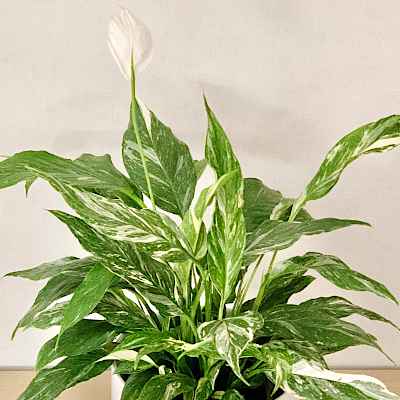
Spathiphyllum wallisii 'Domino'
It is an extremely attractive plant, characterized by its variegated leaves. It reaches a height of 30 to 50 centimeters, bears the same flower as the typical species, and its leaves are glossy green, interrupted by small or large areas of white-cream stripes that follow the direction of the veins.
Spathiphyllum wallisii 'Sensation'
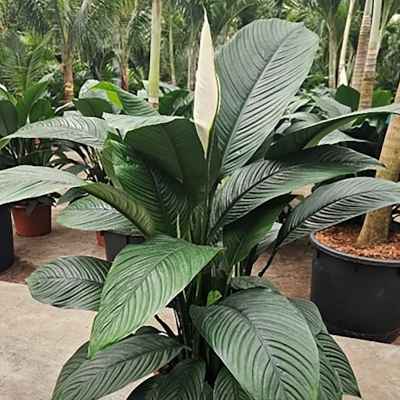
This variety is the most impressive of all Spathiphyllum, as it produces giant plants that can reach heights of up to 1.80 meters. Its leaves, which are up to 50 centimeters long, are broad, lanceolate, with a wavy surface due to the intense veins, while their color is deep green. It bears the same cream-white flower as the typical species.
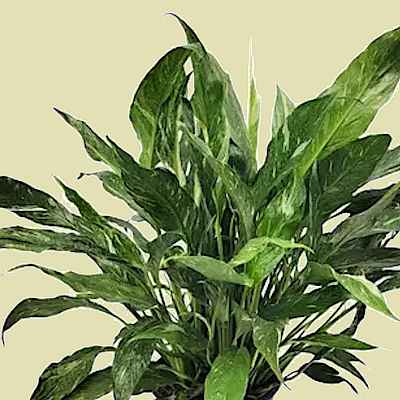
Spathiphyllum wallisii 'Variegata'
Another impressive variety with elongated or normal lanceolate leaves, bright green in color with white-cream variegation. The plant measures 0.50 to 0.60 m in height and 1.80 to 2.40 m in diameter. Here too, inflorescences with white spathes protrude from long flower stalks during the flowering period.
Peace Lily (Spathiphyllum wallisii) – Description and Uses
Peace Lily (Spathiphyllum wallisii) - Use
Use as an Indoor Plant
Spathiphyllum wallisii is one of the most useful plants for decorating the interior of both homes and professional spaces. But beyond the decorative, it still has a more interesting side, as it has the ability to filter, clean, indoor the air of toxins (like formaldehyde, benzene and carbon monoxide) while enriching the atmosphere with oxygen. To perform such a function requires 1 plant per 20 to 25 m².
Use in Garden and Landscape
In areas suitable for its growth, it can be planted both on the ground and in pots – but always in half-shady and shady places.
So, it could be said that Peace Lily is being exploited:
-
As a srhub of particular interest planted alone
-
By mass planting in gardens and landscapes
-
As a ground cover plant
-
In combination with other exotic plants such as Codiaeum variegatum (Garden Croton or Variegated Croton), Caladium spp. (Caladiums or Elephant Ear) and Mandevilla splendens (Shining Mandevilla)
References
Desert Storm (brrr…) we wrote in the introductory note to this article, along with Arabs men and women, and therefore we see no reason why References should not poetically salute the late, great Lawrence Ferlinghetti with his poem And the Arabs Asked Terrible Questions… and to present them with the song Lawah by the Arab artist Aziz Sahmaoui, from Morocco, and the University of Gnawa.
- Acquaah, G. (2009). Horticulture: Principles and Practices. Prentice Hall.
- Bagust, H. C. (2006). The Hutchinson Dictionary of Plant Names.Abingdon: Helicon Publishing.
- Bailey, F., & Alleyway, Z. (2018). Practical House Plant Book: Choose Well; Display Creatively; Nurture and Maintain; 175 Plant Profiles. Dorling Kindersley Limited.
- Bawden-Davis, J. (2007). Indoor Gardening the Organic Way: How To Create a Natural and Sustaining Environment for Your Houseplants. Lanham, MD: Taylor Trade Pub.
- Mounika, K., Panja, B., & Saha, J. (2017). Diseases of Peace Lily (Spathiphyllum sp.) Caused by Fungi, Bacteria and Viruses: A Review. The Pharma Innovation Journal, 6(9), 103-106.
- Shry, C. L., & Reiley, H. E. (2016). Introductory Horticulture.Cengage Learning.
- Spathiphyllum wallisii (Peace Lily): Encyclopedia of Life (EOL)
- Photos of Peace Lily Spathiphyllum wallisii: iNaturalist
Clarification
Of course, it is needless to say – but we will emphasize it – that in this handmade website, no article has been and will not be written with recourse to Artificial intelligence (AI). Natural Intelligence, that is, as much of it as we have and for as long as we are allowed to have it, is enough for us.
Sharing
The use of the material, where third-party rights are not mentioned or implied (such as photos or audiovisual files - with the exception of those belonging to "Kalliergeia"), is absolutely free. Its sharing, possibly, useful.