Home » PLANTS & CROPS »
Management of Apple Powdery Mildew (Podosphaera leucotricha)
CONTENTS ⌵
This article is primarily dedicated to The Management of Apple Powdery Mildew. In which article the epidemiology and the symptoms caused by the disease in the plant parts of the trees affected by the causal agent, i.e. Podosphaera leucotricha, are also presented.
Thus, and in this way, the grower, but also anyone interested, is given the opportunity to form an adequate picture of this ascomycete, both in the field of its identification and in the field of its management and control.
And although Podosphaera leucotricha does not represent one of the most serious threats to the life of the trees it infests – as they will rarely be in mortal danger – it does represent a serious threat to the grower, since it leads her/his trees to a considerable reduction in production capacity, while making the produced product unmarketable, causing her/him significant economic loss.
Therefore, the grower has no other option than to ‘kick out’ the parasite of his orchard. At the same time, of course, it obliges the editorial team of “Kalliergeia” to declare from the outset its full support for the righteous of her/his struggle.
Management of Apple Powdery Mildew (Podosphaera leucotricha)
Epidemiology of Apple Powdery Mildew
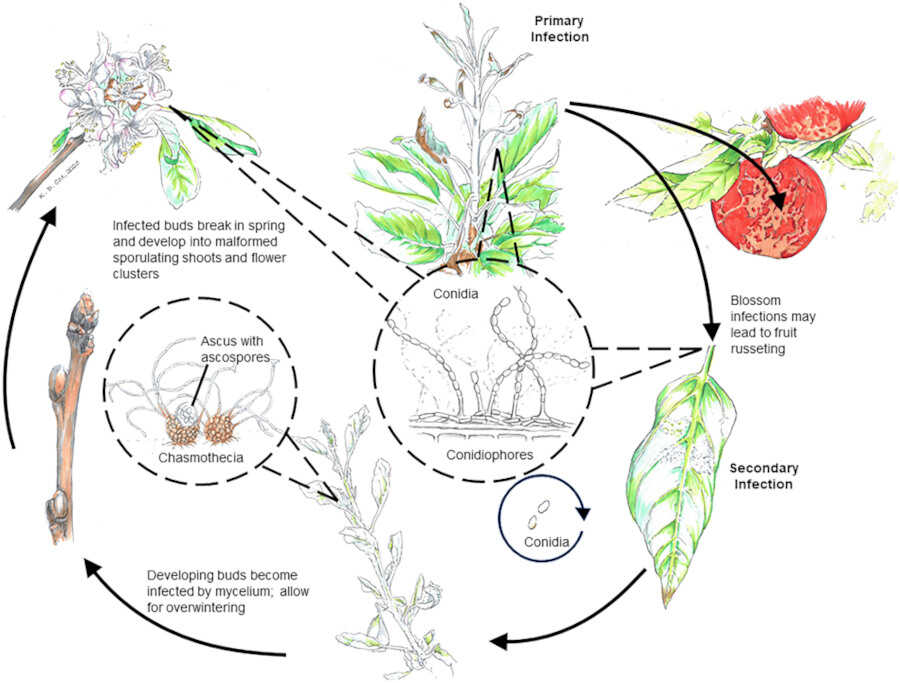
Apple Powdery Mildew emerges in the spring. Primary infections begin when the infected from the previous year buds break their dormancy and the fungus resumes growth. The bud scales do not adequately protect the new vegetation and the fungus spreads to the expanding organs.
Suitable climatic conditions for the development of the pathogen are when the temperature is between 10 and 30 °C (50-86 °F) while the relative humidity is high.
For conidium germination, the relative humidity must be greater than 70%, however, this factor is not as decisive for the the progression of disease as temperatures.
In fact, the wetting of the leaves is inhibiting the conidial growth and the development of the disease. And at this point, Apple Powdery Mildew completely differs from most fungal diseases that affect the fruits and foliage of the orchad crops.
Temperatures favorable to conidium germination are those that range between 10 and 25 °C (50-77 °F) while their optimal range is between 19 and 22 °C (66-71 °F).
Under ideal conditions, the symptoms of the disease become visible to the naked eye within 48 hours.
Management of Apple Powdery Mildew (Podosphaera leucotricha)
Symptoms of Podosphaera leucotricha
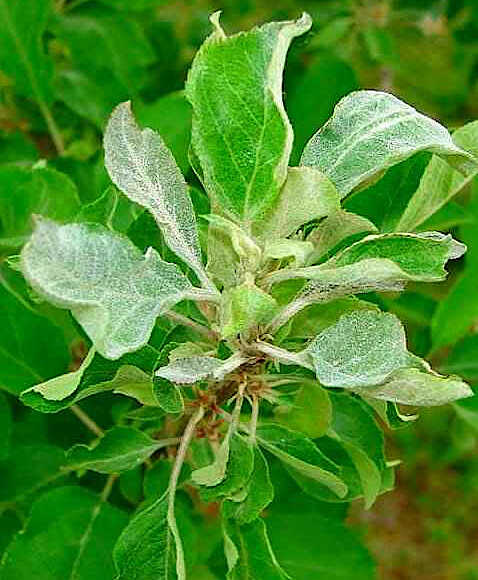
The Podosphaera leucotricha infects almost all the above-ground parts and organs of susceptible plants. Although the completely destroy of them is rare, the damage it causes is often high.
Buds
The infected buds open later than healthy buds, 5 to 8 days, and are already covered with conidia. Strong signs for their presentation is the silver-gray color of the tissues. Sometimes, when the disease spreads with particular tension, they may die-back. In some newly flower buds that are infected by the fungus, the Podosphaera leucotricha remains in dormancy untill next spring.
Flowers
The flowers have initially silver-gray color. They have shrivel parts or even the entire flower. Petals are light green or yellowish green in color. The entire shrivel flower die-back and drops, or – if remain on tree – fail to produce fruit.
Leaves
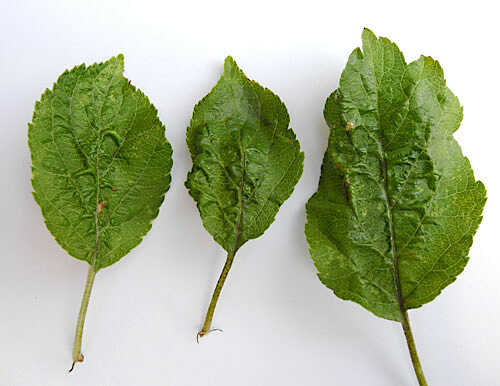
Apple Powdery Mildew infects leaves usually from its lower surface. Initially, small, white-colored spots with unclear borders, often covered by the powder textured mycelium of the phytopathogenic fungus, appear. Spots are gradually spreading, completely covering the lower surface and then the top.
The consequence of this is the loss of elasticity of the leaves, the presence of multi dots and their curled appearance, and even the longitudinally folded.
Under intensity conditions of disease spreading, is observed the die-back of the leaves accompanied by premature defoliation.
However, leaves are vulnerable to Apple Powdery Mildew, up to three weeks since their growing. After this time, the fungus can not infect them.
Shoots
What happens to the leaves is the same with the shoots: Podosphaera leucotricha mainly affects young and tender ones. The surface of the young shoots is covered by the powder textured mycelium of the fungus and becomes stunted. They still could have deformed appearance and usually their top is died-back.
Fruits
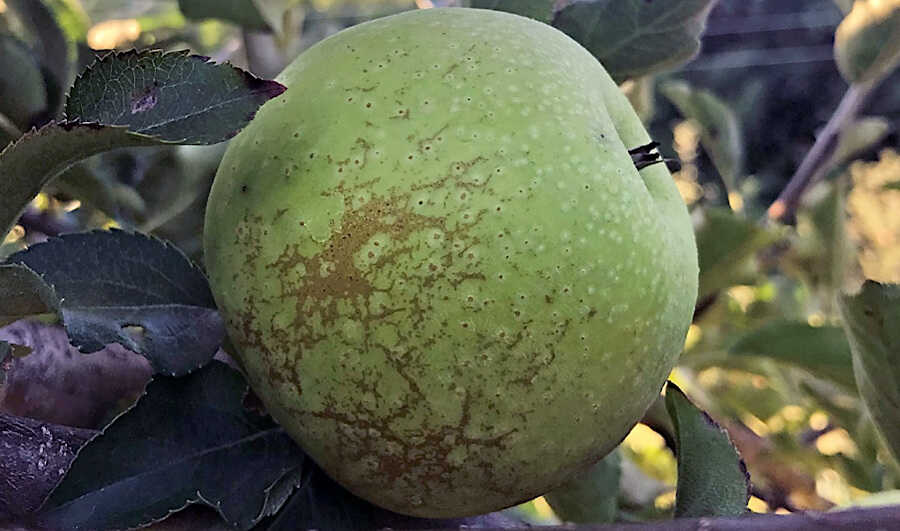
The fungus rarely appears on the fruit. And when that happens, it’s about the immature ones. The affected fruit has a characteristic netlike russeting. That is due to the cell necrosis at the infected sites, a sample at the same time for the necrosis of the mycelium of the fungus. The fruits have a net appearance, which means that their commercial value is severe reduced.
Management of Apple Powdery Mildew (Podosphaera leucotricha)
Preventive Treatment
Apple Powdery Mildew can be treated in a variety of ways and means, both preventive and suppressive.
Preventive treatment refers mainly to the selection of those varieties – especially of the apple tree – which are high and natural resistant to this phytopathogenic fungus. Some of these are listed below.
Resistance Cultivars of Apple
- Ambrosia
- Arkansas Black
- Arlet
- Dayton
- Delicious
- Enterprise
- Fuji
- Gala
- Gala Supreme
- Grimes Golden
- Lambourne
- Lodi
- Lord
- Niagara
- Nittany
- Priscilla
- Sir Prize
- Spartan
- Winesap
- Yataka
Management of Apple Powdery Mildew (Podosphaera leucotricha)
Cultural Practices & Alternative Control of Apple Powdery Mildew
Cultural Control
The cultural practices for the Apple Powdery Mildew control include:
- The right pruning of the trees, in a such way that allow the light to pass as far as possible inside the canopy
- The removal by pruning in the winter of all affected shoots, as they are the basic inoculum sources for primary infections
- The pruning in the spring of all plant parts that are severely infected
Alternative Control
The spraying of Apple trees with emulsions of anhydrous milk fat and soybean oil has give relatively satisfactory results.
Management of Apple Powdery Mildew (Podosphaera leucotricha)
Biological Control of Podosphaera leucotricha
Indicatively, there are some active substances that can be used for the biological control of the Podosphaera leucotricha, with moderate results, however, except of Sulfur.
Active Substances
- Streptomyces lydicus WYEC 108
- Bacillus amyloliquefaciens strain D747
- Bacillus subtilis strain QST 713
- Bacillus pumilus strain QST 2808
Management of Apple Powdery Mildew (Podosphaera leucotricha)
Chemical Control of Apple Powdery Mildew
Apple Powdery Mildew is effectively treated with the use of various plant protection products. At least three sprays are required in the spring season:
- At the Green Tip stage
- At the Pink stage
- After Petal Fall
Below are listed the active substances that can be used to control Apple Powdery Mildew (Podosphaera leucotricha).
➤ Those active substances with the indication [E] are authorized for use in Greece (and most European Union countries) at the time of writing this article.
Active Substances
Conventional Farming
- Benomyl [Ε]
- Boscalid (formerly Nicobifen) [Ε]
- Bupirimate [Ε]
- Captan [Ε]
- Carbendazim
- Copper oxychloride [Ε]
- Cyflufenamid [Ε]
- Dinocap
- Dithianon [Ε]
- Fenarimol
- Fluopyram [Ε]
- Fluxapyroxad [Ε]
- Fosetyl [Ε]
- Kresoxim-methyl [Ε]
- Mefentrifluconazole [Ε]
- Meptyldinocap [Ε]
- Methyl Fenarimol
- Myclobutanil
- Penconazole [Ε]
- Penthiopyrad [Ε]
- Potassium hydrogen carbonate [Ε]
- Pyraclostrobin [Ε]
- Sulphur [Ε]
- Tebuconazole [Ε]
- Tetraconazole [Ε]
- Thiophanate-methyl
- Triadimefon
- Trifloxystrobin [Ε]
Organic Farming
- Extract of Neem oil [Ε]
- Sulfur [Ε]
- Paraffinic oil [Ε]
- Potassium bicarbonate [Ε]
Absolutely Necessary Reminder
The reference to the active substances that can be used against Podosphaera leucotricha is for purely informative reasons. Under no circumstances is their use implied or encouraged without the approval of the local agronomist.
Management of Apple Powdery Mildew (Podosphaera leucotricha)
References
The References of the article with the agonistic title Management of Apple Powdery Mildew (Podosphaera leucotricha), are presented by The Philadelphia Orchestra, under the direction of the Swiss conductor Charles Édouard Dutoit, with the 4th part (Allegro vivace) of the symphony No. 2 in E minor, Op. 27, by the great Russian composer Sergei Rachmaninoff.
- Devasahayam, H. L. (2009). Illustrated Plant Pathology: Basic Concepts. New India Publishing.
- Liang, C., Xing, H. H., Cho, S. E., & Shin, H. D. (2012). First Report of Powdery Mildew Caused by Podosphaera leucotrichaon Photinia serrulata in China. Plant Disease, 96(11), 1695-1695.
- Lind, K., Lafer, G., Schloffer, K., Innerhofer, G., & Meister, H. (2003). Organic Fruit Growing. CABI.
- Miletich, N., Tamas, O., Vuksa, P., Pfaf-Dolovac, E., & Dolovac, N. (2012). The Influence of Shading on the Development of Podosphaera leucotricha Under Field Conditions. Bulgarian Journal of Agricultural Science, 18(2), 178-184.
- Naqvi, S. (Ed.).(2007). Diseases of Fruits and Vegetables: Volume I Diagnosis and Management. Berlin, Germany: Springer Science & Business Media.
- Pollock, M. (Ed.). (2012). Fruit & Vegetable Gardening. DK.
- Westcott, C. (2008). Westcott’s Plant Disease Handbook. Springer Science & Business Media.
- Wurms, K. V., & Ah Chee, A. (2011). Control of Powdery Mildew (Podosphaera leucotricha) on Apple Seedlings Using Anhydrous Milk Fat and Soybean Oil Emulsions. New Zealand Plant Protection, (64), 201-208.
- Powdery Mildew Management in Conventional and Organic Apple Orchards: Achour Amiri, Plant Pathologist, Washington State University (WSU-Wenatchee)
Clarification
Of course, it is needless to say – but we will emphasize it – that in this handmade website, no article has been and will not be written with recourse to Artificial intelligence (AI). Natural Intelligence, that is, as much of it as we have and for as long as we are allowed to have it, is enough for us.
Sharing
The use of the material, where third-party rights are not mentioned or implied (such as photos or audiovisual files - with the exception of those belonging to "Kalliergeia"), is absolutely free. Its sharing, possibly, useful.