We knew it as Gaura lindheimeri, the Lindheimer’s Βeeblossom, and it turned out to Oenothera lindheimeri.
So, given the pace at which plant names have been changing in recent years, we here at “Kalliergia” are considering proposing to the International Association for Plant Taxonomy (IAPT) that their names be replaced with numbers.
This way, any progress in phylogenetic research would not necessarily lead to a name change- with all the problems that this might cause.
For example, the former Lindheimer’s Βeeblossom or Gaura lindheimeri and now Oenothera lindheimeri, could be given the memorable and practical number 7534-2742-9582-1748.
… Did we hear laughter from the gallery, or did it just seem that way?
Lindheimer’s Beeblossom (Oenothera lindheimeri or Gaura lindheimeri)
Lindheimer’s Βeeblossom Origin
Lindheimer’s Beeblossom (Oenothera lindheimeri or Gaura lindheimeri)
Lindheimer's Βeeblossom (Oenothera lindheimeri) - Brief Description
Family: Onagraceae
Genus:Oenothera
Scientific Name: Oenothera lindheimeri (Engelm. & A.Gray) W.L.Wagner & Hoch
Synonyms: Gaura lindheimeri Engelm. & A.Gray
Common Names: Gaura, White Gaura, Pink Gaura, Lindheimer’s Clocweed, Indian Feather, Lindheimer’s Beeblossom
General Characteristics
Leaf Persistence
Evergreen / Semi Evergreen
Form
Perennial Herbaceous Plant
Texture
Fine
Growth Rate
Slow
Flowering Period (Northern Hemisphere)
May – October
Fruiting Period
Summer – Fall
Height
0.5 to 1.5 m (2-5 ft)
Diameter
0.5 to 1.5 m (2-5 ft)
Shapes and Colours
Leaves Shape
Spathulate-Oblong oblanceolate
Foliage Colour
Green, Purple, Red
Autumn Foliage Colour
Green
Flowers Shape
Star-Shaped
Flowers Colour
White, Pink
Fruit
Capsule
Plantation
Soil Type: Excellent drainage, sandy, loamy
Soil pH: 5.5-7.8
Watering: Moderate
Exposure: Sun, Half-Shade
Hardiness: −20 °C (USDA Hardiness Zone 6b)
Uses
Specimen, mass planting, in gardens, parks, squares, pots and planters
Lindheimer’s Beeblossom (Oenothera lindheimeri or Gaura lindheimeri)

Lindheimer's Βeeblossom (Oenothera lindheimeri) - Etymology
Etymology of the Genus Name
The old name of the genus Gaura comes from the Ancient Greek word “γαῦρος“, which means “I pride myself, I am proud, superb, showy, majestic“and its Neo-Latin version refers to the many impressive flowers of the plant.
The new name of the Oenothera genus comes from two Ancient Greek words, “οἶνος” and “θήρα” meaning “wine“ and “hunting” respectively. Now what is the relationship between the plant the wine and the hunt?
Ancient Greeks, with the compound word “οινοθήρα“ (Oenothera), called a plant that used it as a hypnotic, stirring it with wine. This hypnotical word was used by the great Swedish systematic Carl von Linne (Carolus Linnaeus) to name the corresponding genus of plants.
Etymology of the Species Name
The species name “lindheimeri“, although it has European air, it is debt to the North American continent: it was given in honor of the German origin botanist called Ferdinand Jacob Lindheimer (1801-1879), who is often called the Father of Texas Botany and who collected from Texas on behalf of Harvard University, a multitude of plant species – including, what else? – Gaura.
Lindheimer’s Beeblossom (Oenothera lindheimeri or Gaura lindheimeri)
Lindheimer's Βeeblossom (Oenothera lindheimeri) - Origin& Life Span
Origin
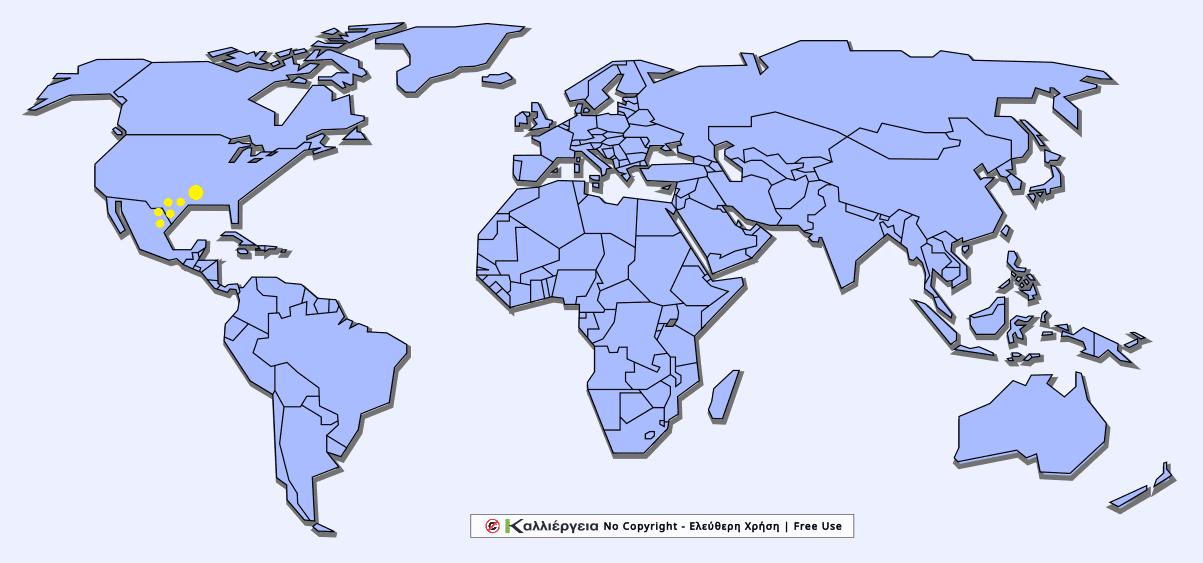
Lindheimer’s Βeeblossom is a native plant of the North American continent. Its populations are mainly located in the United States –Louisiana and Texas– as well as in the neighboring areas of North Mexico.
Its habitats are mainly black-soil prairies, pine forests and lakes banks.
Invasiveness
Without manifesting itself as an aggressive invasive plant, nevertheless, where conditions are favorable for its establishment outside of cultivation, it appears to acclimatize immediately and exhibits the behavior of a potential or actual environmental weed.
It has now established itself in several areas outside its natural range, such as:
- In North America, in the state of Alabama
- In Europe, in the Balearic Islands, Corsica, Germany, Great Britain, Greece, Italy, Portugal, and Spain
- In Africa, in Morocco, the Cape Provinces, and the Northern Provinces of the Republic of South Africa
- In Western Australia, South Australia, New South Wales, and the Australian Capital Territory, Canberra
The areas it prefers are coastal, along with disturbed roadside verges and rocky slopes, in locations that generally have excellent drainage and are fully exposed to the sun.
Life Span
The life span of Gaura is between 3 and 10 years old. To reach and sometimes exceed the decade, it must – among other favorable factors – be planted in purely sunny places.
Lindheimer’s Beeblossom (Oenothera lindheimeri or Gaura lindheimeri)
Lindheimer's Βeeblossom (Oenothera lindheimeri) - Landscape Attributes
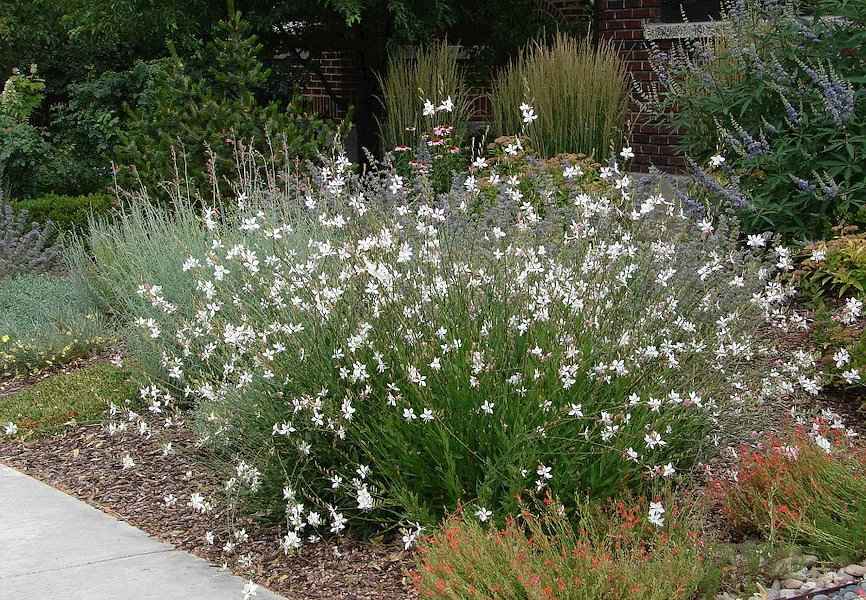
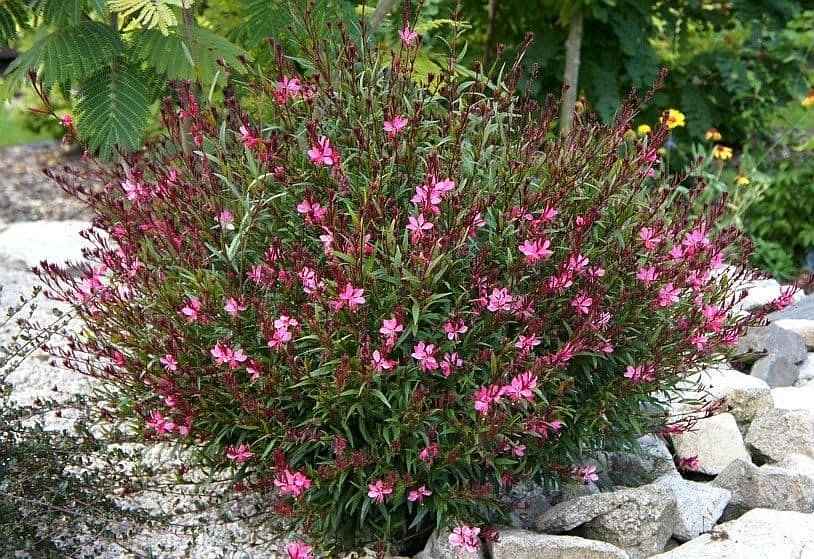
Lindheimer’s Βeeblossom is a semi-woody perennial herbaceous plant, of erect habit. Many villous stems grow from the woody central taproot, which in the flowering period are slightly arching.
Its shape is spherical-flattened or spherical, has dense foliage with a slightly irregular outline and a canopy characterized as fine-textured. It is evergreen, but if the temperature drops significantly, it loses part or all of its foliage.
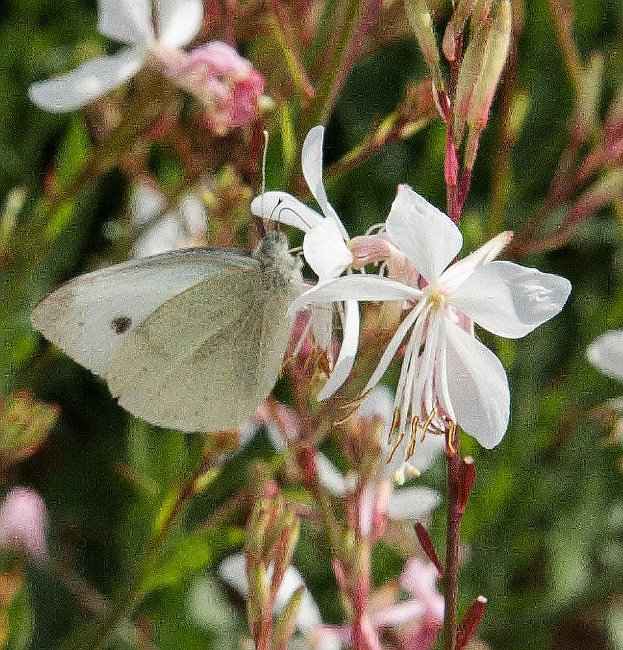
The plant’s most important attraction -and not only for butterflies and bumblebees (Bombus spp.)-, is none other than its white-pink flowers and prolonged flowering, which covers almost the entire O. lindheimeri and usually exceeds 150 days.
Lindheimer’s Beeblossom (Oenothera lindheimeri or Gaura lindheimeri)
Lindheimer's Βeeblossom (Oenothera lindheimeri) - Botanical Description
Root
Lindheimer’s Βeeblossom has a woody central taproot that goes deep, forming a powerful root system that helps it successfully with medium-term drought periods.
Stems & Twigs
The clumping, dense stems of the plant are numerous, rather thin, and villous. The color of the shoots changes depending on their age. When young, they are brownish-red, gradually turning green and then brownish-green as they mature.
Leaves
The leaves, which grow alternately on the shoots, are almost sessile or have a short winged petiole, their color is initially red and then green – sometimes purple – and it is not unusual to have dark spots, which are not a disease symptom but their normal appearance.
They are spathulate to oblong-oblanceolate, almost sinuate, slightly villous, ending in a rounded apex, with slightly dentate or serrated margins and a cuneate-shaped base.
In terms of dimensions, the leaves range in length from 3 to 9 cm and in width from 1.4 to 1.6 cm.
Flowers
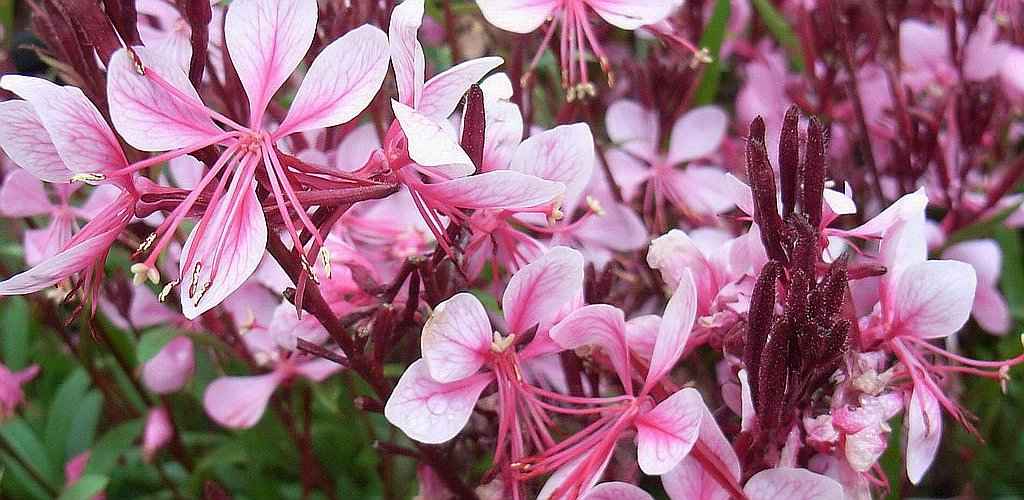
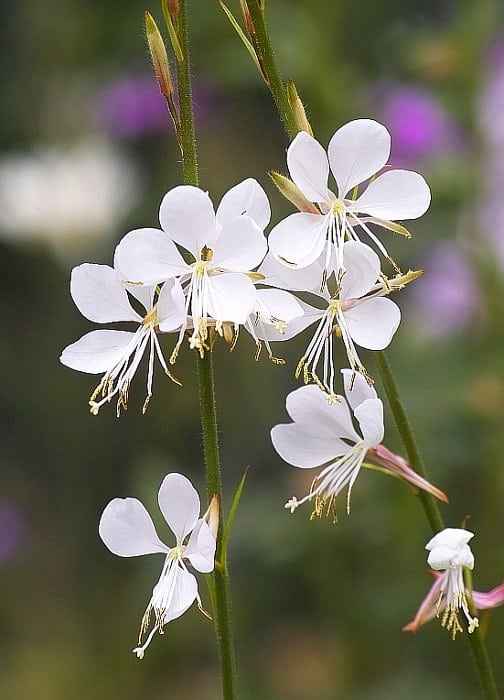
The flowers of the Lindheimer’s Βeeblossom are numerous, hermaphrodite, tetramerous, self-sterile, opening at sunrise, and measuring 1.3 to 1.5 cm (0.5-0.6 in) in length and 2.8 to 3 cm (1.1-1.2 in) in width.
They are borne on open panicles, 20 to 60 cm long, with a central peduncle 5+ cm long, which is formed on the long flower stems, 0.9 to 1.2 m long, which are smooth or more often pilose, as well as dense glandular pubescent, which have their tips pointing downwards.
The flattened, squarish in cross section, reddish top of the flower stalk (hypanthium) is also covered both externally by non-glandular and glandular hairs and internally by dense white interwoven hairs.
The sepals, usually reddish in color, are lanceolate-linear in shape, glandular pubescence, and vary in length between 12 and 15 mm. The petals are spatulate-rhomboid in shape, initially white in color, gradually turning pink, and reaching a length of 12 to 20 mm.
The 8 stamens are almost equal in length, bear red anthers, approximately 4 mm long, have filaments slightly flattened upwards, and range in length from 10 to 15 mm.
The style, which is pubescent at the base, is slightly longer than the stamens, ending in 4 lobes approximately 0.5 mm long. The inferior ovary has 4-locular structure and each locule contains 1 ovule.
Pollination
Pollination is carried out by insects (entomophilous plant) – and of course butterflies are among them.
Fruit
The fruit is an indehiscent capsule with an ellipsoid or ovoid shape, equally thin ends, and a square cross-section. It is initially green in color, turning brown or grayish-brown when ripe, and is it is subglabrous to sparsely pilose. In terms of dimensions, its length ranges from 6 to 9 mm and its width from 2 to 3.5 mm.
Seeds
Each fruit includes 1 to 4 seeds of yellowish light brown color, and seeds dimensions range from 0.2 to 0.23 cm in length and 0.1 to 0.15 cm in diameter.
Lindheimer’s Beeblossom (Oenothera lindheimeri or Gaura lindheimeri)

Lindheimer's Βeeblossom (Oenothera lindheimeri) - Climate and Soil
Temperature
The Gaura lindheimeri is a fairly hardy plant and can withstand low temperatures without damage with minimum values ranging between -17 and -20 °C.
As for the maximums, it does not face problems, even when they reach 40+ °C, as the behavior of its plants in the extremely hot Greek summers has proved.
Soil and pH
The plant grows in a variety of soil types and soils except heavy clays, provided they have excellent drainage. However, it thrives in light sandy or medium texture, deep and medium fertility soils.
In terms of soil pH, the range of values within which it can be grown is between 5.5 and 7.8, with the optimum being between 5.5 and 6.2 – ie slightly acidic to acidic soils or soil mixtures.
Exposure
The Gaura lindheimeri needs sunny places for its good growth and rich flowering, but it can also be placed in semi-shady places – especially in warmer climates – without lagging behind in performance.
Lindheimer’s Beeblossom (Oenothera lindheimeri or Gaura lindheimeri)
Lindheimer's Βeeblossom (Oenothera lindheimeri) - Pests & Diseases
In general, Lindheimer’s Βeeblossoms are not among the plants that will trouble their fans, in the fight against any pests and diseases. Nevertheless, they can be affected both by select pests and distinct diseases.
Of the former, Aphids, White Flies and various Scales can sometimes infect plants, however they are treated with timely use of appropriate insecticides.
Diseases such as Powdery Mildew and Leaf Spot, which are mainly caused by various fungi, can also infect plants, but these are also treated with timely use of appropriate fungicides.
Lindheimer’s Beeblossom (Oenothera lindheimeri or Gaura lindheimeri)
Lindheimer's Βeeblossom (Oenothera lindheimeri) - Toxicity & Allergenic Pollen
Toxicity
The Gaura lindheimeri plants are not toxic to humans and pets.
Allergenic Pollen
As the plants are entomophilous do not cause allergic reactions in the respiratory system.
Lindheimer’s Beeblossom (Oenothera lindheimeri or Gaura lindheimeri)
Lindheimer's Βeeblossom (Oenothera lindheimeri) - Varieties
Of the most popular and beloved flower plants, Lindheimer’s Βeeblossom now numbers several dozen varieties, including white, pink and red flowers, as well as varieties of two-color leaves.
Among the most remarkable are:
- Oenothera lindheimeri “Siskiyou Pink” – (Gaura lindheimeri “Siskiyou Pink”)
- Oenothera lindheimeri “Summer Breeze” – (Gaura lindheimeri “Summer Breeze”)
- Oenothera lindheimeri “Crimson Butterflies” – (Gaura lindheimeri “Crimson butterflies”)
- Oenothera lindheimeri “Belleza® Compact Light Pink” – (Gaura lindheimeri “Belleza® Compact Light Pink”)
- Oenothera lindheimeri “Blushing Butterflies™” – (Gaura lindheimeri “Blushing Butterflies™”)
- Oenothera lindheimeri “Corrie”s Gold™” – (Gaura lindheimeri “Corrie’s Gold”)
- Oenothera lindheimeri “So White” – (Gaura lindheimeri “So White”)
Lindheimer’s Beeblossom (Oenothera lindheimeri or Gaura lindheimeri)
Lindheimer's Βeeblossom (Oenothera lindheimeri) - Use in Garden and Landscape
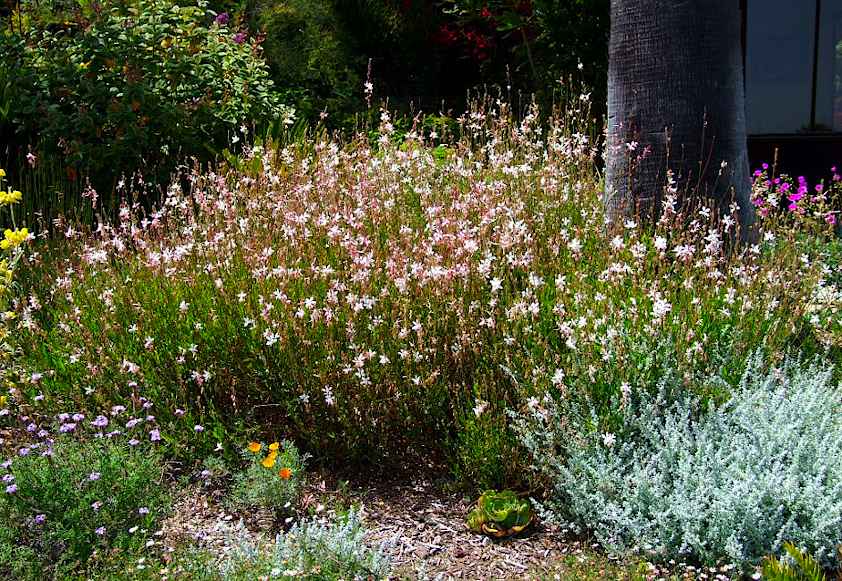
Lindheimer’s Βeeblossom is one of the most tolerant and long-lasting flowering ornamental plants.
The only limits to its use are soil and climate conditions, as well as the imagination of the designer or leisure gardener (… and the money available).
Among others, Lindheimer’s Βeeblossom can be planted:
- One among other flowering plants, always in the penultimate or last row, for the formation of mixed border
- In odd-number groups, consisting of 3, 5 or 7 plants, or among other flowering plants or alone for the formation of flowering islets.
- In rock gardens as well as general in gardens with minimal water consumption
- In xeriscape gardens
- Despite its drought resistance, in sandy pond or natural lake banks
- Combined with cacti and succulents
- In pots and containers, but large enough and in full-sun exposure
- Together with Cape Leadwort (Plumbago auriculata) and English Lavender (Lavandula angustifolia)
References
The References to the article, which deserves the railway title Lindheimer’s Βeeblossom (Oenothera lindheimeri – Gaura lindheimeri), are presented by the compatriot of the plant and Giant of the blues Louisiana Red with the song Alabama Train.
- Baldwin, D. L. (2007). Designing with Succulents. Timber Press.
- Brickell, C. (2019). RHS Encyclopedia of Plants and Flowers. Dorling Kindersley.
- Christenhusz, M. J., Fay, M. F., & Chase, M. W. (2017). Plants of the World: An Illustrated Encyclopedia of Vascular Plant Families. University of Chicago Press.
- Coombes, A. J. (2012). The A to Z of Plant Names: A Quick Reference Guide to 4000 Garden Plants. Timber Press.
- Flora of North America. (2021). Flora of North America: Volume 10, Magnoliophyta: Proteaceae to Elaeagnaceae. Oxford University Press, USA.
- Hortus Third: A Concise Dictionary of Plants Cultivated in the United States and Canada. (1997).
- Loughmiller, C., Loughmiller, L., & In Marcus, J. (2018). Texas Wildflowers: A Field Guide.University of Texas Press.
- Xu, Z., & Deng, M. (2017). Identification and Control of Common Weeds: Volume 2. Springer Netherlands.
Oenothera lindheimeri: USDA Plants Database
Clarification
Of course, it is needless to say – but we will emphasize it – that in this handmade website, no article has been and will not be written with recourse to Artificial intelligence (AI). Natural Intelligence, that is, as much of it as we have and for as long as we are allowed to have it, is enough for us.
Sharing
The use of the material, where third-party rights are not mentioned or implied (such as photos or audiovisual files - with the exception of those belonging to "Kalliergeia"), is absolutely free. Its sharing, possibly, useful.