Ficus lyrata, the Fiddle Leaf Fig Tree, also belongs to the hideous Ficus Great of Stranglers Genus.
This abominable fact, however, in no way frightened or deterred its other partner and co-partner on this planet, the Homo Genus to corrected it, making extensive use of it as a decorative plant.
Of course, the truth is that Ficus lyrata also showed character: it accepted its reformation and by doing its best it became one of the most widely used ornamental plants in the world.
The editorial team of “Kalliergeia” – leaving aside any reservations and/or prejudices about the abominable side of the plant – decided to deal in this article with the presentation of the ornamental aspect of Ficus lyrata.
Let others, more qualified, competent and knowledgeable about the subject, deal with the strangler side.
In the meantime, the above team categorically refutes any correlation between the observed increase in the demand for Phytiatrists – Plant Therapists (and also Psychiatrists) and members of the abominable genus of strangler Ficus.
Ficus lyrata (Fiddle Leaf Fig Tree) – Description and Uses
Fiddle Leaf Fig Tree Origin

Ficus lyrata (Fiddle Leaf Fig Tree) – Description and Uses
Ficus lyrata (Fiddle Leaf Fig Tree) - Brief Description
Family: Moraceae
Genus: Ficus
Scientific name: Ficus lyrata Warb.
Synonym: Ficus pandurata Sander
Common name(s): Fiddle Leaf Fig, Fiddle Leaf Fig Tree, Fiddleleaf Fig, Banjo Fig
General Characteristics
Leaf Persistence
Evergreen
Form
Tree of Round Canopy Shape
Texture
Coarse
Growth Rate
Fast / Indoors: Moderate
Flowering Period (Tropics)
Aprill – June
Fruiting Period
Summer
Height
8-15 m (26-50 ft) Indoors: 0.90-3 m (3-10 ft)
Diameter
8-10 m (26-32 ft) Indoors: 0.90-3 m (3-10 ft)
Shapes and Colours
Leaves Shape
Obovate
Foliage Colour
Green
Autumn Foliage Colour
Green
Flowers Shape
Syconium
Flowers Colour
Green
Fruit
Fig
Plantation
Soil Type: Well-drained, sand, loam, clay
Exposure: Sun, Half-shade
Soil pH: 6-7
Watering: Moderate
Hardiness: 1.7 °C (35 °F – USDA Hardiness Zone 10b)
Uses
In parks, gardens, as well as in indoor and outdoor pots and planters.
Ficus lyrata (Fiddle Leaf Fig Tree) – Description and Uses
Ficus lyrata (Fiddle Leaf Fig Tree) - Etymology
Etymology of the Genus Name
The name of the genus Ficus is the Latin name of Fig and the Fig Tree. The word comes from Ancient Greek ‘σῦκον’, which is presumed to have a Semitic origin, since Phoenician ‘𐤐𐤀𐤂’ means‘half-ripe fig’.
Etymology of the Species Name
The name of the lyrata species has an artistic hue since it is the New Latin version of the Ancient Greek word ‘λύρα’ – lyre, the homonymous musical instrument.
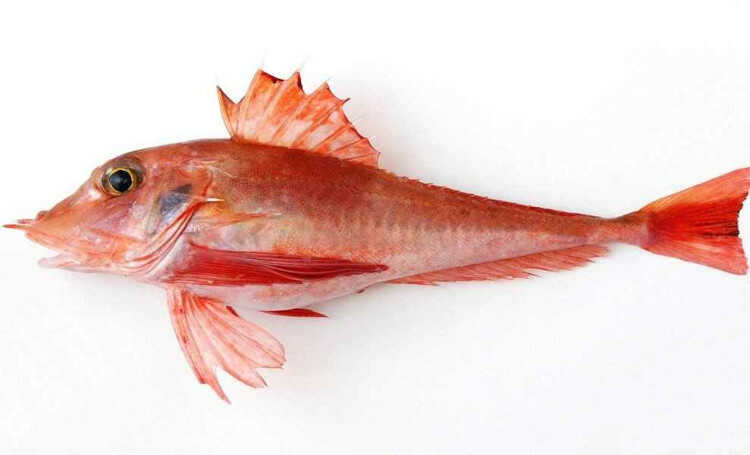
Of course, we should mention here that perhaps beyond the artistic, the word also has a gastronomic hue, since by the word ‘λύρα’ Ancient Greeks also called the delicious fish Trigla lyra, piper gurnard, a triglid fish. Apparently the name of the lyrata species, is extremely attributable to the shape of the leaves of the plant, as well as the lyra, the dorsal and abdominal fin of the piper gurnard.
Ficus lyrata (Fiddle Leaf Fig Tree) – Description and Uses
Ficus lyrata (Fiddle Leaf Fig Tree) - Origin & Life Span
Origin
Ficus lyrata‘s cradle is considered to be the tropical zone of Western and Central Africa. It is found mainly from Cameroon to Sierra Leone in the lowland rainforests and is developed in a variety of soil types and exposures. In its natural niches, the average monthly upper temperature is 30 °C (86 °F), while the average annual rainfall is between 1000 and 2000 mm.
Life Span
Fiddle Leaf Fig Tree in the wild lives more than 50 to 70 years. Conversely, in captivity as an indoor plant, it lives from 10 to 20 years, while in the warmer areas of the subtropical zone, when planted in the garden, lives from 25 to 50 years.
If it could choose, it would most likely choose the first case.
Ficus lyrata (Fiddle Leaf Fig Tree) – Description and Uses
Ficus lyrata (Fiddle Leaf Fig Tree) - Landscape Attributes
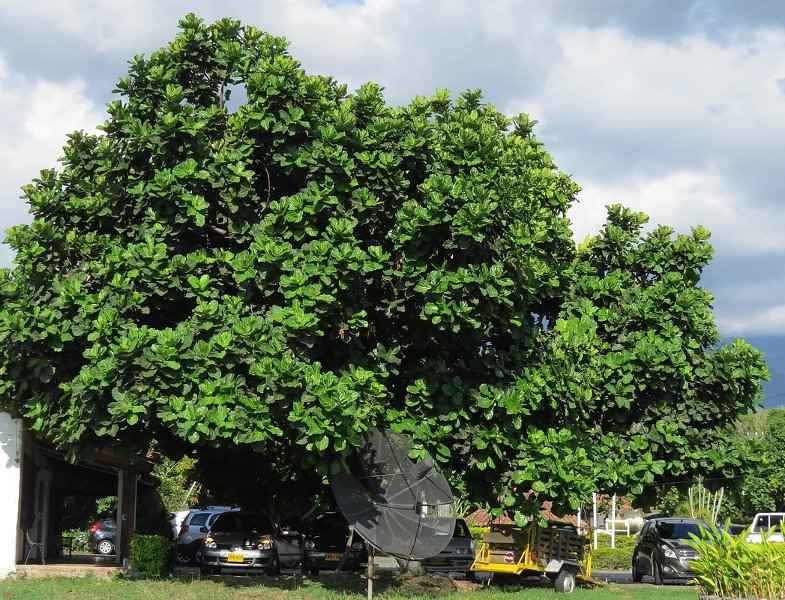
Fiddle Leaf Fig Tree is an evergreen large tree of fast growth rate, when it is in the natural, with a height that often exceeds 25 m (82 ft). When grown, the annual growth rate is moderate and does not exceed 15 m high (50 ft).
It consists usually of a single trunk and a canopy of spherical or hemispherical shape, which is symmetrical with an irregular outline. Its foliage, of coarse texture, is dense, and has an upright or spreading appearance. As an indoor plant it gets significantly smaller dimentions and has rather upright appearance.
Ficus lyrata (Fiddle Leaf Fig Tree) – Description and Uses
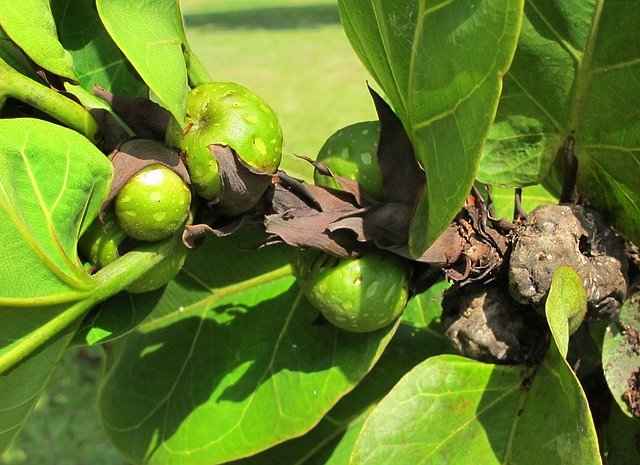
Ficus lyrata (Fiddle Leaf Fig Tree) - Botanical Description
Roots
Ficus lyrata is a typical epiphyte plant. It grows on the branches of various tropical tree species and develops aerial blastogenic roots, that penetrate the soil. The aerial part of these roots becomes trunkish ‘strangling‘ the host tree.
Trunk
In its natural state it has single or many trunks and very rough bark of dark greyish brown color.
Branches & Twigs
They are spreading or upright, thick, having a redish brown color which when matured becomes greyish brown.
Leaves
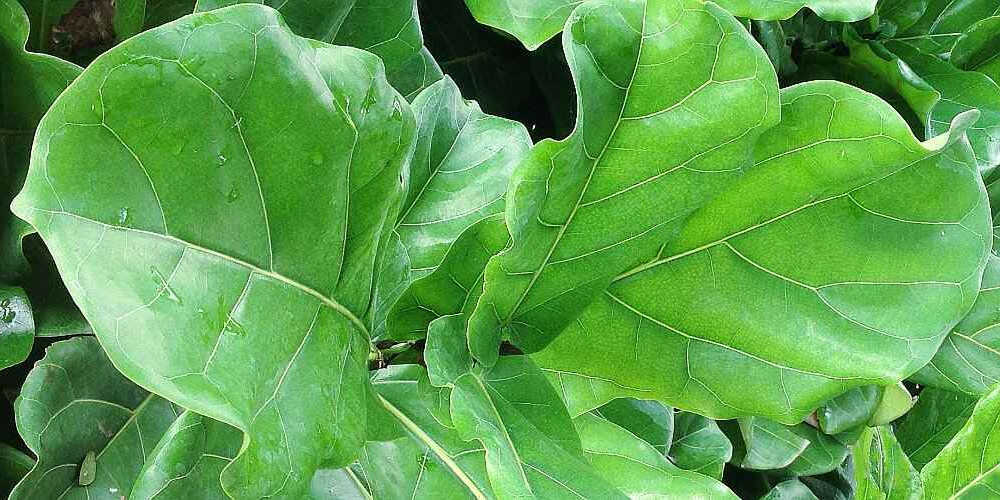
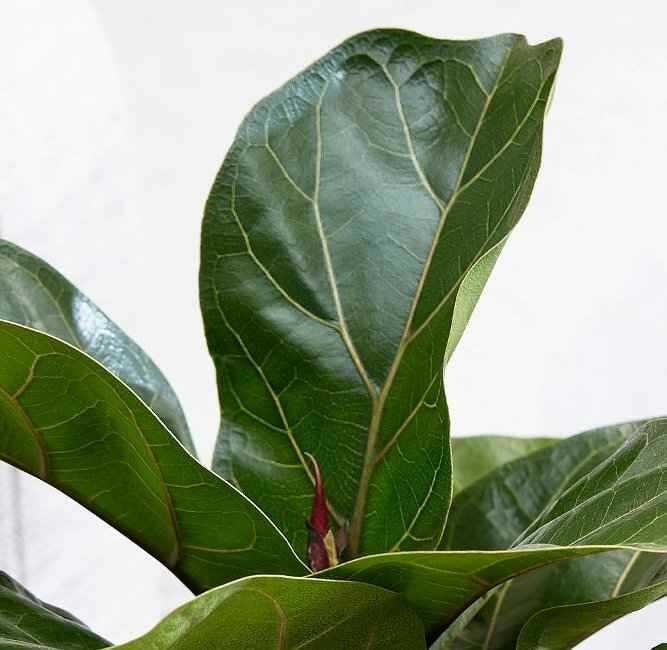
The grooved petiole is thick and glabrous, with a length of between 2 and 5 cm (0.8-2 in). The lamina is large, simple and leathery, nice green in color.
The leaves are relatively thick and have a pronounced reticulate venation, consisting of a strong midrib and 8 to 10 second order veins.
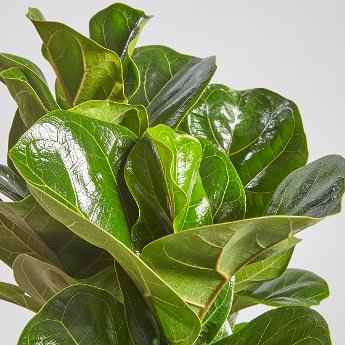
Their shape is similar to a lyre or a fiddle, obovate with a pair of sinuous indentations near the base, and are mainly arranged alternately while their length being between 15 and 30 cm (6-12 in) and their width between 12 and 20 cm (4.7-7.8 in).
Flowers
The flowers are produced in theinterior of an axillary inflorescence. The males consist of 2 to 3 sepals of ovate-lanceolate shape and bear a solitary stamen with ovoid anther. The females consist of 3 ovate-shaped sepals and have a short style with papillate stigma.
Pollination
Fiddle Leaf Fig Tree is exclusively pollinated by the wasp Agaon spatulatum.
Fruit
The achene is the fruit of Ficus lyrata, which is within the special fleshy stem of all the Ficus, the syconium, that consists of plethora achenes.
Ficus lyrata (Fiddle Leaf Fig Tree) – Description and Uses
Ficus lyrata (Fiddle Leaf Fig Tree) - Climate and Soil
Temperature
Ficus lyrata, as another plant of the tropical regions, is cold intolerance. The minimum temperatures, which are also the lowest tolerance limit, range between 4 and 1.7 °C (40-35 °F). With high temperatures, Fiddle Leaf Fig Tree’s behavior is excellent as it does not have particular problems.
In its natural niches grows in areas where temperatures range from 20 °C (68 °F) the minimum and 30 °C (86 °F) or more the maximum.
Soil and pH
Ficus lyrata grows in all soil types, ranging from light sandy to heavy clay soils, provided they drain well but at the same time retain the necessary moisture. However, well-established Fiddle Leaf Fig Trees have high drought tolerance.
In terms of pH, it grows in a range of values ranging from 6 to 7, but it thrives on slightly acidic soils with values ranging from 6 to 6.5.
Exposure
Fiddle Leaf Fig Tree seeks full exposure to sun and/or half-shade. When grown as an indoor plant it is recommended to place it in bright places.
Ficus lyrata (Fiddle Leaf Fig Tree) – Description and Uses

Ficus lyrata (Fiddle Leaf Fig Tree) - Pests & Diseases
Ficus lyrata is generally not affected by pests and diseases. Some (or a lot of) parasites, however, can sometimes create problems.
Pests
Immediately below are recorded the most important pests of Fiddle Leaf Fig Tree.
Various Insects
- Aleurodicus dispersus
- Aphis fabae
- Bemisia tabaci (Silverleaf whitefly)
- Dialeurodes citri (Citrus Whitefly)
- Gynaikothrips ficorum (Laurel Thrips, Cuban Laurel Thrips)
- Hercinothrips femoralis (Banded Greenhouse Thrips)
- Metcalfa pruinosa (Frosted Moth-Bug)
- Opogona sacchari (Banana Moth)
- Parthenothrips dracaenae (Palm Thrips)
- Toxoptera aurantii (Camellia Aphid)
- Singhiella simplex (Fig Whitefly)
Scales
- Ceroplastes rusci (Fig Wax Scale)
- Coccus hesperidum (Brown Soft Scale)
- Hemiberlesia palmae (Tropical Palm Scale)
- Icerya seychellarum (Seychelles Scale)
- Parasaissetia nigra (Pomegranate Scale)
Mealybags
- Pseudococcus calceolariae (Citrophilus Mealybug)
- Pseudococcus longispinus (Long-Tailed Mealybug)
Acari
- Allonychus reisi
- Tetranychus urticae (Red Spider Mite)
- Panonychus ulmi (European Red Spider Mite)
Nematodes
- Aphelenchoides fragariae (Strawberry Crimp Nematode)
- Meloidogyne incognita (Southern Root-Knot Nematode)
► By using the appropriate insecticides and acaricides, their treatment is from satisfactory to difficult, except for nematodes, which are very difficult to control.
Diseases
After the pests, the recording of the diseases follows.
Fungi
- Athelia rolfsii– Sclerotium rolfsii (Southern Blight, Sclerotium Rot)
- Botrytis cinerea (Gray Mold, Botrytis Brown Stain)
- Corynespora cassiicola (Target Leaf Spot of Tomato)
- Glomerella sp. (Anthracnose)
- Myrothecium roridum (Blight: Eggplant)
- Phytophthora sp. (Phytophthora Root and Crown Rots, Buckeye Rot, Phytophthora Blights)
- Phomopsis sp. (Twig Dieback)
- Pythium sp. ( Pythium Root and Stem Rot)
- Rhizoctonia solani (Belly Rot)
Bacteria
- Agrobacterium tumefaciens (Crown Gall)
- Pseudomonas cichorii
- Xanthomonas campestris (Bacterial Leaf Spot)
► By using the appropriate fungicides the treatment of the former is from satisfactory to difficult, while the bacterium of the plant is extremely difficult to control.
Ficus lyrata (Fiddle Leaf Fig Tree) – Description and Uses
Ficus lyrata (Fiddle Leaf Fig Tree) - Toxicity & Allergenicity
Toxicity
Ficus lyrata is not toxic to humans and pets as long as they do not come into contact with the milky sap. In this case, skin irritation or rash may occur.
Respiratory Allergies
People with a history of asthma are likely to develop allergic reactions, when the sap get on dust particles and fly throughout the house or office.
Ficus lyrata (Fiddle Leaf Fig Tree) – Description and Uses
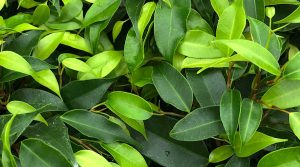
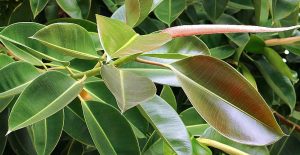
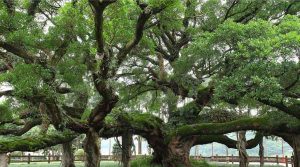
Ficus lyrata (Fiddle Leaf Fig Tree) - Varieties & Cultivars
The most widespread ornamental form of the plant is that of the typical species. However, Fiddle Leaf Fig Tree does not lack cultivars and varieties.
Fiddle Leaf Fig Tree Varieties
Ficus lyrata 'Suncoast'
It is a variety that is more tolerant to cold than the typical species. The minimum temperature at which it can be exposed without damage is -1,1 °C (30 °F). In terms of dimensions, it reaches the height of 3 to 4 m (9-12 ft) while its diameter varies between 2 and 3 m (6-9 ft).
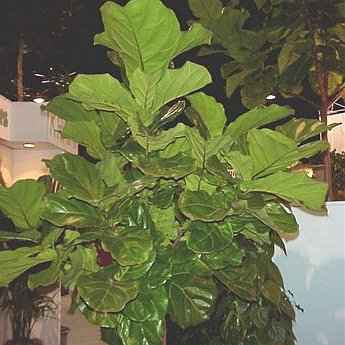
Ficus lyrata ‘Compacta’
As its name implies, it has a compact appearance. It is a slower growth rate than the typical species, which means that transplantation needs to be done in less time. Its dimensions, if planted outdoors, are 8 to 10 m (26-32 ft) in height and 6 to 8 m (20-26 ft) in diameter.
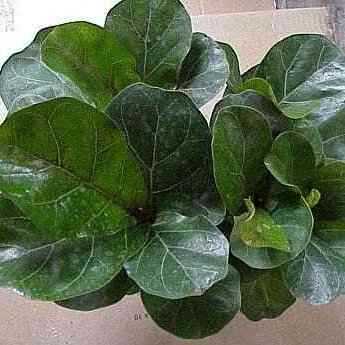
Ficus Lyrata ‘Bambino’
Extremely compact variety derived from natural mutation of the parent plant, which was grown in the Dutch De Wilgenlei nursery. Its leaves are more obovoid in shape than that of the Lyra, while their dimensions range from 14 to 21 cm (5.5-8.2 in) in length, with a width of 13 to 18 cm (5-7 in).
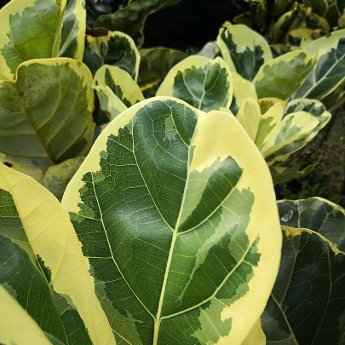
Ficus lyrata 'Variegated’
This is a highly decorative variety with leaves that have yellow-creamy edges. It is also of a slow growth rate.
Ficus lyrata (Fiddle Leaf Fig Tree) – Description and Uses

Ficus lyrata (Fiddle Leaf Fig Tree) - Use
Use as an Indoor Plant
And Fiddle Leaf Fig Tree is one of the most popular plants for decorating the interior of both homes and professional spaces. Its impressive large leaves and the relative ease of maintenance advocate it. What they do not advocate is its use as a plant that filters and purifies the air. That writing or saying about such a kind of use is scientifically totally unfounded.
Use in Garden and Landscape
In areas suitable for its growth, it can be planted both on the ground and in pots at sunny or half-shade exposures.
So, it could be said that Ficus lyrata is being exploited:
-
As a srhub of particular interest planted alone
-
In urban plantings of parks, highways median and streets without sidewalk as it withstands the overwhelming atmosphere of the cities
-
As a shade tree
In combination with other more or less exotic plants such as Crotons (Codiaeum variegatum), Gardenia Bushes (Gardenia jasminoides), Dwarf Powderpuff (Calliandra emarginata) and Star Jasmine (Jasminum nitidum)
References
The References of the musical tone article entitled Ficus lyrata (Fiddle Leaf Fig Tree) – Description and Uses (… and Psychiatrist’s taking sick leave) are presented by the band Talking Heads with their song Psycho Killer.
- Bajaj, Y. (2010). Trees III.Berlin: Springer-Verlag Berlin and Heidelberg GmbH & Co.
- Bailey, F., & Alleyway, Z. (2018). Practical House Plant Book: Choose Well; Display Creatively; Nurture and Maintain; 175 Plant Profiles. DK.
- Burrows, J. E., & Burrows, S. (2003). Figs of Southern & South-Central Africa. Hatfield, South Africa: Umdaus Press.
- Coombes, A. J. (2012). The A to Z of Plant Names: A Quick Reference Guide to 4000 Garden Plants. Timber Press.
- Goodman, R. (Ed.). (2004). Encyclopedia of Plant and Crop Science. Routledge.
- Knight, A. (Ed.). (2007). A Guide to Poisonous House and Garden Plants. CRC Press.
- Lansky, E. P., & Paavilainen, H. M. (2010). Figs: The Genus Ficus. CRC Press.
- Kunkel, G. (1978). Flowering Trees in Subtropical Gardens. Dordrecht: Springer Netherlands.
- Steinkopf, L. E. (2019). Houseplants (mini): A Guide to Choosing and Caring for Indoor Plants. Cool Springs Press.
- Ficus lyrata: NC State University Extension
Clarification
Of course, it is needless to say – but we will emphasize it – that in this handmade website, no article has been and will not be written with recourse to Artificial intelligence (AI). Natural Intelligence, that is, as much of it as we have and for as long as we are allowed to have it, is enough for us.
Sharing
The use of the material, where third-party rights are not mentioned or implied (such as photos or audiovisual files - with the exception of those belonging to "Kalliergeia"), is absolutely free. Its sharing, possibly, useful.