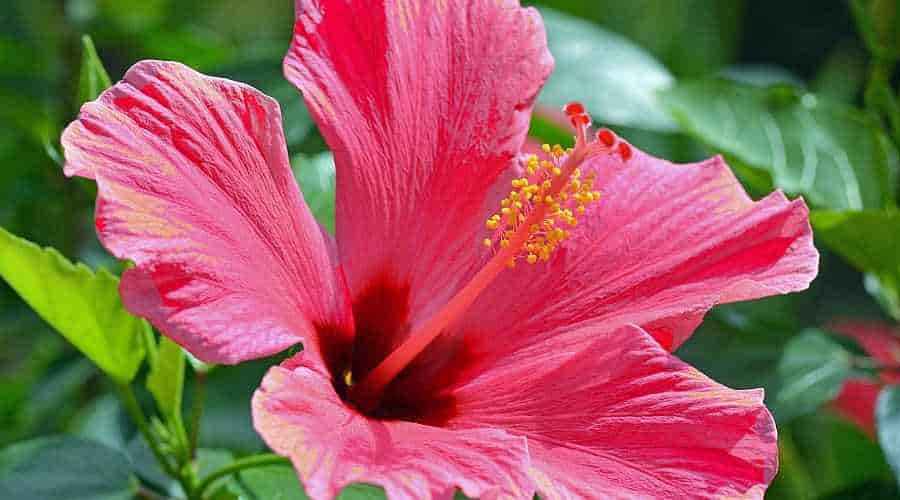
Chinese Hibiscus (Hibiscus rosa-sinensis) belongs to that great group of plants that are not tired of blooming. And blooming unfolds a huge colorful flower range in the most unexpected shapes.
The following article gives the opportunity to present this plant, whose flower – amongst others – is also the Malaysian national symbol.
This great event led the editorial team of ‘Kalliergeia’ to indulge on the topic of symbols and to deepen.
So its came to the conclusion that should publicly state its point of view on a matter that was of great concern to it: the topic – the issue – is about the flag of the of the European Union countries.
The editorial team of ‘Kalliergeia’ therefore proposes as in position of the flag stars get flowers. More specifically, the flowers of another very popular and widespread Hibiscus species, Hibiscus esculentus L. – that is, Okra.
We have the firm belief that this will be perfectly worthy of what the present European Union represents and advocates.
Chinese Hibiscus (Hibiscus rosa-sinensis)
Chinese Hibiscus Origin
Chinese Hibiscus (Hibiscus rosa-sinensis)
Chinese Hibiscus (Hibiscus rosa-sinensis) - Brief Description
Family: Malvaceae
Genus: Hibiscus
Scientific name: Hibiscus rosa-sinensis L.
Common name: Chinese Hibiscus, Tropical Hibiscus, China Rose, Hawaiian Hibiscus, Shoe Flower
General Characteristics
Leaf Persistence
Evergreen
Form
Vase Shape Shrub
Texture
Medium
Growth Rate
Fast
Flowering Period (Tropics)
Year Round
Fruiting Period
Year Round
Height
3-5 m (9.8-16.4 ft)
Diameter
1.5-3 m (4.9-9.8 ft)
Shapes and Colours
Leaves Shape
Ovate
Foliage Colour
Green
Autumn Foliage Colour
Green
Flowers Shape
Funnel-Shaped
Flowers Colour
Red
Fruit
Brown Capsule
Plantation
Soil Type: Well-drained, sand, loam
Exposure: Sun
Soil pH: 6-7.5
Watering: Moderate
Hardiness: 1.7 °C (35 °F – USDA Hardiness Zone 10b)
Uses
In parks, squares, gardens, pots and containers indoors and outdoors
Chinese Hibiscus (Hibiscus rosa-sinensis)
Chinese Hibiscus (Hibiscus rosa-sinensis) - Etymology
Etymology of the Genus Name
The name of the genus Hibiscus is a Latin word derived from the Ancient Greek Ιβίσκος. With this name described the plant Althea (Μολόχα) the important Greek physician and botanist of the 1st CE century Dioscorides, who originated in Tarsus of Cilicia – a city of Turkey located very close to the borders of the once prosperous and now – at the time of writing – unfortunately still martyr Syria. The word Ιβίσκος itself, on the other hand, is of unknown etymology, while it is speculated that it has Pre-Greek origins.
Etymology of the Species Name
The name rosa – sinensis is a Neo-Latin phrase that is composed – that’s amazing! – by the words rosa and sinensis. The word rosa derives its origin from the Spanish rosa, which comes from Latin rosa, which comes from Ancient Greek ῥόδον and means rose.
The second word sinensis comes from Ancient Greek Σῖναι, which probably originates from the Sanskrit word चीन and means China. That is, the name of the species rosa – sinensis is finally translated as China rose or rose of China.
At this point, the editorial team of ‘Kalliergeia’ feels the urgent need to state that the botanical name of the species is one of the most misplaced in the history of the scientific name of the plants. And the reason will be apparent from the following writing.
Chinese Hibiscus (Hibiscus rosa-sinensis)
Chinese Hibiscus (Hibiscus rosa-sinensis) - Origin & Life Span
Origin
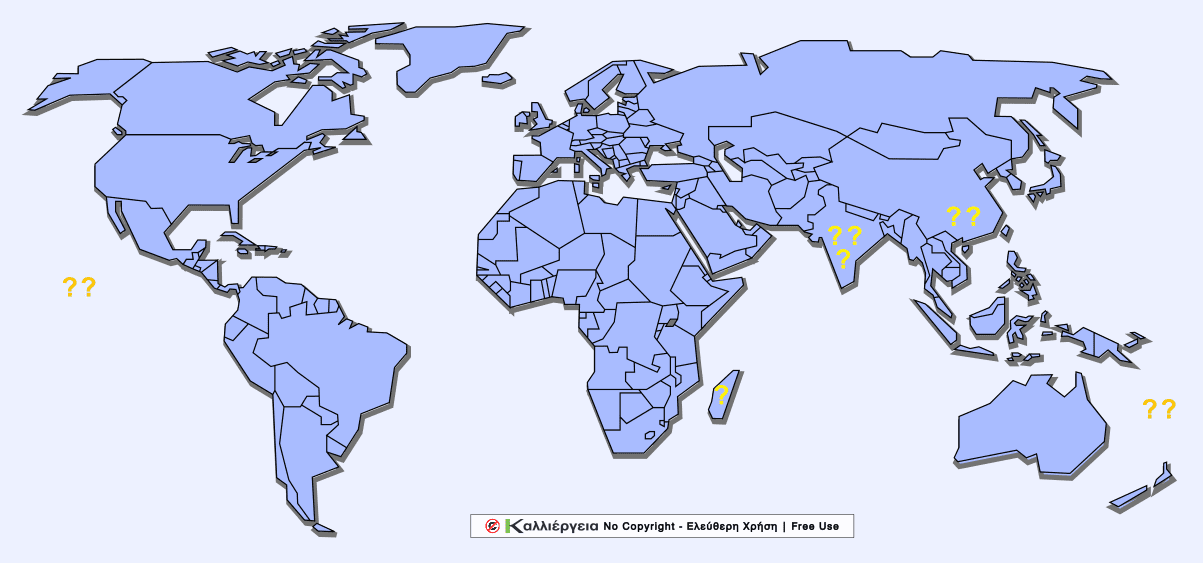
Although it is called China rose or rose of China, Chinese Hibiscus neither rose nor Chinese it is – exclusively. In all probability it is and Chinese, and East Indian, and East African and most of the tropical areas around the Equatorial Line, with the exception of the sea.
In other words, this amazing bush with the beautiful flowers is of unknown origin.
Life Span
Tropical Hibiscus, planted in the appropriate soil-climate environment, can become one of the best friends of man. It lives a little longer than the dog, often exceeding the age of 50, and unlike the dog it does not bite.
Chinese Hibiscus (Hibiscus rosa-sinensis)
Chinese Hibiscus (Hibiscus rosa-sinensis) - Landscape Attributes
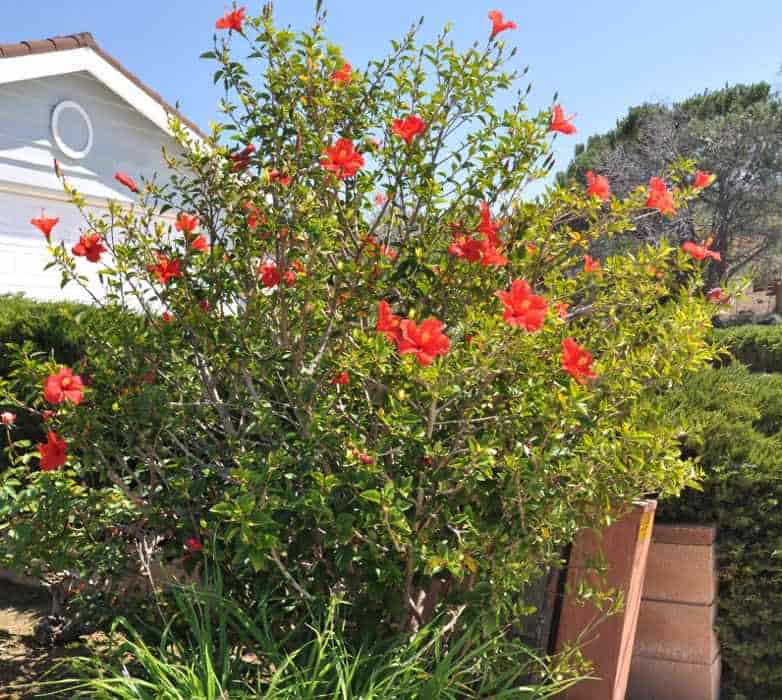
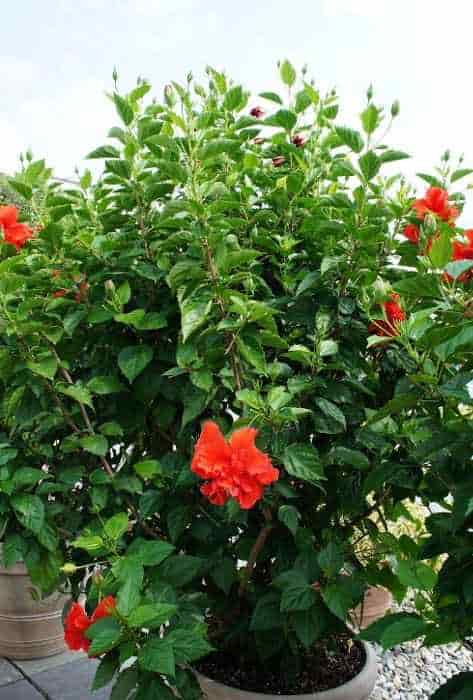
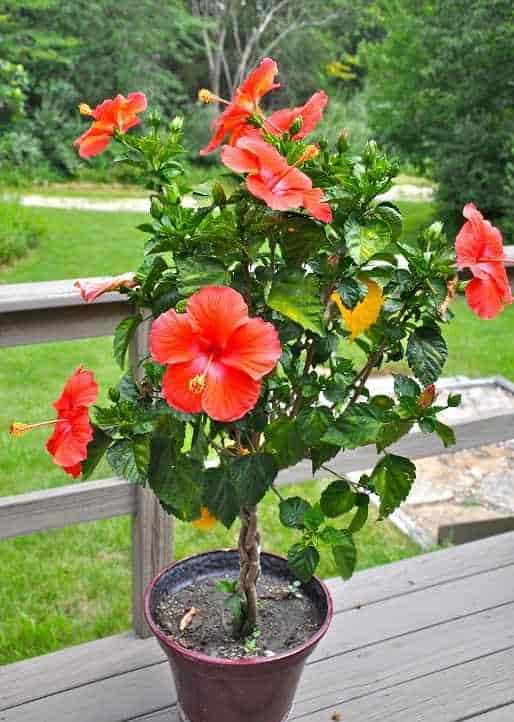
Chinese Hibiscus is an evergreen (in tropical) perennial vase-shaped shrub, of rather upright habit. With the appropriate prunings however, it can be formed into a small tree with one or more trunks.
Its canopy is symmetrical, of medium textured and density. And the canopy of the plant with the appropriate pruning can take shapes other than the natural – although its usual formed as spherical.
The dominant decorative feature of the plant is its red flower, which appears, of course, during the plant’s long (in favorable conditions) flowering period, which lasts for 120 days or more.
Chinese Hibiscus (Hibiscus rosa-sinensis)
Chinese Hibiscus (Hibiscus rosa-sinensis) - Botanical Description
Shoots & Twigs
The shoots of the plant are mainly vertical. At young age, the twigs, are medium-thick, slightly pubescent and reddish. The mature shoots are hairless and covered with greyish-brown bark.
Leaves
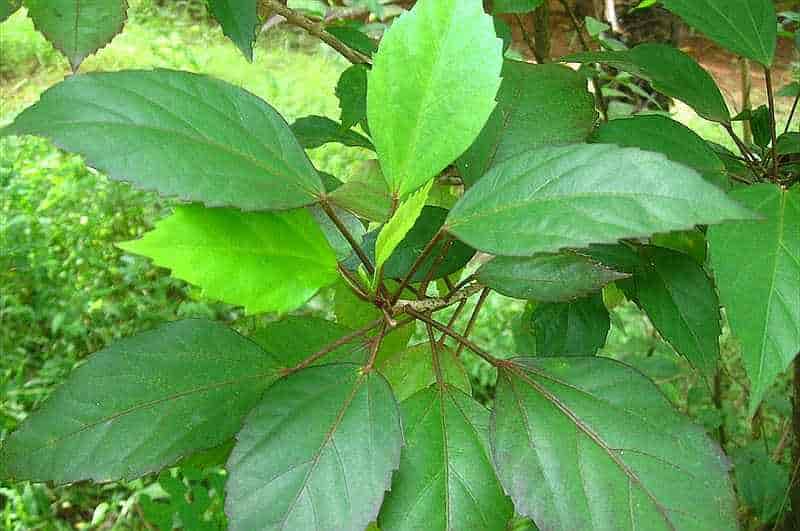
The leaves are simple, bright green coloured, with few minute hairs on the nerves beneath. They are arranged alternately on the shoots and are oval-shaped. They lead to a acuminate apex and have smooth margins at the base and serrate at the rest of the section. The length of leaves varies between 4 and 13 cm (1.57-5.11 in), while their width is between 2 and 7 cm (0.78-2.75 in).
Flowers
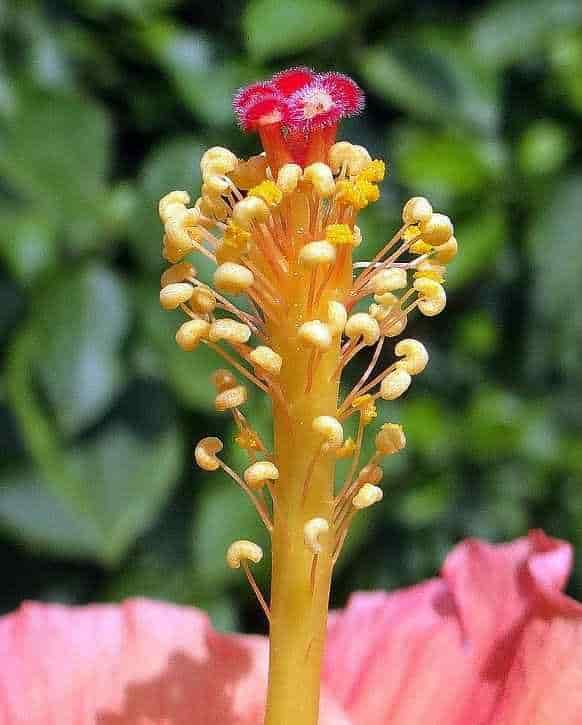
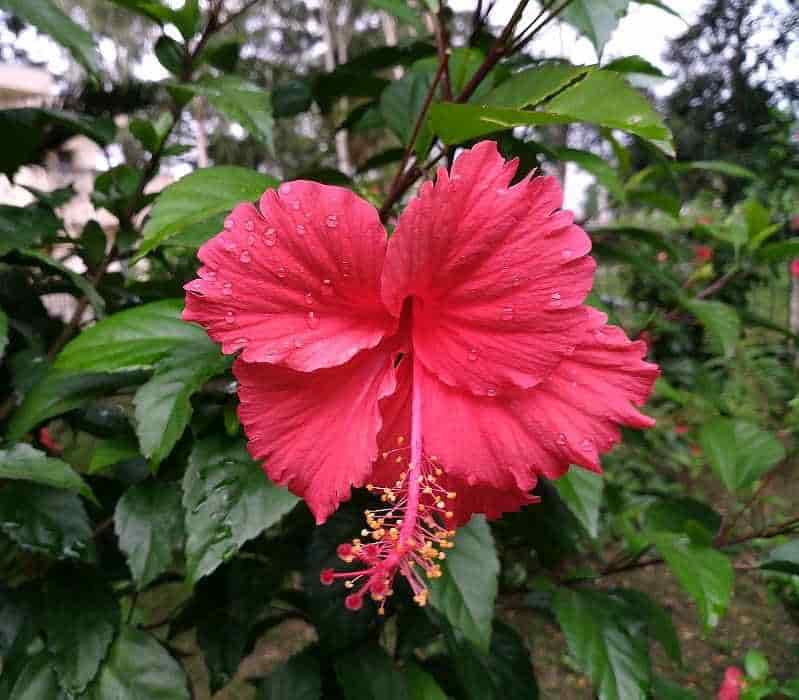
Tropical Hibiscus has single, hermaphrodite, funnel-shaped flowers. They are usually erect in the axillary of the leaves and are restrained by a pedicle of length 1 to 7 cm (0.4-2.75 in). The calyx has a bell-shaped morph and consists of 5 light green coloured sepals.
The corola is formed by 5 wrinkled petals and is 4 to 10 cm (1.57-3.93 in) wide. The petals have are obovate, clawed with an obtuse apex and with crenate margins.Their length ranging from 5 to 9 cm (1.96-3.54 in) and their width from 3 to 7 cm (1.18-2.75 in).
Pollination
Pollination occurs mainly by birds and secondarily by insects – the latter include of course bees and butterflies.
Fruit & Seeds
The fruit of Chinese Hibiscus is an oval shaped five-cell capsule. It is smooth, bears numerous seeds, has a brown color and a length of between 2 and 2.5 cm (0.78-0.98 in).
Chinese Hibiscus (Hibiscus rosa-sinensis)
Chinese Hibiscus (Hibiscus rosa-sinensis) - Climate & Soil
Temperature
Tropical Hibiscus does not tolerate low temperatures. The minimum temperatures, which are also the lowest strength limit, range between 4 to 1,7 °C (40-35 °F). Of course fully established trees can, for a short time, tolerate temperatures of 0 to -4 up to -6 °C (32 to 24.8 up to 21.2 °F), with manageable damages.
At high temperatures the plant’s behavior is excellent. AHS classifies the plant in zones 6-11 and indeed, temperatures often reaching 40 °C (104 °F) have no negative effect on the plant except one: flowering stops. And it stops because Hibiscus blooms at temperatures ranging between 18 and 28 to 32 °C (64.4 and 82.4 to 89.6 °F).
Soil and pH
Chinese Hibiscus growing in a variety of soil types provided they drain well. Soils that water logged should be avoided or added sand or other similar materials to improve their structure. Fertile, loam sandy and loam soils are best suited for Hibiscus planting. For pot plants optimum soil mixture consisting of 2 parts excellent quality potting soil, 1 part peat moss, 1 part compost neutral pH and 1 part perlite or zeolite.
As for pH, it grows in a range of values ranging from 6 to 7.5, but prefers slightly acidic soils with values ranging from 6.5 to 6.8.
Exposure
Tropical Hibiscus (Hibiscus rosa-sinensis) is always planted in full sun exposure. Even when grown as an indoor plant, extraordinarily bright places should be selected.
Chinese Hibiscus (Hibiscus rosa-sinensis)
Chinese Hibiscus (Hibiscus rosa-sinensis) - Care
Fertilization
Chinese Hibiscus fertilization is carried out from beginning of spring until the beginning of autumn. Can be used a complete fertilizer with main elements N-P-K in a ratio of 1: 1: 1.5 (12-12-17) or 1: 1:1 (20-20-20). Administration is done once, if it is controlled release, or in doses at a frequency of 1 every 15 to 20 days.
The indicative total amount of administration for adult shrubs is 150 to 300 gr (0.33 – 0.66 lb). The 1/3 of the quantity is given by the first application, while over the same period, administration of Magnesium Sulphate is necessary. No other fertilization required after the beginning of autumn.
Regarding the organic matter of the soil, it is recommended to add 25 to 50 liters of neutral pH compost per plant in late autumn with early winter.
Irrigation
Tropical Hibiscus needs systematic irrigation for satisfactory flower production but also for covering the water needs of the plant in general. That is why in no case is the soil allowed to dry. The same applies to the soil mixture in potted plants.
Pruning
In general, systematic pruning is beneficial for the plant, whether it is shrubby or tree-like. However, more information on pruning Chinese Hibiscus can be found by the legendary patient reader of “Kalliergeia” in another future feature, which we promise to do -by the conspicuous (in)consequence that distinguishes us- on this topic exclusively.
Chinese Hibiscus (Hibiscus rosa-sinensis)

Chinese Hibiscus (Hibiscus rosa-sinensis) - Pests & Diseases
Chinese Hibiscus has some problems from pests and diseases. In most cases, the issue is rather aesthetic but there are also some that can become a major problem.
Pests
Immediately below are recorded the most important pests of the plant.
Various Insects
- Aleurodicus dispersus (Spiralling Whitefly)
- Aleurodicus dugesii (Giant Whitefly)
- Aphis sp. (Aphids)
Acari
- Tetranychus urticae (Red Spider Mite)
- Oligonychus ilicis (Southern Red Mite)
Scales
- Pinnaspis strachani (Lesser Snow Scale)
- Paratachardina pseudolobata (Lobate Lac Scale)
Mealybugs
- Phenococcus solenopsis (Cotton Mealybug)
- Paracoccus marginatus (Marginal Mealybug)
- Ferrisia virgata (Spotted Mealybug)
► By using the appropriate insecticides and acaricides their treatment is satisfactory.
Diseases
After the pests, the recording of the diseases follows.
Fungi
- Phyllosticta dioscoreae
- Phytophthora nicotianae (Black Shank)
Bacteria
- Pseudomonas syringae pv. hibiscus(Bacterial Leaf Spot)
- Pseudomonas syringae pv. syringae (Bacterial Canker)
- Pseudomonas cichorii (Bacterial Blight Of Endive)
► By the timely use of appropriate formulations the treatment of fungi is satisfactory, while the control of bacteria is extremely difficult.
Chinese Hibiscus (Hibiscus rosa-sinensis)
Chinese Hibiscus (Hibiscus rosa-sinensis) - Toxicity & Allergenic Pollen
Toxicity
Chinese Hibiscus is not toxic to humans and pets. However, direct skin contact with plant parts of Tropical Hibiscus may cause dermatitis, irritation or skin rash in people with plant sensitivity.
Allergenic Pollen
As an entomophilous plant, it does not cause allergic respiratory reactions with its pollen.
Chinese Hibiscus (Hibiscus rosa-sinensis)
Chinese Hibiscus (Hibiscus rosa-sinensis) - Varieties
Chinese Hibiscus is an extremely widespread species both as a garden and landscape plant and as an indoor plant. This makes it easy to understand how the varieties number a few thousand, which implies that no sane writer or editorial team would attempt to record them all.
Instead, a writer or editorial team renowned for their acumen and ingenuity would choose just 20 varieties. The patient ‘Kalliergeia’ reader will probably understand what editorial team we are talking about – for the writer we have no idea.
The Varieties of the Chinese Hibiscus (Hibiscus rosa-sinensis)
Varieties with Variegated Leaves
- Hibiscus rosa-sinensis ‘Tricolor’ (syn. ‘Cooperi’)
- Hibiscus rosa-sinensis ‘Snow Queen’
- Hibiscus rosa-sinensis ‘Red Hot’
Varieties with Red Flower
- Hibiscus rosa-sinensis ‘Red Wave’ (Single)
- Hibiscus rosa-sinensis ‘Red Flag’ (Single)
- Hibiscus rosa-sinensis ‘Red Monarch’ (Double)
Varieties with Orange Flower
- Hibiscus rosa-sinensis ‘Light My Fire’ (Single)
- Hibiscus rosa-sinensis ‘Magic Moment’ (Double)
- Hibiscus rosa-sinensis ‘Double Orange’ (Double)
Varieties with Yellow Flower
- Hibiscus rosa-sinensis ‘Yellow’ (Single)
- Hibiscus rosa-sinensis ‘Peggy Hendri’ (Double)
- Hibiscus rosa-sinensis ‘Yellow Submarine’ (Single)
Varieties with Pink Flower
- Hibiscus rosa-sinensis ‘Double Pink’ (Double)
- Hibiscus rosa-sinensis ‘Pink Frost’ (Single)
- Hibiscus rosa-sinensis ‘Tiny Tina’ (Single)
Varieties with White Flower
- Hibiscus rosa-sinensis ‘White Swan’ (Single)
- Hibiscus rosa-sinensis ‘Elephant Ear’ (Double)
Varieties with Multi-Colored Flower
- Hibiscus rosa-sinensis ‘Voodoo Queen’ (Single)
- Hibiscus rosa-sinensis ‘Night Runner’ (Single)
- Hibiscus rosa-sinensis ‘Queen of Dreams’ (Double)
Chinese Hibiscus (Hibiscus rosa-sinensis)
Chinese Hibiscus (Hibiscus rosa-sinensis) - Use
Ethnobotany
Almost all plant parts of the Chinese Hibiscus are used ethnobotanical in various forms in the traditional medicine of many peoples. In particular, they are administered against spasms, bronchitis, diarrhea, stomach aches and gonorrhea, as well as for the treatment of period abnormalities.
Therapeutic & Pharmaceutical
Modern research – and in the case of Chinese Hibiscus – justified the traditional use of the plant. Chinese Hibiscus has anticonvulsant, anti-inflammatory, antipyretic, aphrodisiac, anxiolytic and antioxidant properties and is used as an alternative medicine to combat the respective diseases.
Use in Garden & Landscape
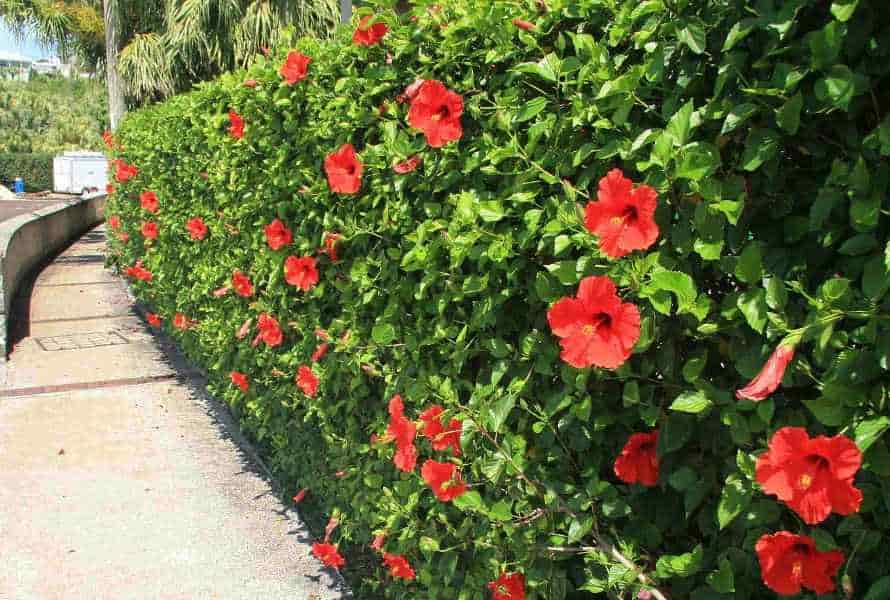
Chinese Hibiscus is used as an ornamental plant in both the garden and the landscape and as an indoor plant. Its dominant decorative element is certainly its flowers, which depending on the variety can be single or double and almost any possible or impossible color and hue. If it is planted in tropical climate, it is flowing incessantly throughout the year.
With all this in mind, it could be said that Chinese Hibiscus is being exploited:
-
As a srhub of particular interest planted alone
-
By mass planting in gardens and landscapes
-
In coastal areas – if it is protected from aerosol salts
-
In urban plantings
-
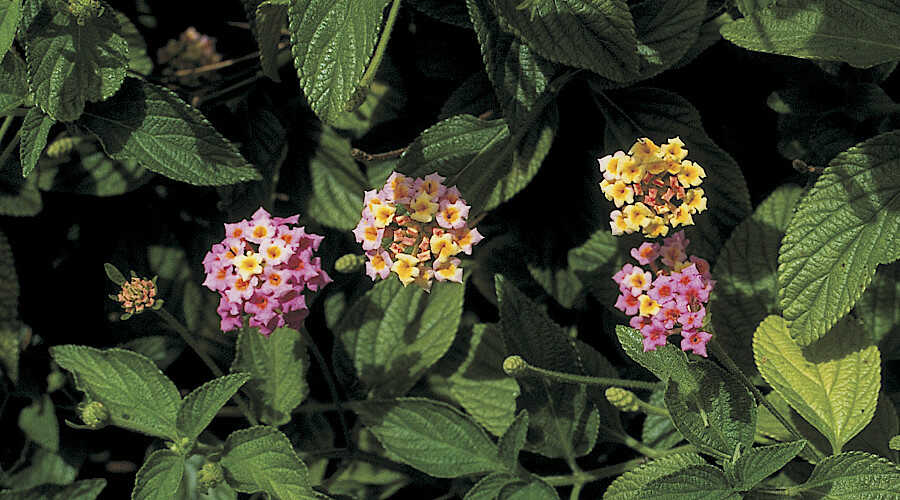
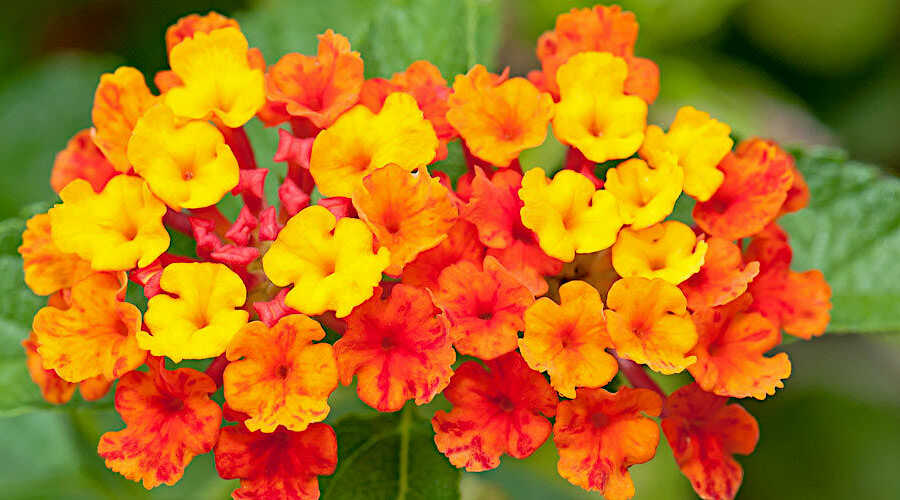
In combination with flowering plants and shrubs such as Crape Myrtle (Lagerstroemia indica ‘Petite Orchid’), West Indian Lantana (Lantana camara) and Cannas (Canna indica ‘Phasion’)
-
By applying the appropriate technique, as indoor bonsai
References
The References of the unknown origin Chinese Hibiscus, are presented by the well-known origins artists Mariam Doumbia, Amadou Bagayoko and Manu Chao with the song Senegal Fast Food.
- Akpan, G. A. (2006). Hibiscus rosa-sinensis. Flower Breeding and Genetics, 479–489.
- Bendre, A., & Kumar, A. (2010). A Textbook of Practical Botany 2. Rastogi Publications.
- Brooklyn Botanic Garden. (1990, Spring). Plants For Indoor Bonsai. Plants & Gardens, 46(1), 82-94.
- Devipriya, V. (2005). The Shoe-flower Plant: ‘Hibiscus Rosa-sinensis’ Linn.: A Monograph. Anitha Publications.
- Goleniowski, M., Bonfill, M., Cusido, R., & Palazon, J. (2013). Phenolic Acids. Natural Products, 1951-1974.
- Idžojtić, M. (2019). Dendrology Cones, Flowers, Fruits and Seeds. Academic Press.
- Jarrett, A. (2003). Ornamental Tropical Shrubs. Pineapple Press.
- Koh, H. L., Chua, T. K., & Tan, C. H. (2009). A Guide to Medicinal Plants: An Illustrated, Scientific and Medicinal Approach. World Scientific.
- Pekamwar, S. S., Kalyankar, T. M., & Jadhav, A. C. (2013). Hibiscus rosa-sinensis, A Review on Ornamental Plant. World Journal of Pharmacy and Pharmaceutical Sciences, 2(6), 4719-4727.
- Hibiscus rosa-sinensis L.: Encyclopedia of Life (EOL)
- Hibiscus rosa-sinensis L. Shoeblackplant: USDA
Clarification
Of course, it is needless to say – but we will emphasize it – that in this handmade website, no article has been and will not be written with recourse to Artificial intelligence (AI). Natural Intelligence, that is, as much of it as we have and for as long as we are allowed to have it, is enough for us.
Sharing
The use of the material, where third-party rights are not mentioned or implied (such as photos or audiovisual files - with the exception of those belonging to "Kalliergeia"), is absolutely free. Its sharing, possibly, useful.