Home » PLANTS & CROPS »
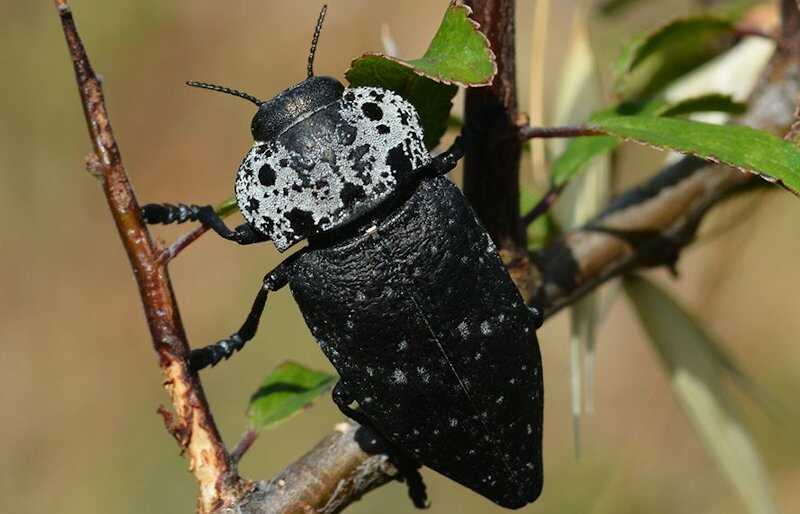
Capnodis tenebrionis Control (Peach Rootborer)
CONTENTS ⌵
The Capnodis tenebrionis Control (Peach Rootborer) is not an easy task, to the extent that the coleoptera has already infected the trees of an orchard and has settled in the crops of an area.
On the contrary, the appropriate actions of “shielding” trees and crops before and to avoid infestations by Peach Rootborer are sufficiently effective, proving in this case the validity of the popular proverb that “Prevention is better than cure“.
A privileged field for the manifestation of the destructive action of the insect consists of the fruit fruit trees, primarily the Stone Fruits, followed by the Pome Fruits and some of the Nuts.
The good news for the commercial producers of the above-mentioned fruits is that both the means and the prevention techniques that can be applied are not few, and although the treatment even with the appropriate preparations is difficult, it is more than possible to have satisfactory results.
The bad news is that the presentation of the methods and techniques for the Capnodis tenebrionis Control, at least in this article, undertakes to make the well-known and unexceptionable editorial team of “Kalliergeia”.
This proves the validity of another popular proverb, which says that “Misfortunes never come singly“.
Capnodis tenebrionis Control (Peach Rootborer)
Symptoms & Damages by the Capnodis tenebrionis
For the most effective Capnodis tenebrionis Control, it is very important to detect its presence in time, either in the wider area or in the affected trees of the orchard or nursery, so that the necessary operations can be carried out without delay.
This is because, on the one hand, time is an ally of the coleoptera, and on the other hand, the destructive power of young insects in particular is great.
Suffice it to consider that, for example, only one of its larvae can infect a one-year-old tree to kill it, while in mature trees the same can happen within one to two years of the action of a few larvae.
Symptoms & Damages by the Capnodis tenebrionis Adults
The presence of green leaves in the soil of the orchard is an indication of the presence and action of the adults of Capnodis tenebrionis. In general, however, the damage from their action is not usually considered serious.
The adults mostly choose the least hardy and vigorus trees, and of these those areas of the foliage that are most exposed to the sun.
Thus, the sunny mornings of Spring appear on the sun-exposed areas of their hosts canopy to feed.
Their diet includes the bark of young shoots, the buds and the petioles of the leaves.
The result of their action is the partial defoliation of the trees, as well as the debarking wounds on twigs and young branches.
Symptoms & Damages by the Capnodis tenebrionis Larvae
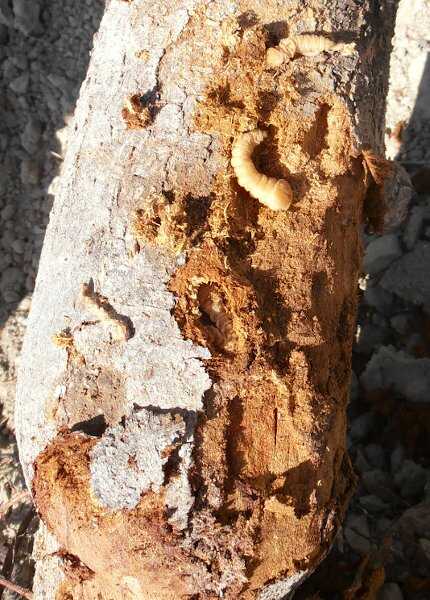
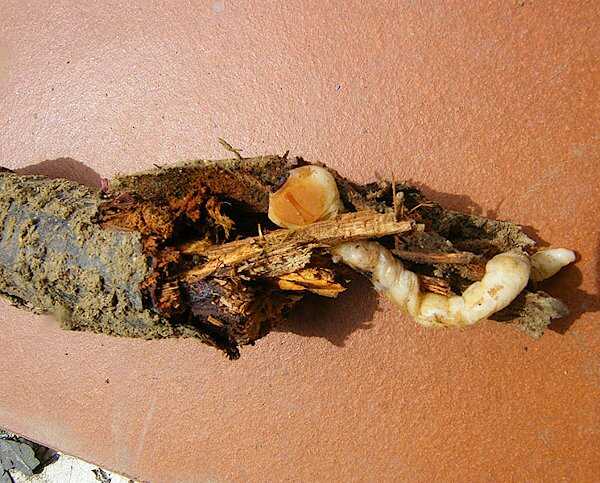
The penetration of young larvae into the roots of fruit trees also marks the beginning of the infestation. The larvae dig up galleries that reach up to the cambium and sapwood of their hosts – damage that can be seen by removing the bark of the roots and the collar area of the tree.
Due to this activity of the larvae, the host’s vascular tissue undergoes irreparable damage that even if they do not cause their death, they cause a permanent degradation of their productive capacity.
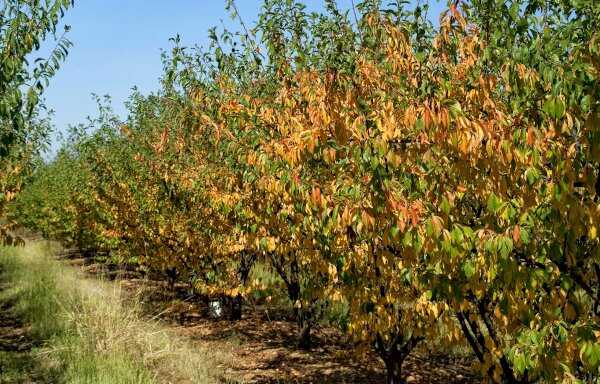
The visible symptoms, which unfortunately appear to be delayed as for the initial infestation, and which manifest in the aboveground part of the trees include:
- General weakness
- Chlorosis
- Premature defoliation
- Drying of libs and branches
- Necrosis
The weakening of the trees facilitates the entry of other secondary pests, such as Scolytes (Curculionidae Family, Scolytinae Subfamily), and there are few times that is attributed – wrongly – to them the infection.
Capnodis tenebrionis Control (Peach Rootborer)
Prevent the Introduction of Capnodis tenebrionis
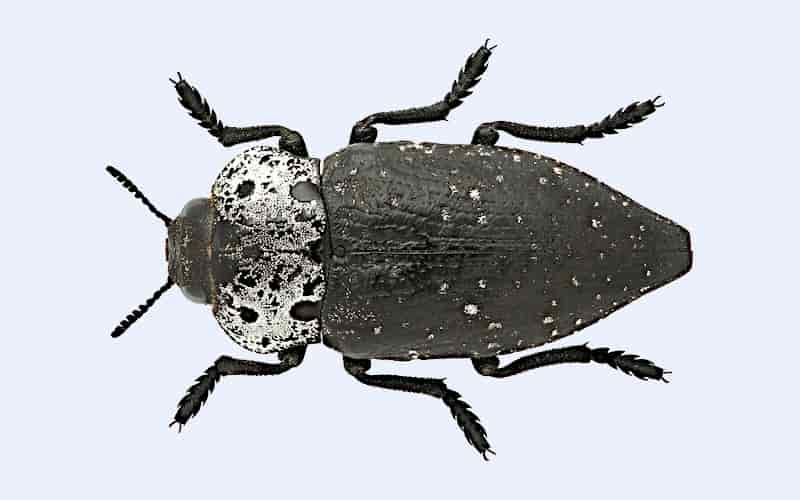
Various means, methods and techniques of various nature are used for the Capnodis tenebrionis Control. All of this will be discussed immediately below, however, here we will start with prevention. Because the defense against Capnodis tenebrionis starts from the nursery and reaches up to the surrounding area of the orchard or production unit.
Resistance Rootstocks
The use of resistant rootstocks is a key precautionary measure against Peach Rootborer infestations. In addition, in the selected rootstocks, the development of a deep root system is a desirable feature.
At the time, the prevailing rootstock for Stone Fruits against many pests of the trees, and among others and the larvae of the Capnodis tenebrionis, it is the Wild Almond Prunus webbii.
Also very good results against the larvae of the insect has given the Spanish origin rootstock of Peach and Almond Rootpac® 40 Nanopac – (P. dulcis x P. persica) x (P. dulcis x P. persica).
Clearing of the Surrounding Area
The wild trees belonging to the Rosaceae family are included in the beloved hosts of Capnodis tenebrionis. The proximity of the orchard or the production unit with these trees is clearly dangerous.
Therefore, their elimination is imperative – of course, to the extent that such an operation does not conflict with the environmental sensitivity of the producer but also with the legislation of each place.
Healthy Saplings
No further explanation may be needed, as saplings that are selected for the planting of a new orchard should be healthy and of course free of Capnodis tenebrionis larvae.
That is why they will not be given.
Capnodis tenebrionis Control (Peach Rootborer)
Cultural Practices for Capnodis tenebrionis Control
A number of cultivation works help in the Capnodis tenebrionis Control. Some of them are listed below.
Fertilization and Irrigation
It is assumed that healthy and robust orchard trees are less likely to be affected. Therefore, systematic, regular fertilization and irrigation of trees – among other things – is an important crop prevention tactic.
Especially abundant irrigation during the ovulation period seems to act as a deterrent to the laying of eggs by females, as well as to carry out the infestation if it is ordered to lay eggs in the soil of the orchard.
The reason is that in such a modification of living conditions, the neonates of Peach Rootborer who try to penetrate and enter the roots can not cope, as they do not survive in soil with high humidity.
But also increasing the frequency of watering seems to have positive results even if some larvae have managed to settle in the trees.
Without it being known precisely the way in which it mobilised the defense mechanism of trees to cope with the attack, it is speculated that the killing of the larvae is due to the copious secretion of gum that overwhelms the larvae galleries.
Geotextiles Placement
The geotextiles play in some way the role of armor in the invasion of the Peach Rootborer’s larvae. They can be installed in two ways:
- In the whole rows with the planted trees
- Individually to each tree
In either case, the geotextiles should be at least 1 m wide to be effective – that is, 50 to 60 cm around the trunk of the tree.
In general, this is the longest distance that the newly hatched larvae of Capnodis tenebrionis can go in order to reach the roots.
In addition, it is also recommended to cover the base of the trees from the collar up to about 20 cm above the ground.
Soil Cultivation
The uneven surface of the orchard soil acts as a deterrent to the laying of eggs by females of Capnodis tenebrionis. Alight tillage helps to prevent that.
Picking Up by the Hand
The hand-picked collection of Peach Rootborer’s adults is another way to get rid of the parasite – although not the most effective, especially in large orchards.
Its presence is easier to find in young trees than in older ones, because visual inspection and conception of adults are immediately possible, since the canopy of the trees is not developed and the branches are fewer.
However, it should be noted that when Capnodis tenebrionis is perceived as dangerous, it first hides behind the shoot that holds it and then falls to the ground – although it has the ability to fly, which it rarely uses to escape.
Capnodis tenebrionis Control (Peach Rootborer)
Capnodis tenebrionis Alternative Control
The use of kaolin as a deterrent seems to have yielded some results, as a much lower concentration of Peach Rootborer’s adults has been observed in orchard trees that have undergone such treatment.
This is due to the discomfort caused by the application of kaolin powder in adults.
Applications & Dose
The recommended dose for Capnodis tenebrionis Control is 3 kgr of kaolin powder per 100 lt of water, with a spray frequency of 1 per month, starting in April and ending in September.
Note: In any case, the instructions on the label of each preparation by the manufacturer shall be followed.
Capnodis tenebrionis Control (Peach Rootborer)
Biological Control
The entomopathogenic nematode Steinernema carpocapsae is effective for Capnodis tenebrionis Control. Its insect pathogenic action is due to the unique feature of nematode Steinernema to coexist with bacteria of the genus Xenorhabdus.
The penetration of Steinernema carpocapsae into the host’s body – in this case the larvae but also and to the emerges adults that appear after the pupae period – and its parasitism, results in the release of the symbiotic bacterium Xenorhabdus nematophila.
Xenorhabdus nematophila together with a variety of proteins produced by nematodes enter the blood cells of the insect’s hemolymph and cause septicemia, which resault to the death of the host within 24 to 48 hours.
Applications & Dose
The recommended dose for the Capnodis tenebrionis Control ranges between 1 and 3 million nematodes per tree in 30 lt of water. It is applied with the irrigation system or by watering each tree root in April-May and in September-October, in conditions of high soil moisture.
Note: In any case, the instructions on the label of each preparation by the manufacturer shall be followed.
Capnodis tenebrionis Control (Peach Rootborer)
Capnodis tenebrionis Control by Chemical Means
In the heroic era of the agrochemical industry, a number of insecticides (Azinphos-methyl, Chlorpyrifos, etc.) loosened the hands of producers in dealing with a number of pests of crops, including Peach Rootborer.
Unfortunately, many of these have caused side effects for both producers and consumers, such as Chlorpyrifos, which causes brain damage, behavioral disorders and teratogenesis.
Fortunately, their use (most recently Chlorpyrifos in the European Union – early 2020) has been banned.
However, there are still insecticidal active substances that are effective in insecticidal active substances, although at least in Greece, none of them has an approval for use against this particular pest.
Immediately below are listed the insecticidal active substances.
➤ Those active substances with the indication [E] are authorized for use in Greece (and most European Union countries) at the time of writing this article.
Active Substances
Conventional Farming
- Imidacloprid [Ε]
- Beta-Cyfluthrin [Ε]
- Cypermethrin [Ε]
- Deltamethrin [Ε]
Applications
An application is performed in late August to September, as the adults of the new generation of Peach Rootborer live and feed on the trees.
However, if the previous year’s infestation was severe, another application could be performed in the spring on the thriving of the previous generation.
Absolutely Necessary Reminder
The reference to the active substances that can be used against Peach Rootborer, is for purely informative reasons. Under no circumstances is their use implied or encouraged without the approval of the local agronomist.
Capnodis tenebrionis Control (Peach Rootborer)
References
The References to the insectivorous article entitled Capnodis tenebrionis Control (Peach Rootborer) are presented by the French organist Michel Chapuis with the work Wo Soll Ich Fliehen Hin, BWV 694 by the great German composer Johann Sebastian Bach.
- Alford, D. V. (2014). Pests of Fruit Crops: A Colour Handbook, Second Edition. Boca Raton, FL: CRC Press.
- Ben-Yehuda, S., Assael, F., & Mendel, Z. (2000). Improved Chemical Control of Capnodis tenebrionis and C. carbonaria in Stone-Fruit Plantations in Israel. Phytoparasitica, 28(1), 27-41.
- Bonsignore, P., Vacante, V., & Manti, F. (n.d.). Field and Tree Distribution of Capnodis tenebrionis (Linnaeus, 1767) (Coleoptera: Buprestidae) Adults in an Apricot Orchard in Italy. Journal of Applied Entomology, 2008(132), 216-224.
- Marannino, P., & De Lillo, E. (2007). Capnodis tenebrionis (L. 1758) (Coleoptera: Buprestidae): Morphology and Behaviour of the Neonate Larvae, and Soil Humidity Effects on the Egg Eclosion. Annales de la Société Entomologique de France (N.S.), 43(2), 145-154.
- Marannino, P., Tarasco, E., & De Lillo, E. (2004). Biological Notes on Larval Hatching in Capnodis tenebrionis (L.) (Coleoptera Buprestidae) and Evaluation of Entomopathogenic Nematodes in Controlling Neonate Larvae. Redia, (86), 101-105.
- Martinez de Altube, M. D., Strauch, O., Fernandez De Castro, G., & Martinez Peña, A. (2007). Control of the Flat-Headed Root Borer Capnodis tenebrionis (Linné) (Coleoptera: Buprestidae) with the Entomopathogenic Nematode Steinernema carpocapsae (Weiser) (Nematoda: Steinernematidae) in a Chitosan Formulation in Apricot Orchards. BioControl, 53(3), 531-539.
- Mfarrej, B., & Naim, M. (n.d.). Host Selection of Peach Rootborer Capnodis tenebrionis L. (Coleoptera: Buprestidae) to Stone-Fruit Trees in Jordan). Jordan Journal of Agricultural Sciences, 7(4).
- Capnodis tenebrionis: iNaturalist
Clarification
Of course, it is needless to say – but we will emphasize it – that in this handmade website, no article has been and will not be written with recourse to Artificial intelligence (AI). Natural Intelligence, that is, as much of it as we have and for as long as we are allowed to have it, is enough for us.
Sharing
The use of the material, where third-party rights are not mentioned or implied (such as photos or audiovisual files - with the exception of those belonging to "Kalliergeia"), is absolutely free. Its sharing, possibly, useful.