Black Baccara Hybrid Tea Rose belong to Hybrid Tea Roses (what a surprise!). Apart from its honorable ranking in the large family of hybrid roses, it still has a great privilege: thanks to the deep dark red color of its flower, it is called black rose, since its flower sometimes approaches almost the “elusive”, absolutely black coloring rose.
While it was initially developed to meet the needs of florist trades, its cultivation soon spread to the gardens by the ‘anxious’ friends of this odd kind of flower-lovers, attracted and fascinated by the extremely dark colors of the flowers of various herbaceous but also shrub plants.
Was there any chance that the “black” Black Baccara rose would escape them?
No.
… Of course, and to be honest, in order for this variety to give the observer the visual impression of the ‘black’ of its roses, it must be grown in a special environment, as we aim to show in the rest of the article.
And we are firmly convinced that we will succeed.
Black Baccara Hybrid Tea Rose – The Black Roses
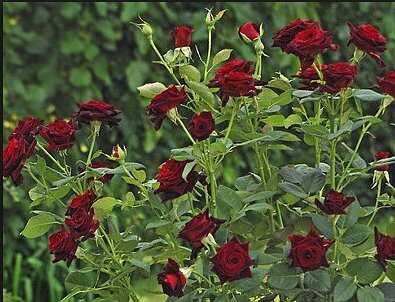
'Black Baccara' Hybrid Tea Rose - General Information
The course of the creation of the ‘Black Baccara’ rose variety is given below, while here we provide some brief identifying details and its basic characteristics.
Facts in Short
Family: Rosaceae
Genus: Rosa
Scientific Name: Rosa ‘Black Baccara’
Synonyms: Rosa ‘Meidebenne’
Common Names: ‘Black Baccara’ Rose, Black Rose Bush
Horticultural Group: Hybrid Tea Roses
Plant Breeder: Jacques Mouchotte, France (before 2000) – Meilland International
Uses In Brief
This Hybrid Tea Rose variety is suitable for:
- Specimen
- Mass plantings
- Informal hedges
- Urban plantings
- Pots & containers
- Cut flowers
Black Baccara Hybrid Tea Rose – The Black Roses
Breeding & Landscape Attributes
Breeding
The ‘Black Baccara’ Hybrid Tea Rose, is a tetraploid variety 2n=28 (4×7) resulting from the cross between Rosa ‘Celica’ x Rosa ‘Fuego Negro’ (and/or ‘Carte Noire’) – syn. Rosa ‘Meifota’ x Rosa ‘Meilouzou’. The Rosa ‘Meilouzou’, the male parent, is remarkably more thorny than its offspring, while the outer petals of its flowers occasionally are discolored due to burns. Rosa ‘Meifota’, the female parent, is smaller in growth, with medium-sized pink flowers.
Seeds were produced from the cross between these two varieties and sown, and from the plants with varying characteristics that resulted, only one was selected, which had the most desirable characteristics. The one that stood out was named Rosa ‘Meidebenne’ (or Rosa ”Black Baccara”). Its dominant decorative feature is its dark red roses, and it has proven to be extremely suitable and fruitful for the production of cut flowers as a greenhouse crop.
Landscape Attributes
The ‘Black Baccara’ rose is a woody deciduous, medium-sized, perennial shrub. In terms of size, the height of the plant reaches 1.7 to 1.9 m (5.5-6.2 ft) while its diameter varies between 0.5 and 0.7 m (1.6-2.2 ft). It has a hemispherical shape, an upright appearance and a dense and symmetrical canopy with rather irregular perimeter. It is characterized as a rough texture, while the dense foliage gives to the ‘Black Baccara’ rose a compact appearance.
Its flowering is repeated and long-lasting – flowering that begins at the end of spring and ends in October. Its life span is over 25 years.
Black Baccara Hybrid Tea Rose – The Black Roses
'Black Baccara' Hybrid Tea Rose - Description
‘Black Baccara’ Hybrid Tea Rose is a multi-brunched shrub with thorny stems. Its glossy leaves are composite, consisting of 5 to 7 leaflets, oval and serrated, whith nice dark green color.
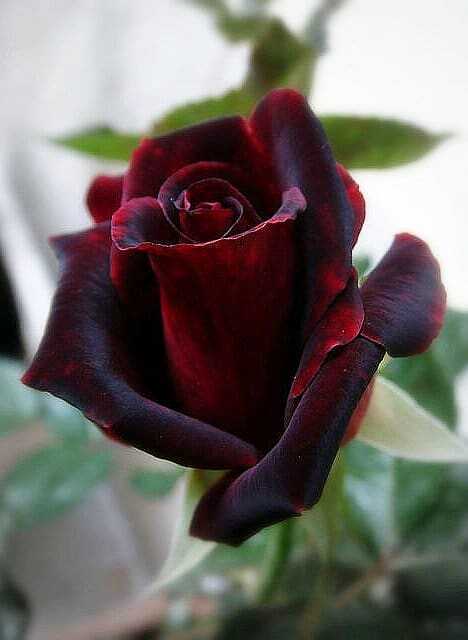
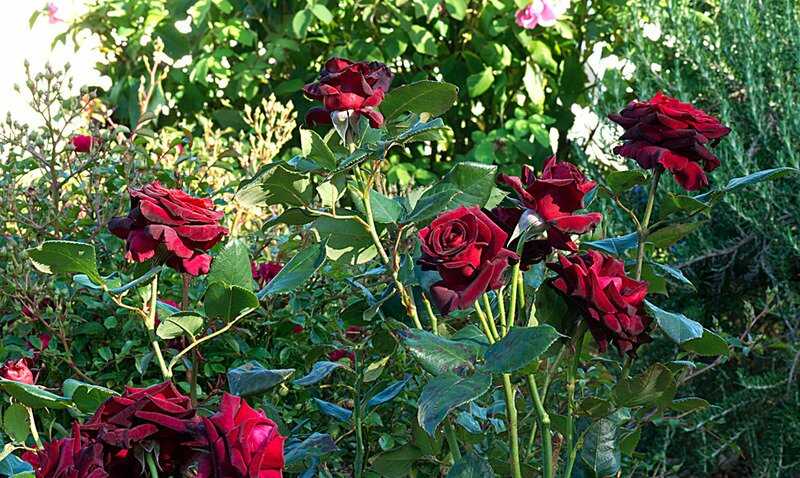
Roses are formed at the edge of their annual shoots, about 3 to 5 per stem. It is numerous, medium in size with a diameter of 10 to 12 cm (4- 4.8 in). They consist of 30 to 45 petals, velvety texture and extremely dark deep red to dark red burgundy color.
How deeply dark is the color – hence how intensely ‘black’ it is – depends on two factors:
-
From the stage of development of the rose
-
From the temperatures of the area where it is planted
These two factors generally affect the formation of color in ‘black’ roses. So when the flower in the ‘Black Baccara’ Hybrid Tea Rose is at the bud stage but and shortly after, the very dark tones prevail, giving to the observer the feeling of black color.
The same, but to a lesser degree and regardless of the stage of development, occurs when the ‘Black Baccara’ Hybrid Tea Rose is planted in low-temperature areas.
How low they may be, we’ll see it right afterwards – after taking a brief break for reflection and a cigarette.
In the meantime – and not to forget it: the reader may have read that ‘Black Baccara’ roses have a light scent.
The truth is that the roses of this black Hybrid Tea rose have neither a light nor a mild perfume: in fact they completely deprive of the perfume, to great sorrow for all amateur and professional alchemists.
Break Time
ContentsBlack Baccara Hybrid Tea Rose – The Black Roses
'Black Baccara' Hybrid Tea Rose - Environment of Establishment
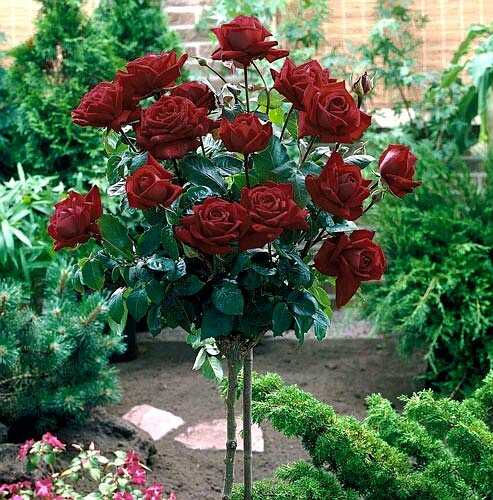
After the short break, we return renewed to the issue of temperatures. And we start by saying that in general the Hybrid Tea Roses do not withstand planting in areas with particularly low temperatures.
But besides this, and especially for ‘Black Baccara’ roses, it is still to be said that they are extremely vulnerable to late frosts of spring.
Therefore, suitable areas for the planting of ‘Black Baccara’ rose are those in which no frosts are observed in spring, while in the case of temperature the minimum must be between -12 and -15 °C (5-10 °F).
Since ‘Black Baccara’ Hybrid Tea Rose planting in areas where temperatures are generally low – and winter temperatures are particularly close to minimum safety limits – then the darker tones of the roses are the highest possible. This fact causes the flower observer to take the color of the roses as black. And thanks to this recruitment, the reputation of ‘Black Baccara’ rose Increased.
In relation to the soil, ‘Black Baccara’ Hybrid Tea Rose is recommended to be planted in fertile and rich in organic matter loamy soils, which additionally have excellent drainage.
In terms of soil pH, the appropriate range is remarkably large, ranging from 4.5 to 8.0 – although the closer it is to the extreme values, the higher the risk of nutrients deficiency.
In relation to the exposure, there is nothing more inaccurate than the recommendation for planting ‘Black Baccara’ in half-shade positions. ‘Black Baccara’ Hybrid Tea Rose grows well only in full sunshine. This means that it has to receive the sunlight directly for at least 6 to 8 hours a day. Any other option undermines its successful cultivation.
Black Baccara Hybrid Tea Rose – The Black Roses
'Black Baccara' Hybrid Tea Rose - Use
As stated at the beginning of this article, ‘Black Baccara”s main goal was to meet the needs for producing a very dark ‘black’ rose flower color. But soon ‘Black Baccara’ passed to the gardens, making it another choice for planting roses of the Hybrid Tea type, and one of the few choices – and not just for roses – to enjoy the ‘black’ color in flowers.
It could generally be said that ‘Black Baccara’ Hybrid Tea Rose:
-
It is cultivated for its flower, which as a cut flower can last in the vases for up to 10 days
-
It is used in the garden as a plant of particular interest
-
It is used in the garden in conmpanion with other plants such as Clematis vitalba (Old Man’s Beard or Traveller’s Joy), Salvia nemorosa (Woodland Sage or Balkan Clary), Berberis thunbergii f. atropurpurea ‘Atropurpurea Nana’ (Japanese barberry ‘Atropurpurea Nana’), Festuca glauca (Blue Fescue) and Cupressus arizonica ‘Glauca’ (Arizona Cypress)
-
It can be planted as a hedge plant
-
Can be pruned appropriately to a small tree
-
Finally, it is possible to plant it in large-sized pots and full-sun exposures
Black Baccara Hybrid Tea Rose – The Black Roses
References
The References of the dark article titled ‘Black Baccara’ Hybrid Tea Rose – The Black Roses, are presented by the amazing Oumou Sangaré from Mali, the so-called ‘The Songbird of Wassoulou‘, with the song Djoukourou.
- Bessi, F., & Clauser, M. (2018). Le Rose in Fila: Rose Selvatiche e Coltivate: Una Storia Che Parte da Lontano. Firenze University Press.
- Feaster, F. (2025). The Goth Garden: The Mystery, Beauty, and Lore of Dark Gardening. Simon & Schuster.
- Lazzari, V. (2023). 100 Roses for the South Florida Garden. University Press of Florida.
- Meilland, A., & Lambert, G. (1984). Meilland, a Life in Roses. Carbondale, IL: SIU Press.
- Poulson, G. (2024). Grace Rose Farm: Garden Roses: The Complete Guide to Growing & Arranging Spectacular Blooms. Hachette UK.
- Pryke, P. (2017). Floristry Now: Flower Design and Inspiration. Jacqui Small LLP.
- Rosa ‘Black Baccara’: Wikipedia
With Pomp and Circumstance
VIDEO
Black Rose and Black Africa: The excellent Ms. Oumou Sangaré, in dance and song.
Clarification
Of course, it is needless to say – but we will emphasize it – that in this handmade website, no article has been and will not be written with recourse to Artificial intelligence (AI). Natural Intelligence, that is, as much of it as we have and for as long as we are allowed to have it, is enough for us.
Sharing
The use of the material, where third-party rights are not mentioned or implied (such as photos or audiovisual files - with the exception of those belonging to "Kalliergeia"), is absolutely free. Its sharing, possibly, useful.