The Bear’s Breeches (Acanthus mollis) belongs to those plants that have been closely associated with the Arts—painting, sculpture, architecture.
But in this tribute to Acanthus mollis, we will not deal with this plant dimension but with the plant itself, describing the species botanically, giving information about the origin and the ecological environment in which it grows, recording its pests and diseases, and presenting the potential ways of utilizing it in the garden and in the landscape.
By saying this from the outset, it does not mean that we detract from the responsibility of the presentation of the “artistic” aspect of the plant – not at all.
With the ingrained, as we want to believe, certitude of the patient reader that we hold our word, the editorial team of ‘Kalliergeia’ is bound up with its ingrained (in)consistency, for a future tribute only to the artistic dimension of the plant.
Until then, α bird in the hand is worth two in the bush.
Bear’s Breeches (Acanthus mollis), the Corinthian Columns Capital Plant
Bear’s Breeches Origin
Bear’s Breeches (Acanthus mollis), the Corinthian Columns Capital Plant
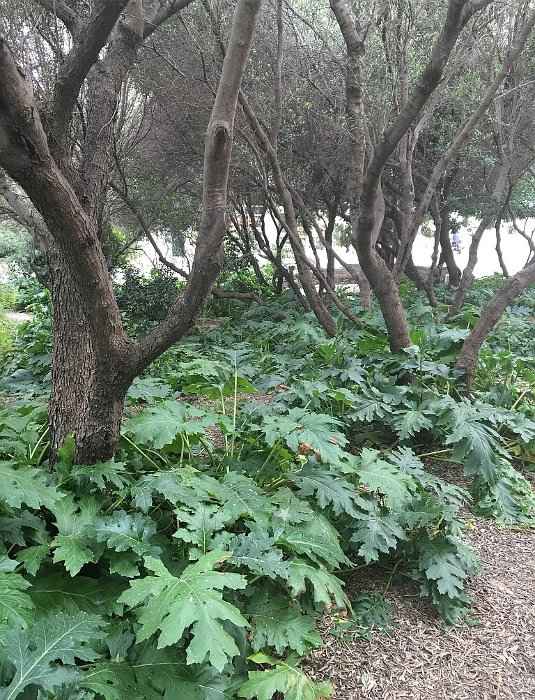
Bear's Breeches (Acanthus mollis) - Brief Description
Family: Acanthaceae
Genus: Acanthus
Scientific Name: Acanthus mollis L.
Common Name: Artist’s Acanthus, Bear’s Breech, Bearsfoot, Big Spinach, False Orchid, Grecian Pattern Plant, Oakleaf Acanthus, Oyster Plant, Sea Dock, Sea Holly
General Characteristics
Leaf Persistence
Evergreen / Semi Evergreen
Form
Herbaceous Perennial
Texture
Coarse
Growth Rate
Moderate
Flowering Period (Northern Hemisphere)
May – July to August
Fruiting Period
Summer
Height
10.6 to 1.2 m (2-4 ft)
Diameter
0.6 to 1.2 m (2-4 ft)
Shapes and Colours
Leaves Shape
Ovate, Pinnatifid
Foliage Colour
Dark Green
Autumn Foliage Colour
Dark Green
Flowers Shape
Tubular
Flowers Colour
White-Purple Pink
Fruit
Brown Capsule
Plantation
Soil Type: Well-drained, sand, loam, slightly acidic to neutral
Exposure: Sun, Half-Shade
Soil pH: 6-7
Watering: Medium
Hardiness: −15 °C (5 °F – USDA Hardiness Zone 7b)
Χρήσεις
In parks, squares, gardens, flower pots and planters, cut flowers and dried flowers
Bear’s Breeches (Acanthus mollis), the Corinthian Columns Capital Plant
Bear's Breeches (Acanthus mollis) - Etymology
Etymology of the Genus Name
The name of the genus Acanthus is the Latin version of the Ancient Greek word ἄκανθος, which is complex, as it is formed from the words ἀκή and ἄνθος.
The first means sharp and comes from the same meaning Proto-Indo-European word *h₂eḱ-, and the second, used in Modern Greek with the same original meaning, i.e. flower, comes from the Proto-Indo-European word *h₂éndʰos, and means bloom, blossom and flower.
Therefore the name of the genus Acanthus could be given as a sharp plant, thorny plant, spiny plant, or a plant with sharp flowers and / or leaves – an extremely apt name, as it conveys a very accurate picture of the plants that make it up.
Etymology of the Species Name
The name of the species mollis is a Latin word which is interpreted as soft, weak, conveying to the speech the feeling it gives to the touch, the texture of the plant leaf.
Its origin is found in the Proto-Indo-European word *(h₂) moldus, which also means soft, weak, while its most distant source is found in the Proto-Indo-European root *mel-, whose meaning is soft, weak, tender.
Note
We can not fail to point out here that, while each of the words Acanthus and mollis aptly ascribes the properties of plants of the species, when they are seen as a whole then they are interpreted as a tender thorn, an oxymoron – if we do not miss something.
And if we really do not miss something, then with a little comic mood we could say that the expression tender thorn reminds us of the Tenderfoot of Lucky Luke (as the old settlers of the Wild West called the newcomers botanically).
But more about the tender thorn, in the continuation of the article, while for the Tenderfoot we refer the reader to the Lucky Luke issue of the same title (Le Pied-tendre – The Tenderfoot).
Bear’s Breeches (Acanthus mollis), the Corinthian Columns Capital Plant
Bear's Breeches (Acanthus mollis) - Origin & Life Span
Origin
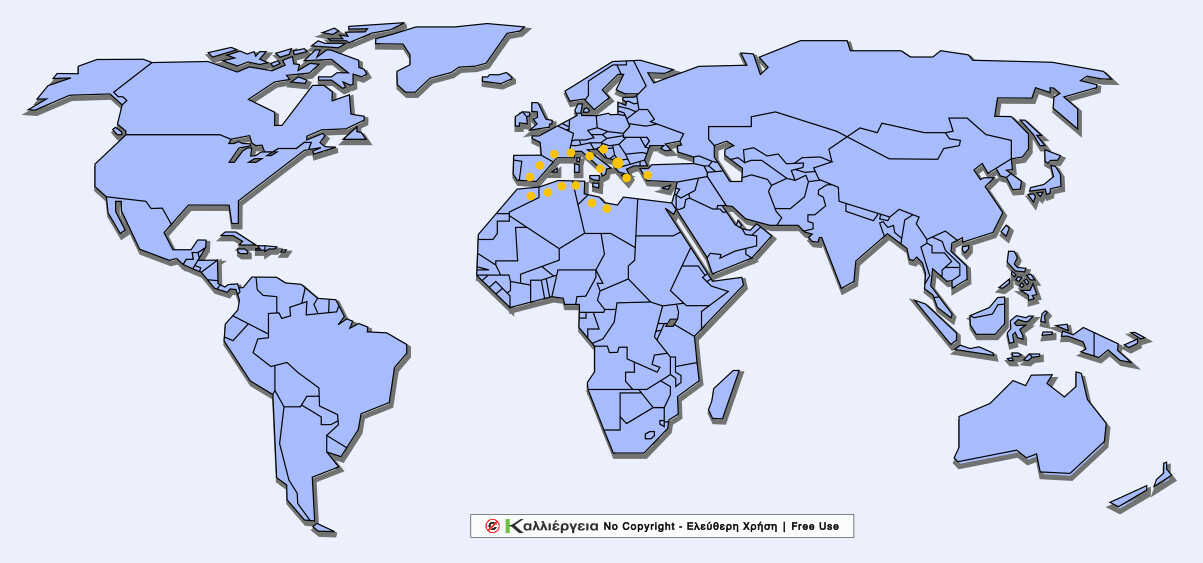
Bear’s Breeches is a native plant of southern Europe and the regions of the Mediterranean Basin and its islands. Its habitats are mainly calcareous soils in brushwood forests as well as rocky slopes and stony hillsides sheltered from the north.
Invasiveness
The plant can be relatively easily escaped from the garden, either with the seeds or with pieces of the rhizome, and turned into a weed. For this reason, the attention of those who plant Artist’s Acanthus outside the urban areas is recommended, in order to remove the mature flowers in time, not allowing the production and dispersal of the plant’s seeds.
Life Span
Bear’s Breeches life spans over 10 years. Of course, in cultivation is recommended to separate it every 3 to 5 years, so life expectancy is clearly greater.
Bear’s Breeches (Acanthus mollis), the Corinthian Columns Capital Plant
Bear's Breeches (Acanthus mollis) - Landscape Attributes
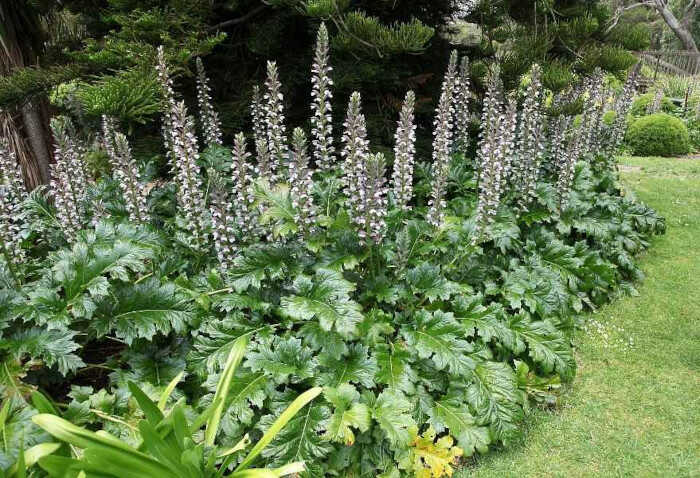
Bear’s Breeches is a perennial, rhizomatous plant, of upright habit. Its shape is spherical, has dense foliage and is characterized as a coarse texture.
It is an evergreen plant, but maintaining or not foliage does not depend on temperature but in soil moisture.
Indeed, if there is not enough moisture or the plant is not irrigated normally after the end of flowering, in the summer, it completely loses its foliage. Otherwise the leaves remain.
Bear’s Breeches (Acanthus mollis), the Corinthian Columns Capital Plant
Bear's Breeches (Acanthus mollis) - Botanical Description
Leaves
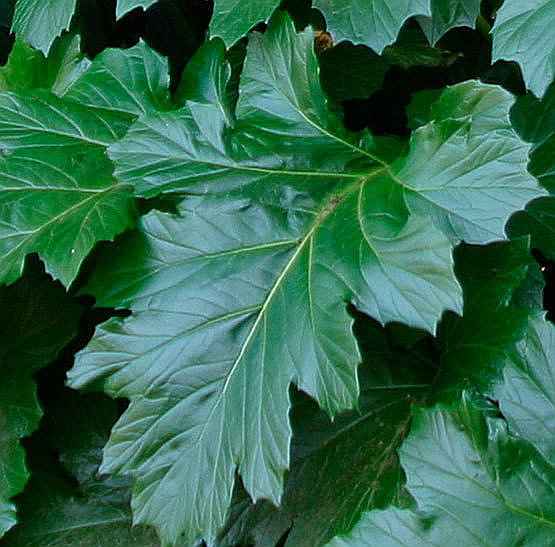
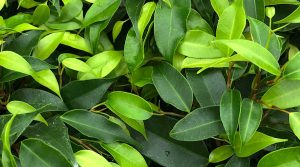
By the side of the central rhizome, the large shiny, deeply lobed and cut leaves, between 10 cm and 60 cm (4-24 in) long and between 5 and 30 cm (2-12 in) width, are grown in the form of a rosette.
Their lamina is smooth, without hairs, although sometimes the surface is covered with pubescence, and the margins are incise dentate, with sharp perpendicular teeth.
They are carried on long, reclining and hard petioles 10 to 50 cm (4-20 in) long, while those leaves (cauline) that grow directly from the long flower stem, are either sessile or carried on small petioles 1 to 5 cm (0.4-2 in) long.
The flower stem grows vertically from the center of the rosette and is 30 to 40 cm (12-16 in) long.
Flowers
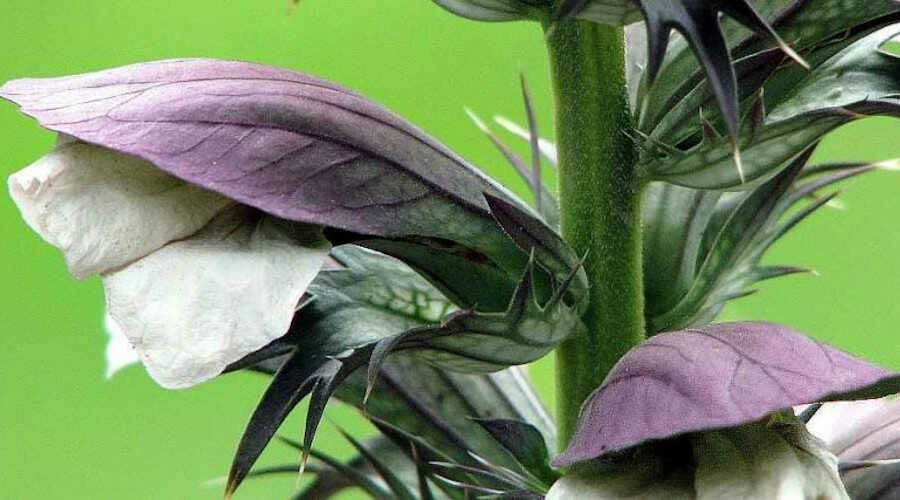
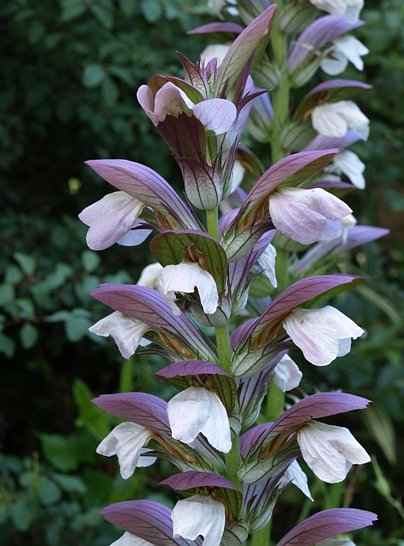
The flowers of Bear’s Breeches are hermaphroditic (perfect), zygomorphic, white to purple-red, carried on dense, terminal, cylindrical spikes inflorescence, and are numerous, 100 to 120 per flower stem.
Each flower is covered on the underside by 1 bract, however the bracts at the base of the inflorescence often lack flowers.
The bracts grow cuneate from the flower stem and are covered on their entire surface by fine pubescent. They terminate on either side of the midrib in 4 to 5 to 7 sharp spiny teeth, while they show 5 main veins that start from the base.
They have an ovate shape, and their dimensions are 3 to 4 cm in length, and about 1 cm in width.
Although the Bear’s Breeches belongs to the Acanthaceae family, the members of which have flowers mostly bilabiate, here the corolla of the flower, about 4 to 4.5 cm long, shows on the lower side 1 three-lobed white lip, but the upper one is absense.
The role of the upper lip is played by the upper part of the 4-lobed calyx, which like the lower one is large, with a length of 4 and 3 cm respectively, while both are covered by a fine pubescent, and end in a serrated apex. The lateral parts of the calyx are small.
Between the corolla and the bracts grow the 2 cm long bracteoles, which have a lanceolate – linear shape, and are covered by pubescent.
The stamens of the flower are 4, didynamous, ending in 1-celled anthers of purple or brown color, and are carried on filaments 0.2 to 0.25 cm long.
The ovary is Inferior, hairless, unlike the about 3 cm long style, which has hairs on its upper and lower part.
Pollination
The pollination takes place with insects – bees or wild bees of the Bombus genus.
Fruit
The fruit is green and mucronate oval dry capsule, shiny or glabrous, with mucro’s few hairs at the base. The capsule is bi-locular, dehiscent, and sometimes looks-like a small lemon.
When ripe, it becomes hard, and longitudinall splits open along the midrib or dorsal suture, and the indurated funicles, the jaculators, eject the 2 to 4 seeds that contains at a long distance, thus ensuring their maximum dispersion.
Seeds
The seeds are hard, with a wrinkled coat’s appearance, have a flattened oval shape and a dark brown color, and their length is between 1 and 1.4 cm while their width is between 0.6 and 0.8 cm.
Bear’s Breeches (Acanthus mollis), the Corinthian Columns Capital Plant
Bear's Breeches (Acanthus mollis) - Climate & Soil
Temperature
The Acanthus mollis, due to its origin, is a plant fully adapted to the Mediterranean climatic conditions.
It successfully copes with minimum temperatures that reach -12 to -15 °C (10-5 °F), while in terms of maximum values, it does not face problems up to 40 °C (104 °F) – sometimes even higher – especially if it is planted in half shade places.
Soil and pH
The Bear’s Breeches grows in various soil types, even in gravelly, rocky or stony, except for heavy clay soils and those that hold water or are permanently waterlogged. However, it thrives in light or medium-textured soils, which are of medium or high fertility.
In terms of soil pH, suitable for plant growth is one that has values between 6 and 7 – that is, slightly acidic to neutral reaction soils.
Exposure
The Acanthus mollis is recommended to be planted in sunny or half shade places – especially in areas where the summer is extremely hot. In conditions of absolute shading the plant does not present any problem, however it blooms little and / or not at all.
Bear’s Breeches (Acanthus mollis), the Corinthian Columns Capital Plant
Bear's Breeches (Acanthus mollis) - Pests & Diseases
The Artist’s Acanthus belongs to the plants that are not particularly troubled by pests and diseases, as in practice there are no parasites that can harm it.
An exception to this idyllic setting are the Helix sp. (Snails) and Limax sp. (Slugs), which when they find Bear’s Breeches are able to party with the plants, defoliating them.
Also sometimes Cercospora beticola (Cercospora Leaf Spot of Beets) and Golovinomyces orontii (Powdery mildew) from fungi can infect the plant.
With the timely use of appropriate formulations all the above mentioned pests are treated satisfactorily.
Bear’s Breeches (Acanthus mollis), the Corinthian Columns Capital Plant
Bear's Breeches (Acanthus mollis) - Toxicity & Allergenic Pollen
Toxicity
The plant is not toxic to humans or pets.
Allergenic Pollen
Being an entomophilous plant, it does not cause allergic respiratory reactions.
Bear’s Breeches (Acanthus mollis), the Corinthian Columns Capital Plant
Bear's Breeches (Acanthus mollis) - Cultivars & Varieties
Although not one of the most widespread species, however, several Bear’s Breeches varieties have been created. Some of the most interesting ones are presented below.
Acanthus mollis Varieties
Acanthus mollis 'Hollard’s Gold'
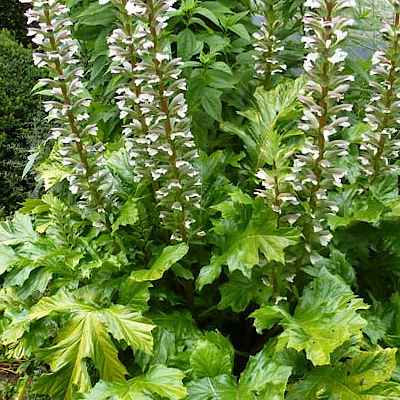
A particularly decorative variety, thanks of course to its flowers but also to the color of its foliage, as it appears yellow-green or golden-green in spring, bright green in summer and again yellow-green or golden-green in autumn. It is slightly smaller in growth than the typical species, reaching a height and diameter of 80 to 100 cm.
Acanthus mollis 'Rue Ledan'
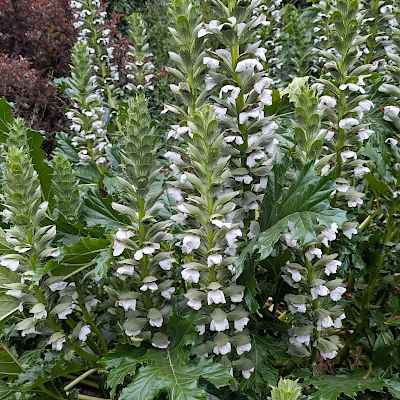
The element that makes this variety special is its pure white flowers with green bracts. In combination with the duration of its flowering, which reaches approximately three months, it is truly an impressive ornament for any garden. It is therefore not surprising that it has received the prestigious Award of Garden Merit from the Royal Horticultural Society of the United Kingdom. As a plant, it presents no difficulty in cultivation.
Acanthus mollis 'Tasmanian Angel'
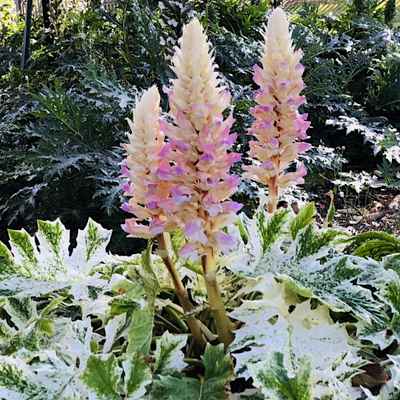
It comes from Tasmania, of course, and presents a unique ornamental interest as it has dark green leaves with irregular white margins and spots, while from its rich foliage grow the long flower stalks that on the spike inflorescence bear abundant pink flowers with pure white bracts. It is not a very cold-resistant variety, as the minimum tolerated values of the lowest temperatures should not fall below -9.4 °C (15 °F).
Acanthus mollis 'Whitewater'
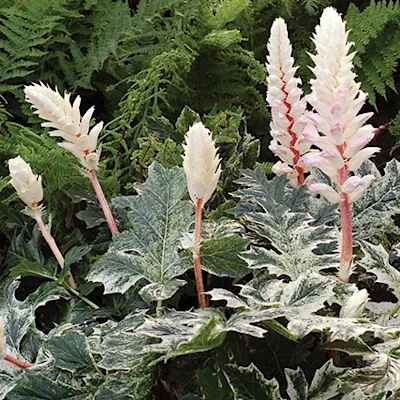
To create this very decorative variety, Acanthus mollis ‘Tasmanian Angel’ plants (pollen parent) were crossed with Acanthus x ‘Summer Beauty’ plants (seed parent). The result is attractive foliage, the bright green leaves of which are varied with white-cream margins and spots, and striking flowers, which are pure white at first, but gradually take on pink hues while the bracts remain white. Each spike inflorescence of the plant blooms for about 5 weeks, from May to July.
Bear’s Breeches (Acanthus mollis), the Corinthian Columns Capital Plant
Bear's Breeches (Acanthus mollis) - Use
Artistic
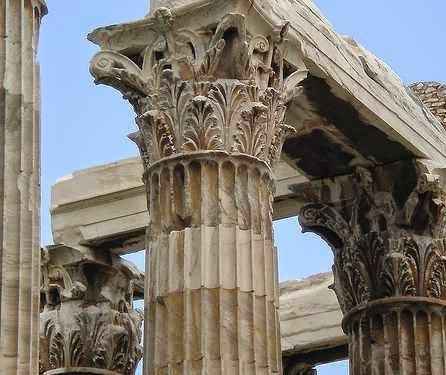
The Bear’s Breeches has been associated with art since classical antiquity. The plant first entered Architecture, with the inventor and creator of the Corinthian column capital, the sculptor and architect Callimachus (End of the 5th century BCE – mid 4th century BCE) and then, until about the end of the 19th century CE, passed to almost every other forms of art.
But more about this topic – as mentioned in the introductory note to this article – will find the art lover reader in the special tribute of “Kalliergeia” with an exclusive theme, the “artistic” dimension of the plant.
Pharmaceutical & Ethnobotany
Bear’s Breeches in both its widespread species, Acanthus spinosus and Acanthus mollis, are of great pharmaceutical interest but also of considerable ethobotany use.
Related research has shown what is rightly recommended in traditional medicine to use the roots as a cataplasm for treating psoriasis. This is why it has been shown that the methanolic extract of the leaves of the plant has inhibitory activity on cycloxygenase and lipoxygenase.
Still the Bear’s Breeches leaf extract has shown that it has antiparasitic activity against schistosoma (Blood-flukes – Schistosoma mansoni cercariae).
In traditional medicine, Bear’s Breeches is also recommended for the treatment of burns, wounds and sprains.
Use in Garden and Landscape
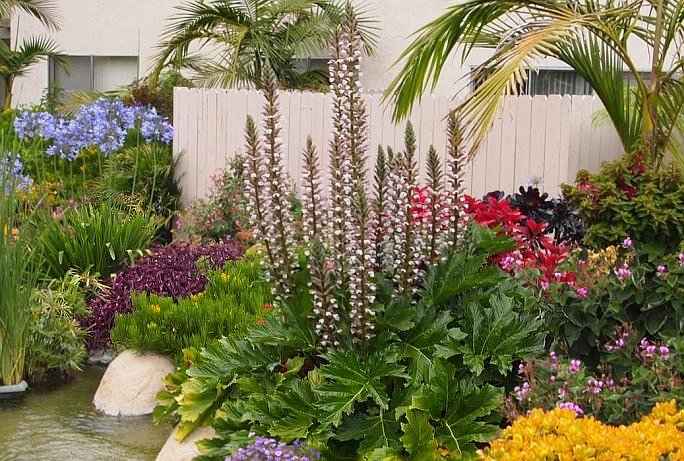
The Acanthus mollis is characterized as an architectural plant due to the geometric features of the foliage and its flowering parts. These features give great flexibility in its use.
Thus, among others, Bear’s Breeches can be planted:
-
Linear in front of buildings of neoclassical or modern rhythm. In the first case harmony will arise from the continuation of the architectural lines in the plant world, while in the second, from the dynamic contrast.
-
In groups between other shrubs and herbaceous, especially if it is desired to highlight the vertical-to-horizon level.
-
In the archaeological sites
-
Under olive trees used mainly for ornamental purposes.
-
In compositions with other shrubs and herbs such as Echinops, Salvias, New Zealand Flaxes and Box-Leaved Honeysuckles (eg Echinops bannaticus ‘Blue Glow’, Phormium tenax ‘Variegatum’, Salvia mexicana, Lonicera pileata ‘Moss Green’)
References
The References to the article entitled Bear’s Breeches (Acanthus mollis), the Corinthian Columns Capital Plant are presented by Gioconda’s Smile, which belongs not only to one of the most important paintings in Western painting but also to a potentially -mutatis mutandis- worthy musical work: Manos Hadjidakis from Gioconda’s Smile the composition When The Clouds Come.
- Brickell, C. (2019). RHS Encyclopedia of Plants and Flowers (6th ed.). DK Publishing (Dorling Kindersley).
- Carter, S., Becker, C., & Lilly, B. (2007). Perennials: The Gardener’s Reference. Timber Press (OR).
- Dijk, H. V. (1998). Encyclopaedia of Border Plants. The Netherlands: Rebo Productions.
- Filippi, O. (2008). The Dry Gardening Handbook: Plants And Practices For a Changing Climate : With Over 400 Colour Illustrations. London: Thames & Hudson.
- Llamas, K. A. (2003). Tropical Flowering Plants: A Guide To Identification And Cultivation. Timber Press (OR).
- Perry, B., & Perry, R. C. (2010). Landscape Plants for California Gardens: An Illustrated Reference of Plants for California Landscapes. Land Design Pub.
- Quattrocchi, U. (2016). Acanthus mollis. In CRC World Dictionary of Medicinal and Poisonous Plants: Common Names, Scientific Names, Eponyms, Synonyms, and Etymology (5 Volume Set) (1st ed., Vol. 1, pp. 43-44).
- Rice, G. (2012). Planting the Dry Shade Garden: The Best Plants for the Toughest Spot in Your Garden. Timber Press.
- Turner, R. G. (1996). The Ultimate Plant & Garden Book. New York: Crown Publishers Inc.
- Τεσσερομμάτη, Χ. (2016). Φυτά με Φαρμακολογικές Ιδιότητες – Σύγχρονες Φυτοθεραπευτικές Δυνατότητες [Plants with Pharmacological Properties – Modern Phytotherapeutic Capabilities]. Αθήνα: Εκδόσεις Σπανός – Βιβλιοφιλία.
Acanthus mollis: Missouri Botanical Garden
Clarification
Of course, it is needless to say – but we will emphasize it – that in this handmade website, no article has been and will not be written with recourse to Artificial intelligence (AI). Natural Intelligence, that is, as much of it as we have and for as long as we are allowed to have it, is enough for us.
Sharing
The use of the material, where third-party rights are not mentioned or implied (such as photos or audiovisual files - with the exception of those belonging to "Kalliergeia"), is absolutely free. Its sharing, possibly, useful.