Introduction
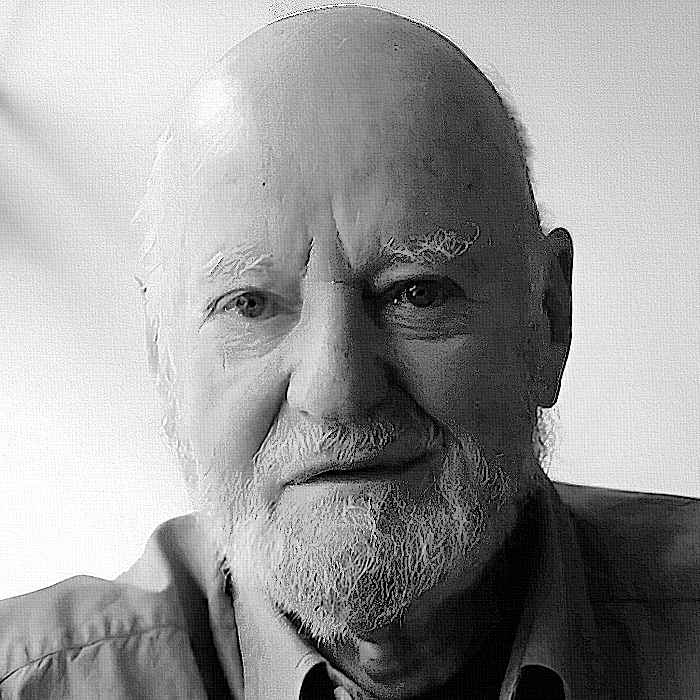
The poem titled And the Arabs Asked Terrible Questions … was written by the important American poet and writer Lawrence Ferlinghetti (March 24, 1919) and is included in the collection Pictures of the Gone World, published in 1955 by City Lights Publishers.
In the introduction to the anniversary edition of the collection in 2015, Lawrence Ferlinghetti wrote that ‘there is a freshness of perception that only young eyes have, in the dandelion bloom of youth’.
With almost a century of creativity behind him, and having established himself in American literature and internationally as an iconic figure who still has young eyes, he is a living literary monument.
All that remains is his official proclamation as such.
(Article Update: Although he ultimately passed away on February 22, 2021, his official proclamation-although undoubtedly mortal- as a living monument remains a notable pending issue).
Something like a Very Brief Biography of Lawrence Ferlinghetti
Ferlinghetti was born Lawrence Monsanto Ferlinghetti on March 24, 1919, in Yonkers, New York. He grew up in a foster family, as his Italian immigrant father took the untimely initiative to die of a heart attack shortly before his birth, and not long after, his Sephardic mother was admitted to a psychiatric clinic.
After completing his secondary education (Mount Hermon School for Boys), he attended the University of North Carolina, where he received a Bachelor of Arts (BA) degree in journalism in 1941. And after getting through World Carnage II, he took courses in English literature at Columbia University, earning a master’s degree (MA) in 1947. Not content with these degrees and diplomas, he went to the Sorbonne, where he received a doctorate in comparative literature.
In 1951, he settled in San Francisco, a city he never left. In 1953, he helped found the historic City Lights bookstore, and in 1955, he became its sole owner.
In 1958, New Directions published his now classic poetry collection A Coney Island of the Mind, which established his reputation. Other important works of his are mentioned below, but here we will refer to another aspect of his creativity, which is none other than his involvement in painting: for many decades, galleries and museums in the US have hosted his works.
In addition to his dedication to the arts, Ferlinghetti was also a consistent political activist, with Buddhism and philosophical anarcho-communism as his ideological starting points.
Something like a Very Brief Reference to City Lights Bookstore
It is impossible to write about Ferlinghetti without mentioning City Lights bookstore and, consequently, Peter Dean Martin (1923–1988).
Peter D. Martin was the son of the well-known Italian-American anarchist Carlo Tresca and nephew of Elizabeth Garley Flynn, chair of the National Committee of the Communist Party USA. After moving from New York to San Francisco to teach sociology at San Francisco State College, in 1953 he came up with the brilliant, innovative idea of opening the City Lights bookstore, selling only paperback books. On the day he hung up the shop sign, Ferlinghetti happened to be passing by. He struck up a conversation with Martin, shared his enthusiasm, and eventually they became partners.
Their collaboration lasted no more than two years, as Peter Martin left to return to New York, where he founded the New Yorker Bookstore, which closed permanently in 1982.
On the other hand, when City Lights passed entirely into his hands, Ferlinghetti also founded the historic publishing house City Lights Publishers. Its main purpose was, especially through the Pocket Poets series, to introduce contemporary poetry to a wider readership.
The publishing house has released a plethora of important beat and other poets (Marie Ponsot, Allen Ginsberg, William Carlos Williams, Robert Duncan, and Denise Levertov). However, the publication of Allen Ginsberg’s poetry collection Howl and Other Poems (1956) remained unforgettable. This was because Ferlinghetti was arrested due to the release of this now classic work. He was tried (1957) on charges of publishing an obscene work and, fortunately for the good reputation of the United States, was acquitted.
Something like a Very Brief Bibliography
A multifaceted personality, Ferlinghetti engaged in a multitude of intellectual and artistic activities. However, we will not discuss all these aspects here: instead, the only thing that will be recorded here is that part of his poetic and literary work that is evaluated by our textual and subjective, but always objective, judgment as the most important.
Poetry
- Pictures of the Gone World (1955)
- A Coney Island of the Mind (1958)
- Starting from San Francisco (1961)
- The Secret Meaning of Things (1969)
- Open Eye, Open Heart (1973)
- Landscapes of Living and Dying (1979)
- Endless life: The Selected Poems (1981)
- Over all the Obscene Boundaries (1984)
- These are My Rivers (1995)
- Americus, Book I (2005)
Novel
- Her (1960)
- Love in the Days of Rage (1988)
… And after presenting Ferlinghetti’s most important works, based purely on objective criteria, as we have clearly explained, the moment has come to present the poem “And the Arabs Asked Terrible Questions …”, as follows.
L. Ferlinghetti - And the Arabs Asked Terrible Questions …
And the Arabs asked terrible questions
and the Pope didn’t know what to say and the people
ran around in wooden shoes asking which way was the
head of Midas facing and everyone said
No instead of Yes
While still forever in the Luxembourg
gardens in the fountains of the Medicis were the
fat red goldfish and the fat white goldfish
and the children running around the pool
pointing and piping
Des poissons rouges!
Des poissons rouges!
but they ran off
and a leaf unhooked itself
and fell upon the pool
and lay like an eye winking
circles
and then the pool was very
still
and there was a dog
just standing there
at the edge of the pool
looking down
at the tranced fish
and not barking
or wavilig its funny tail or
anything
so that
for a moment then
in the late November dusk
silence hung like a lost idea
and a statue turned
its head
Lawrence Ferlinghetti, 1955
Poem from the collection Pictures of the Gone World (1955)
Lawrence Ferlinghetti Speaking at UCLA
On May 20, 1969, Lawrence Ferlinghetti responded to an invitation from the University of California, Los Angeles (UCLA) to give a lecture there. The entire event was recorded in the archives of the UCLA Communications Studies Department and digitized in 2013.
- Cherkovski, N. (1979). Ferlinghetti, a Biography. Knopf Doubleday Publishing Group.
- Felver, C. (1998). Ferlinghetti Portrait. Salt Lake City: Gibbs Smith Publishers.
- Ferlinghetti, L. (2015). Pictures of the Gone World. City Lights Publishers.
- Morgan, B., & Peters, N. J. (2006). Howl on Trial: The Battle for Free Expression. City Lights Books.
- Silesky, B. (1990). Ferlinghetti, the Artist in His Time. Little Brown & Company.
- Skau, M. (1989). “Constantly Risking Absurdity”: The Writings of Lawrence Ferlinghetti. Whitston Pub Co Inc.
- Smith, L. R. (1983). Lawrence Ferlinghetti, Poet-at-Large. Southern Illinois University Press.
- Φερλινγκέτι, Λ. (2015). Ατέλειωτη Ζωή (Γ. Μπλάνας, Μετ.). Αθήνα: Ελεύθερος Τύπος.
- Lawrence Ferlinghetti: Interview – The Guardian
Clarification
Of course, it is needless to say – but we will emphasize it – that in this handmade website, no article has been and will not be written with recourse to Artificial intelligence (AI). Natural Intelligence, that is, as much of it as we have and for as long as we are allowed to have it, is enough for us.
Sharing
The use of the material, where third-party rights are not mentioned or implied (such as photos or audiovisual files - with the exception of those belonging to "Kalliergeia"), is absolutely free. Its sharing, possibly, useful.