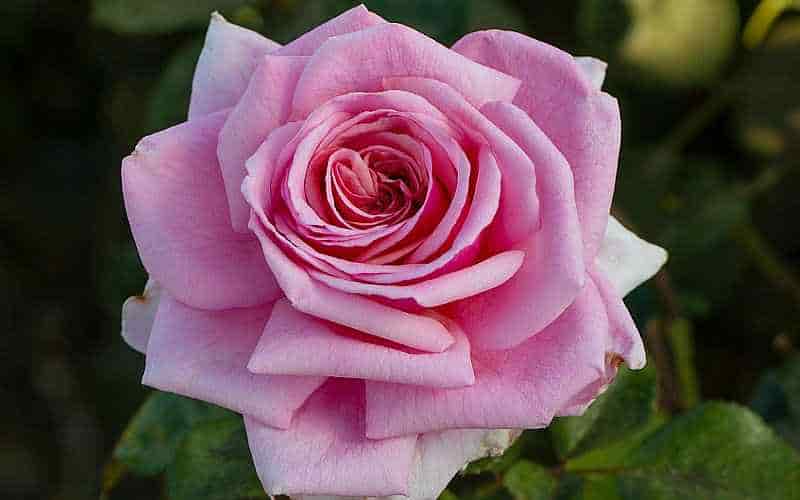
‘Aloha’ Rose belongs to climbing hybrid tea roses and is classified in Modern Roses.
It is another historical Rosa variety, not only because it was released in 1949, but also because of its exceptional breeder Eugene Boerner, the so-called Papa Floribunda – whose works and life we reserve the right to craft a “satisfying” portrait-tribute, but in due course.
Several decades after its breeding, climbing Rose ‘Aloha’ remains a hugely popular plant.
And its name, the word ‘Aloha’, derives from the Hawaiian language of Polynesian origin, which means love, affection, peace, compassion and mercy.
Bearing in mind the creation time of this variety of Rose, it is up to the reader to choose whichever interpretation suits him best.
‘Aloha’ Rose (Climbing Hybrid Tea – Modern Roses)
'Aloha' Rose - General Information
The course of the creation of the ‘Aloha’ rose variety is given below, while here we provide some brief identifying details and its basic characteristics.
Facts in Short
Family: Rosaceae
Genus: Rosa
Scientific Name: Rosa ‘Aloha’
Common Names: ‘Aloha’ Rose, Rosa ‘Aloha’, ‘Aloha’ Climbing Rose, Climbing Rose ‘Aloha’
Horticultural Group: Climbing Hybrid Tea – Modern Roses
Plant Breeder: Eugene Boerner – USA, 1949
Awards: Award of Garden Merit – Royal Horticultural Society, 2002
Uses In Brief
This Rose variety is suitable for:
- Specimen
- Mass plantings
- Informal hedges
- Urban plantings
- Pots & containers
- Cut flowers
‘Aloha’ Rose (Climbing Hybrid Tea – Modern Roses)
Breeding & Landscape Attributes
Breeding
The hybrid climbing ‘Aloha’ Rose is the result of the efforts of breeder Eugene Boerner, who crossed the varieties Rosa ‘Mercedes Gallart’ x Rosa ‘New Dawn’.
‘Mercedes Gallart’ (1930), the male parent, was created by Spanish nurseryman Blas Munné. It belongs to the hybrids tea and has pink-fuchsia roses. ‘New Dawn’ (1930), the female parent, is a natural mutation derived from the Rosa ‘Dr. W. Van Fleet’ variety.
The mutation was noticed by landscape gardener Henry F. Bosenberg, who reproduced the plant and patented it – the first plant patent in the US (U.S. Plant Patent no. 1). ‘New Dawn’ is a climbing variety of repetitive blossoms.
It belongs to the Hybrid Perpetual roses, and its flowers are light pink in color.
Landscape Attributes
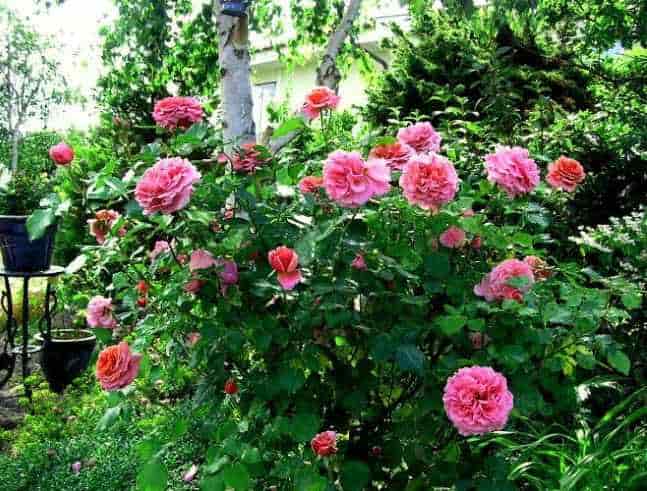
The new climbing ‘Aloha’ Rose, combining features of both parent plants, is a tall, vigorous, woody, deciduous perennial shrub.
In terms of size, the height of the plant reaches 2.5 to 4 m (8-13 ft) while its diameter varies between 1.5 and 2.5 m (5-8 ft) – reaching its dimensions within a period of 2 to 5 years after its planting. Still, it has upright appearance with a dense canopy, which is rather symmetrical with an irregular outline.
The dominant decorative element of the plant is of course the aromatic pink roses that appear during its repeated and extended flowering – flowering that starts from the end of May and ends with the first cold in October – November.
However, it is worth mentioning the highly decorative value of leather foliage that best highlight the produced roses.
Its life span is over 25 years.
‘Aloha’ Rose (Climbing Hybrid Tea – Modern Roses)
'Aloha' Rose - Description
‘Aloha’ Rose is a shrub moderately branched with shoots that have thorns. Its leaves are composite, consisting mainly of 5 leaflets, oval – ellipsoid and toothed. The tip of the leaflets ends at a acute peak while their color is deep green.
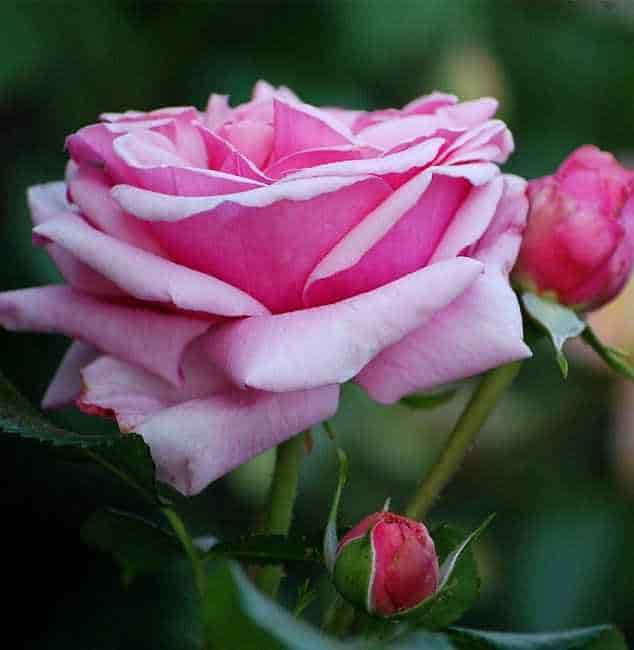
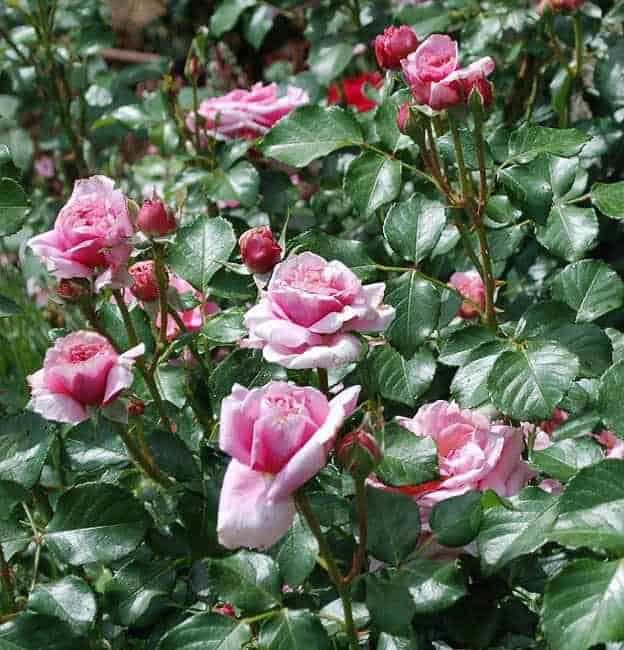
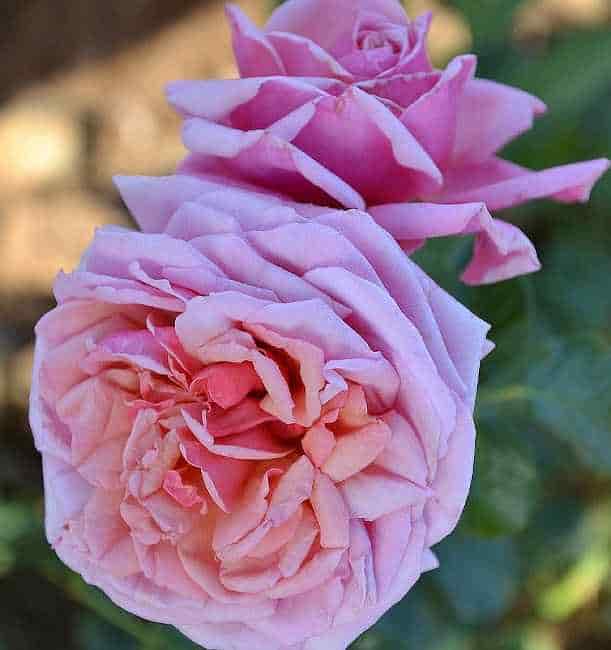
The roses are formed in clusters at the top of their annual shoots, usually 3 to 5 per stem. They are double, large in size with a diameter of 10 to 12 cm (4-5 in). They consist of 50 to 60 petals whose color is of medium pink intensity – slightly deeper on the back surface.
They are moderate to strong aromatic, and their fragrance reminds the feeling that remain of mature apple.
During the flowering period it attracts the beneficial insects, among which includes and the butterflies.
‘Aloha’ Rose (Climbing Hybrid Tea – Modern Roses)
'Aloha' Rose - Environment of Establishment
‘Aloha’ Rose is very resistant to cold plant. Its lowest temperature tolerance ranges from -23 to -26 °C (-10 to -15 °F – USDA Hardiness zone 5b), while fully established roses of the variety can withstand minimum temperatures up to -29 °C (−20 °F) without being damaged.
In relation to the soil, ‘Aloha’ Rose – like most roses – is recommended to be planted in fertile and rich in organic matter loamy soils, which must have extra and excellent drainage.
In terms of soil pH the appropriate range is relatively large, ranging between 5.6 and 7.8. However, it thrives in soils that have a slightly acidic to neutral reaction, ie at pH values ranging from 6 to 7.
In relation to the exposure, it can be planted in both sunny and semi-shady places, while its impeccable flowering is also characteristic in even days of constant clouds.
In addition, it should be noted that its roses are not destroyed by the rains.
‘Aloha’ Rose (Climbing Hybrid Tea – Modern Roses)
'Aloha' Rose - Uses
‘Aloha’ Rose contributes in many ways to the decoration of gardens and landscapes, because it has excellent fragrance, repeated blooming and still it is vigor and robust as a plant.
Thus, it could generally be said that ‘Aloha’ Rose:
-
It is cultivated for its roses, which as a cut flower can last in the vases from about 5 to 8 days
-
It is used in the garden as a plant of particular interest
-
It is used in the garden planting in groups of three
-
It is used in the garden in conmpanion with other plants such as Lavandula angustifolia (English Lavender), Lychnis coronaria (Rose Campion) and Clematis ‘Jackmanii’ (Late Large-Flowered Clematis)
-
It can be planted as an informal hedge plant
-
Can be used as a climbing plant on walls, trellis and pergolas, with appropriate support
-
Can be pruned appropriately to shrub
-
Finally, it is possible to plant it in large-sized pots and full-sun exposures
‘Aloha’ Rose (Climbing Hybrid Tea – Modern Roses)
References
The References to the slightly Hawaiian article with a little English essay and titled ‘Aloha’ Rose (Climbing Hybrid Tea – Modern Roses), are presented by the excellent gentlemen J.J. Cale and Eric Clapton, with the song of the first of them After Midnight.
- Armitage, A. M. (2011). Armitage’s Vines and Climbers: A Gardener’s Guide to the Best Vertical Plants. Timber Press.
- Bhattacharjee, S. K., & Banerji, B. K. (2010). The Complete Book of Roses. Jaipur: Aavishkar Publishers.
- Brickell, C. (2019). RHS Encyclopedia of Plants and Flowers. Dorling Kindersley.
- Quest-Ritson, C., & Quest-Ritson, B. (2003). The American Rose Society Encyclopedia of Roses. DK Publishing (Dorling Kindersley).
- Publishing, D. K., Bown, D., & Joyce, D. (1996). Roses. London, England: Dk Pub.
- Scanniello, S. (1994). Climbing Roses. Macmillan General Reference.
- Schneider, P. (2009). Right Rose, Right Place. Storey Publishing.
- Thomas, G. S. (1966). Climbing Roses Old and New. New York, NY: St. Martins’s Press.
- Rosa ‘Aloha’: Wikimedia Commons
With Pomp and Circumstance
VIDEO
J. J. Cale and Eric Clapton blossom together on stage After Midnight (Crossroads Guitar Festival 2004).
Clarification
Of course, it is needless to say – but we will emphasize it – that in this handmade website, no article has been and will not be written with recourse to Artificial intelligence (AI). Natural Intelligence, that is, as much of it as we have and for as long as we are allowed to have it, is enough for us.
Sharing
The use of the material, where third-party rights are not mentioned or implied (such as photos or audiovisual files - with the exception of those belonging to "Kalliergeia"), is absolutely free. Its sharing, possibly, useful.