Home » PLANTS & CROPS »
The Peach Leaf Curl Disease (Taphrina deformans)
CONTENTS ⌵
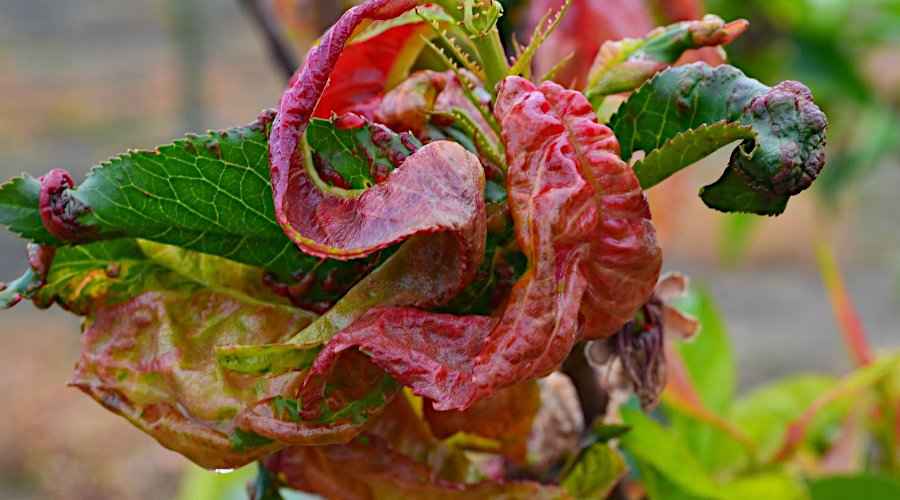
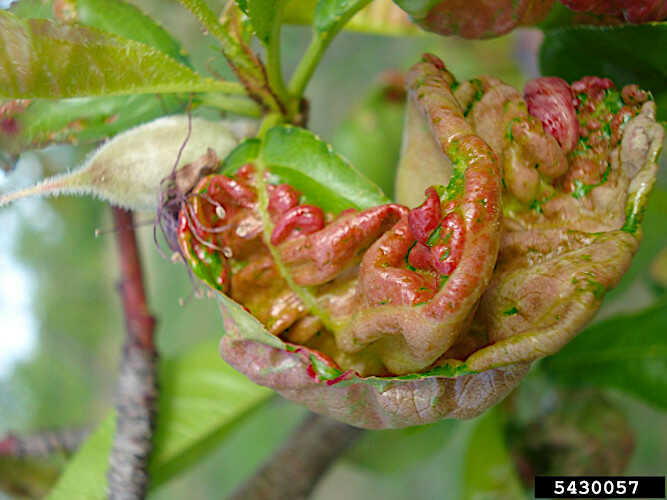
The Peach Leaf Curl caused by the ascomycete fungus Taphrina deformans. The disease is considered extremely serious as the pathogen causes significant damage to the tree and crop, including severe defoliation, a significant reduction in peach production, and it might dry the tree completely.
In addition to Peach, T. deformans infects other Stone Fruits, as well as Almonds from Nuts.
The Peach Leaf Curl belongs to the genus Taphrina (syn. Exoascus), in which all the Exoascus species are classified. Of these, Taphrina wiesneri (syn. T. cerasi) infects the Cherry, T. pruni infects Damson Plum, and T. armeniacae infects the Apricot.
Despite the similarities that the Exoascus fungi present to each other, in this article only the Peach Leaf Curl will be mentioned. More specifically, the taxonomic scheme of the parasite will be given, its main biological forms will be described, and its biology and ecology will be presented in general.
Of course, it would be an unforgivable omission on our part, if we did not make it known that there will soon be another article dedicated exclusively to the methods, means and ways of control T. deformans.
As it would likewise be an inexcusable omission, if we did not make known to the philistine reader of “Kalliergeia”, the firm belief of almost the entire scientific community, that the fungus was first arbitrarily introduced to European Peach growers in the distant 1841, coming directly from the native tree land, the (then) imperial China.
The Peach Leaf Curl Disease (Taphrina deformans)
Classification of the Taphrina deformans
Peach Leaf Curl is classified in the Kingdom of the Fungi and in the Subkingdom Dikarya. The complete taxon of the fungus is listed below.
Classification
- Domain: Eukaryota (Eukarya)
- Kingdom: Fungi
- Subkingdom: Dikarya
- Phylum: Ascomycota (Sac Fungi)
- Subphylum: Taphrinomycotina
- Class: Taphrinomycetes
- Subclass: Taphrinomycetidae
- Order: Taphrinales
- Family: Taphrinaceae
- Genus: Taphrina
- Species: T. deformans
Taphrina deformans (Berk.) Tul. (1866)
➤ Teleomorph: Taphrina deformans (Berk.) Tul. (1866)
➤ Anamorph: Lalaria deformans (Moore 1990)
Synonyms
- Ascomyces deformans Berk. (1860)
- Exoascus deformans (Berk.) Fuckel (1870)
- Exoascus amygdali Jacz. (1926)
- Taphrina amygdali (Jacz.) Mix (1936)
Common Names
- Greek: Εξώασκος της Ροδακινιάς, Καρούλιασμα Φύλλου Ροδακινιάς
- English: leaf blister; leaf blister of peach; leaf curl of peach
- Spanish: abolladura del melocotonero; arrufat (melocotonero); lepra del melocotonero; verrucosis del durazno
- French: cloque de l’amandier; cloque du pecher
- Germany: Kraeuselkrankheit; Pfirsich
- Chinese: 畸形外囊菌
- Arabic: الفطر المسبب
The Peach Leaf Curl Disease (Taphrina deformans)
Description of The Peach Leaf Curl
The main biological forms of the Peach Leaf Curl are described, such as the mycelium, asci, ascospores, as well as conidia.
Mycelium
The mycelium of Taphrina deformans is yellowish-cream to pinkish-cream, butyrous, and have a smooth and glossy surface. Its mycelial hyphae consist of cells whose shape is mainly oval to ellipsoid, 3.3 to 4.9 µm in diameter and 5.1 to 7.7 µm in length.
Aski
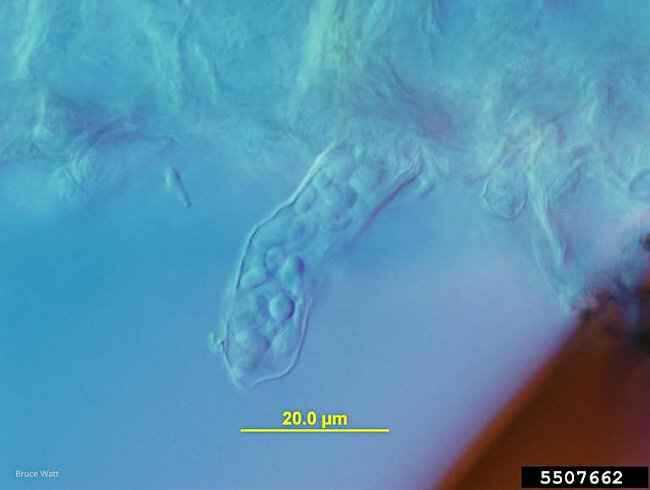
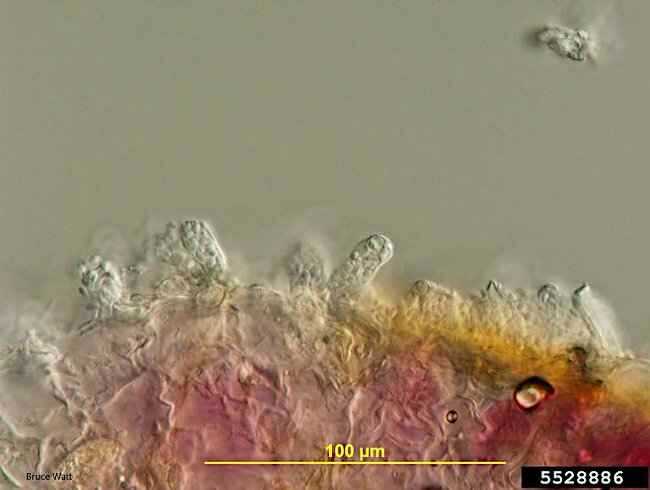
The aski are cylindrical-clavate shaped and rounded or truncate at the apex. Their length dimensions range between 17 and 56 µm, while the diameter is between 7 and 15 µm.
Ascospores
Within each ascus up to 8 ascospores are formed – sometimes only 2. They are unicellular, ovoid or ellipsoidal and vitreous, with length and diameter ranging from 3 to 7 µm.
Conidia
The conidia (blastospores) of the Peach Leaf Curl range in size from 2 to 6 µm in length and 4.5 µm in diameter.
The Peach Leaf Curl Disease (Taphrina deformans)
The Biology & Ecology of Taphrina deformans
The Taphrina deformans belongs to the phytopathogenic fungi, whose territory is planetary: it is sufficient to refer only to the extensive cultivation zone of Peach, located between latitude 25 ° North and 45 ° South, to understand its range.
Its biological cycle is biphasic as it contains a parasitic and a saprophytic phase, reproduces both sexual with ascospores and asexual, with conidia (or blastospores), while the disease it causes is not polycyclic as it is rarely observed and secondary infections.
All of this, but also a little more, are discussed below.
Biological Cycle
In early spring and with low temperatures and high relative humidity, the fungus mainly enters by its germinated bud-conidia in the host tissues.
There it settles in the intercellular spaces of the upper epidermis by developing a dense network of mycelial textures. With the appearance of the sexual reproductive organs, the asci, break through the cuticle and erupt the ascospores.
Ascospores by budding produce conidia, which are dispersed into new plant parts and leaves by drops of rain or irrigation water.
Both in the form of ascospores and conidia, Taphrina deformans will pass the summer on host tissues, where in autumn, again with low temperatures and high relative humidity, ascospores will produce new bud-conidia.
Gradually, as they become more numerous, the conidia will form a thin film on the host’s tissues, remaining there until spring.
Parasitic Phase
The parasitic phase of the Peach Leaf Curl starts by spores that produce a hypha which penetrates the cuticle and invades the plant tissues between the epidermal and the parenchyma cells and lasts until the dispersal of its native reproductive products, the ascospores, during late spring through early summer.
Saprophytic Phase
Saprophytic phase is manifested by the budding of ascospores and the formation of vegetative (asexual) products, the conidia (blastospores). With ascospores and blastospores, the fungus settles mainly on the bark of Peach tree in the summer, as well as other infested trees.
The Peach Leaf Curl Disease (Taphrina deformans)
Biology of Reproduction of the Peach Leaf Curl
Sexual Reproduction
As the mycelium grows, ascogenic cells are formed. Ascogenic cells elongate perpendicular to the surface of the host, lifting the cuticle of leaves, while at the same time the individual nuclei of each cell unite to form a diploid (Zygote).
The diploid nucleus is divided by mitosis, and from the two resulting nuclei, one moves to the distal end of the elongated ascogenous cell while the other remains at the base. The cell is then divided by producing two unequal daughter cells.
The larger of these is the ascus mother cell, and the smaller, the stalk cell, connects the parent to the mycelial textures.
The forming asci growth upward, and rises the pierced or torn cuticle of the leaves and reveal on the surface appearing as a more or less continuous hymenium.
Within the asci, with successive nucleation, up to 8 haploid nuclei are formed, respectively formed up to 8 ascospores.
Eventually the ascosporia are dynamic expelled through an apical slit or rupture at the top of the asci which most often accumulate on the surface of the leaves, giving them the characteristic white or ash powdery condition.
Asexual Reproduction
Asexual reproduction of Taphrina deformans occurs with conidia (or blastospores). Conidia are produced by ascospores either by budding them into the asci, where they can form up to 16 to 18 conidia, or after the ascospores are released.
Conidia have the potential to produce mycelium or new conidia.
For the production of mycelium, during conidia budding their nucleus is divided. The resulting two nuclei move and divide at the same time, forming hyphae on the host whose cells are binuclear.
The Peach Leaf Curl Disease (Taphrina deformans)
Overwintering & Oversummering of the Fungus
Overwintering
The Peach Leaf Curl overwintering with both conidia and ascospores – though with the latter less common. The conidia remain in the soil or are dispersed on the tree, in the folds of the bark, trunk and branches, as well as on the bud scales. Extremely resistant to adverse weather conditions, they can survive for more than two years.
Oversummering
The Peach Leaf Curl oversummering epiphytic or saprophytic, in high temperatures in summer, as ascospores and bud-conidia (blastospores), and in places on the tissues of the affected trees.
It mainly resides in the outer bark of Peach trees as part of the multitude of other non-harmful epiphytic fungal organisms and their colonies.
The Peach Leaf Curl Disease (Taphrina deformans)
Hosts of the Taphrina deformans Fungus
Peach Leaf Curl infects numerous plants, both fruitful and ornamental. The most important hosts of this phytopathogenic fungus are listed below.
Hosts
Fruit Trees
- Prunus persica (Peach)
- Prunus persica var. nucipersica, συν. Prunus persica var. nectarina (Nectarine)
- Prunus avium (Sweet Cherry)
- Prunus domestica (Common Plum)
- Prunus armeniaca (Armenian Plum)
- Prunus dulcis (Almond)
Ornamental Plants
- Prunus spp. – Ornamental varieties of Prunus
The Peach Leaf Curl Disease (Taphrina deformans)
Geographical Distribution of Peach Leaf Curl
What we stated in a previous article about the Apple Powdery Mildew is also true for the Peach Leaf Curl: its absence from the Poles is more than noticeable.
The Peach Leaf Curl Disease (Taphrina deformans)
References
The References of this curly article of ‘Kalliergeia’, such as that for Peach Leaf Curl disease, are presented by the excellent Daraa Tribes with their song titled Rohal.
- Agrios, G. N. (2005). Plant Pathology. Amsterdam, Netherlands: Elsevier.
- Kurtzman, C., Fell, J., & Boekhout, T. (2011). The Yeasts: A Taxonomic Study. Amsterdam, Netherlands: Elsevier.
- Ogawa, J. M., & English, H. (1991). Diseases of Temperate Zone Tree Fruit and Nut Crops. UCANR Publications.
- Ownley, B. H., & Trigiano, R. N. (2016). Plant Pathology Concepts and Laboratory Exercises (3rd ed.). CRC Press.
- Vidhyasekaran, P. (2004). Concise Encyclopedia of Plant Pathology. CRC Press.
- Παναγόπουλος, Χ. Γ. (1987). Ασθένειες Καρποφόρων Δένδρων & Αμπέλου [Diseases of Fruiting Trees & Vines]. Αθήνα: Καραμπερόπουλος Α.Ε.
- Taphrina deformans (Berk.) Tul. 1866: Global Biodiversity Information Facility (GBIF)
With Pomp and Circumstance
VIDEO
Sounds of Daraa Tribes from the Daraa River Valley of southeast Morocco – via the Netherlands.
Clarification
Of course, it is needless to say – but we will emphasize it – that in this handmade website, no article has been and will not be written with recourse to Artificial intelligence (AI). Natural Intelligence, that is, as much of it as we have and for as long as we are allowed to have it, is enough for us.
Sharing
The use of the material, where third-party rights are not mentioned or implied (such as photos or audiovisual files - with the exception of those belonging to "Kalliergeia"), is absolutely free. Its sharing, possibly, useful.