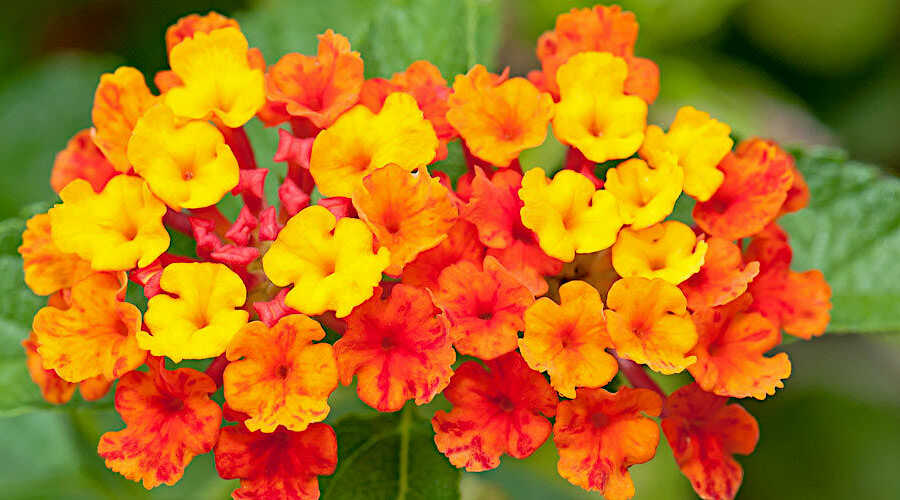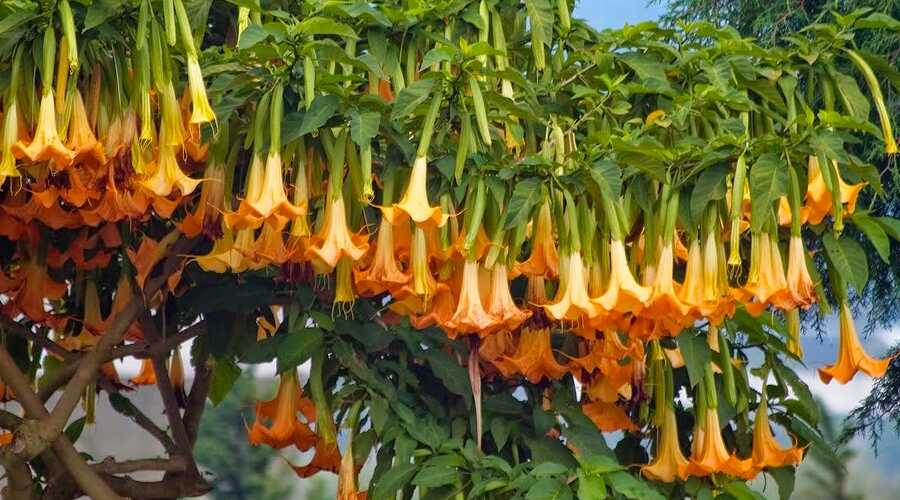
The genus Brugmansia (Brugmansia Pers.) consists of plant species, which have unusually large and fragrant flowers.
And while it could, it’s not, or at least that wasn’t the main reason they have linked their fortunes to human activity for centuries.
Because human communities began cultivating them in South America almost 10,000 years ago, not for their ornamental but for their therapeutic and entheogenic properties.
Of course the species of the genus paid for this relationship somewhat expensively: they did not disappear completely like other plant species, but abandoned their wild state and natural evolution.
On the other hand, it is a fact that for about four decades, the plants of the genus have gained worldwide distribution, primarily in the form of hybrids, which further highlighted the attractive ornamental characteristics of their flowers.
Whether the so-called Psychonauts also contributed in this direction is a possibility that the well-known editorial team of “Kalliergeia” is impassively investigating.
Genus Brugmansia – Taxonomy & Description
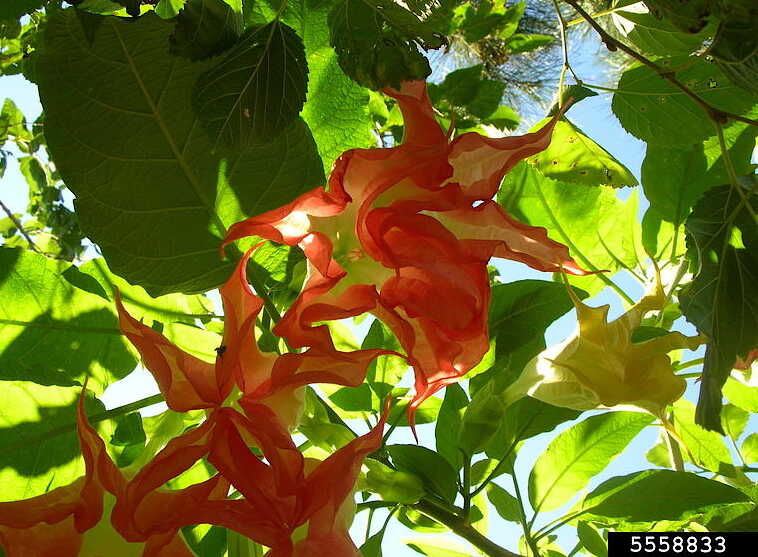
Brugmansia arborea Flowers
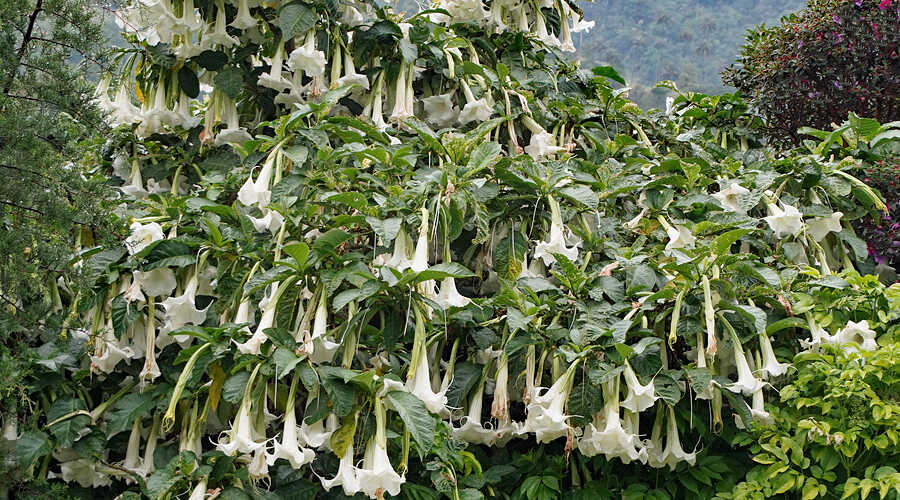
Genus Brugmansia – Taxonomy & Description
The Inclusion of Brugmansia Species in a Separate Genus
For the species belonging to the genus Brugmansia, it could be said that, as with the Pomegranate, although cultivated for thousands of years by humans, many aspects of them have not been scientifically researched in depth.
One of them is the taxonomic one.
The Taxonomic Adventures of the Genus Brugmansia
The master of systematic Carl von Linné or as he is better known on τηε English-speaking Charles Linnaeus, in its work Species Plantarum of 1753 settled the species of Brugmansia in the genus Datura.
The excellent and insightful German mycologist Christiaan Hendrik Persoon, who made successful additions to the fungal taxonomic system of the former, recognized in 1805 that it was a distinct genus, and baptism it Brugmansia, separated them.
For the next 168 years, however, systematic botanists played tennis with species of the genus, sometimes placing them in the genus Datura and others in the genus Brugmansia.
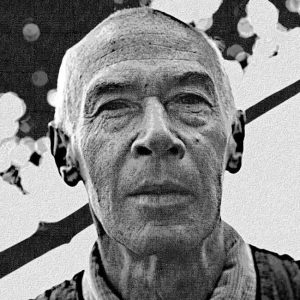
The sport came to an end (?) only in 1973, when Tommie Earl Lockwood, with well-founded arguments, attributed its unique characteristics to each genus.
Genus Brugmansia – Taxonomy & Description
The Theses of Lockwood
In brief, the fruitful remarks of T.E. Lockwood, who established the botanical distinction of the two genera are listed in the following table.
Morphological Comparison Of Datura & Brugmansia
Habit, Growth, Form & Longevity
| |
|---|---|
Herbaceous annuals or shortlived perennials which die back to their roots
| Woody, relatively long-lived arborescent shrubs or small trees, producing vascular cylinders of considerable size |
Vegetative axes restricted to the basal portions of the plant
| Vegetative axes not limited to the basal portions of the plant |
Branching restricted to the inflorescence | Branching not restricted to the inflorescence |
Plants lacking an effective means of vegetative reproduction | Plants reproducing vegetatively by root suckers and forming sizable clones |
Inflorescence | |
|---|---|
Inflorescence predominantly dichasial
| Inflorescence predominantly monochasial |
Inflorescence is localized to the
upper portions of the plant, and once initiated does not revert to vegetative growth
| Inflorescence not localized and reverts to a vegetative axis at the end of flowering |
The major part of the plant is inflorescence
| The major part of the plant is not inflorescence.
|
Flower | |
|---|---|
Flowers borne in an erect position | Flowers pendulous or inclined, never erect |
Flowers closing during the day and opening in the evening
| Flowers remaining open duringthe day and throughout anthesis
|
Anthesis one or two days
| Anthesis four to six days |
Calyx not spathe like except in Datura cerotocaula, the calyx teeth usually separating more or less equally
| Calyx frequently spathe-like or split along more than one side doe to the failure of the calyx teeth to separate
|
Fruit | |
|---|---|
Fruit a relatively small, dehiscent berry or capsule borne on short pedicels in an erect, suberect or nodding position
| Fruit a large pendulous berry borne on much eloneated pedicels |
Fruit in most species possessing a dehiscence mechanism
| Fruit lacking any dehiscence mechanism
|
Pericarp usually spinose | Pericarp smooth and unarmed |
Seeds | |
|---|---|
Seeds relatively small and lacking a corky seed coat
| Seeds large and most species with a thick, corky seed coat
|
Seeds usually with a well developed funicular caruncle
| Seeds lacking a caruncle
|
What Does It Mean—Apart from the Obvious—The Question Mark
The always observant reader of “Kalliergeia” will notice that in the previous chapter which refers to the taxonomic adventures of the genus, there is a question mark somewhere in the last paragraph.
The question mark is justified since the taxonomic scheme listed below and recognizing that a total of 7 species belong to the genus Brugmansia, is not generally acceptable.
For the always observant and systematic reader of “Kalliergeia” the opposite would be strange
What is not disputed, however – at least as of this writing – is that it is a separate botanical genus.
Genus Brugmansia – Taxonomy & Description
Genus Brugmansia (Brugmansia Pers.) & Species Classification
- Domain: Eukaryota (Eukarya)
- Kingdom: Plantae (Plants)
- Subkingdom: Viridaeplantae (Green Plants)
- Infrakingdom: Streptophyta (Streptophytes)
- Superphylum: Embryophyta (Land Plants)
- Phylum: Tracheophyta (Vascular Plants)
- Subphylum: Spermatophytina (Seed Plants)
- Class: Dicotyledonae (Dicotyledons)
- Order: Solanales
- Family: Solanaceae (Nightshades)
- Tribe: Datureae (Thornapples)
- Genus: Brugmansia Pers. (Angel’s Trumpet)
Section: Brugmansia
Species:
- Brugmansia aurea Lagerh.
- Brugmansia insignis (Barb.Rodr.) Lockwood ex R.E. R.E.Schult.
- Brugmansia suaveolens (Willd.) Sweet
- Brugmansia versicolor Lagerh.
Section: Sphaerocarpium
Species:
- Brugmansia arborea (L.) Sweet
- Brugmansia sanguinea (Ruiz & Pav.) D.Don
- Brugmansia vulcanicola (A.S.Barclay) R.E.Schult.
Note: From the above it can be seen that the species are divided into two natural, genetically isolated groups, the Brugmansia Section group which includes the Warm Group Brugmansias, and the Sphaerocarpium Section group which includes the Cold Group Brugmansias – the most tolerant in the cold.
Genus Brugmansia – Taxonomy & Description
Distribution and Ecology of Genus Brugmansia
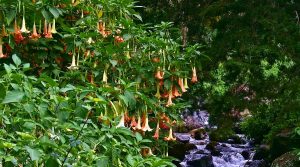
As mentioned in the introduction of this article, of the 7 species constitute the genus Brugmansia there is no one who forms wild natural populations.
This is the reason why in the Red List of Threatened Species of the International Union for Conservation of Nature (ICUN), also known as simply the “Red List“, all species of the genus are listed as Extinct in the Wild.
What we know about them is related either to the fact that they are cultivated by humans or to the fact that they escaped of cultivation, and therefore the reference to the distribution and ecology of these species should be seen from this point of view.
Origin
The genus Brugmansia is native to the tropics of South America. Its cradle occupies an area whose northern tip reaches as far as Venezuela, southern to northern Chile, eastern to Brazil and the Atlantic coast, while western occupies the Andean Cordillera to the Pacific.
Extremely attractive plants, Brugmansia species are now cultivated as ornamental plants all over the world. This pleasant event gave the genus plants the opportunity to spread spontaneously as weeds, developing populations in various – mostly isolated – tropical regions of the planet.
These areas are found in North America and Africa, as well as in Australia and Asia.
Altitude
Within their natural growth zone, the Brugmansis have adapted and are developing in an extremely large altitude range, starting from almost sea level (e.g. Brugmansia versicolor) and reaches up to 3500 m (e.g. Brugmansia vulcanicola).
Climate
The species belonging to the genus Brugmansia, as plants of the tropical regions of South America, thrive where the humid climate prevails.
Temperature
As for the minimum values, the temperature of -6.7 °C marks the lower tolerance limit of the species of the genus. The mean annual temperature for their growth is between 15 and 25 °C, the mean maximum temperature of hottest month 30 °C, while the mean minimum temperature of coldest month 10 °C.
Rainfall
The minimum mean annual rainfall is 500 mm, while the maximum annual rainfall is 2500 mm for 6 of the 7 species, while the seventh, Brugmansia insignis, thrives in even wetter areas, where the mean annual rainfall is between 2500 and 5000 mm.
The upper limit of dry season duration as number of consecutive months with <40 mm rainfall for all Brugmansia species is about 3 months.
Soil
Species belonging to the genus Brugmansia show great adaptability to the soil type they grow. Apart from very heavy clays, they grow in any other soil shallow or deep, medium and / or light in texture.
And while they enjoy the presence of soil moisture, they want the place where they grow to drain well, with the possible exception of Brugmansia suaveolens, which grows well in moist and swampy soils.
In terms of soil pH it is acidic to neutral, taking values ranging between 5.5 and 7.
Genus Brugmansia – Taxonomy & Description
Genus Brugmansia Plants Morphology
The species included in the genus Brugmansia are evergreen shrubs or small trees, which appear multi-branched and often multi-trunked.
The plants are mostly pubescent with simple, non-glandular hairs, without spines or thorns, and their height varies between 2.4 and 11 m.
They have the shape of an inverted cone or pyramid (vase), and a canopy that is symmetrical, of normal outline and coarse texture.
Genus Brugmansia – Taxonomy & Description
Botanical Description of the Genus Brugmansia
Leaves
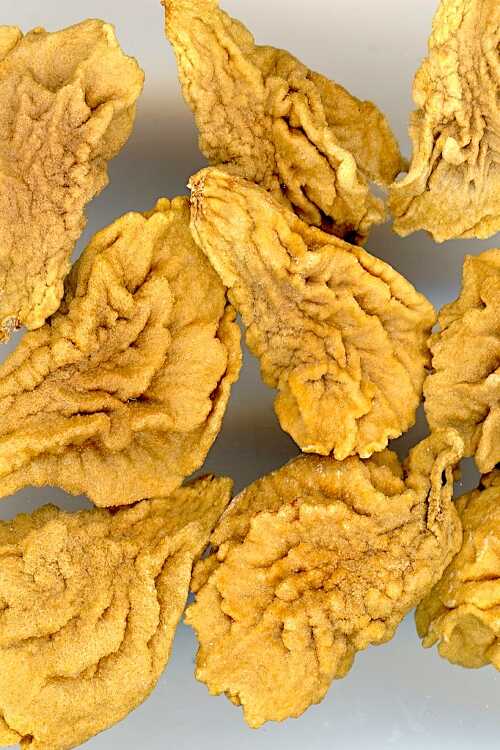
The leaves are simple, ovate, green, and generally large in size, with a length ranging between 7.4 and 30 cm, and a width ranging from 2.7 to 18 cm.
The margin of the leaves is entire or coarsely serrated, however it mostly shows a wavy edge, while the whole blade is often covered with fine hairs, and the venation is pinnate.
The leaves are arranged alternately on the stems, and are attached to a petiole of circular cross-section.
Flowers
The flowers are solitary, hermaphrodite, actinomorphic, and are placed on an inflorescence that grows at the nodes of the leaves near the ends of the branches.
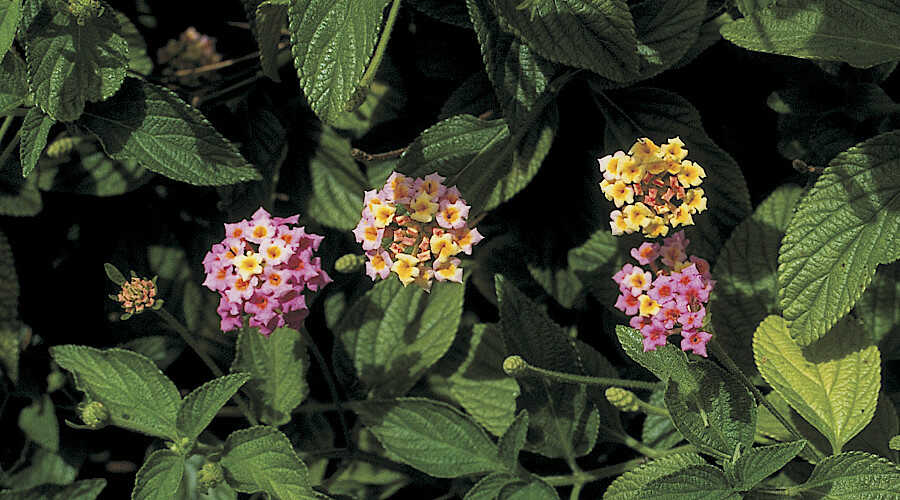
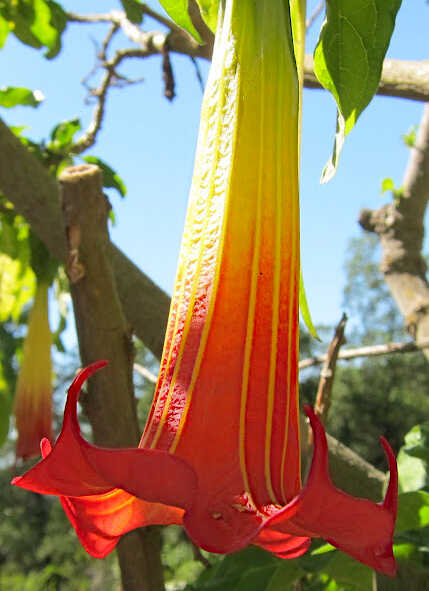
They are often pleasantly fragrant, with the greatest intensity of the aroma being felt after sunset. In terms of color, they are white, yellow, pink, orange, green or red.
They are large in size, with a length between 14 and 50 cm and a width between 10 and 35 cm.
The calyx of the flowers has a tubular shape, the sepals are fused 2 to 5, sometimes resembling a spathe, and either all fall off or persistent in fruit.
The corolla is funnel-shaped, sometimes appears double, is sympetalous and 5-lobed or 10-lobed, and the lobes are pointed, folded and twisted in bud.
The stamens are 5, in 2 or 3 equal or didynamous with two and three stamens of similar height, they are carried on a hairy filament at the base, which protrudes from the lower half of the tubular part of the corolla. The anthers are bilocular, basifixed, dehiscing by elongated slits.
The ovary is superior, two- or four-locular, with two carpels which are placed obliquely to the midline of the flower.
Pollination
Among the many areas that have not been adequately researched for Brugmansia spp. is the process as well as the biology of pollination of species of the genus.
According to current data, the plants of Brugmansia spp. is considered that pollinated by both day and night pollinators.
The former include bees, the latter moths and bats, which are thought to be the dominant. This is somehow documented by the intensity of the aroma of the flowers, which – as mentioned above – becomes much stronger at night, apparently to attract nocturnal pollinators.
Of course there is a species of the genus, Brugmansia sanguinea, which completely lacks the aroma of its flowers. For its pollination, however, long-billed hummingbirds assist.
Fruit
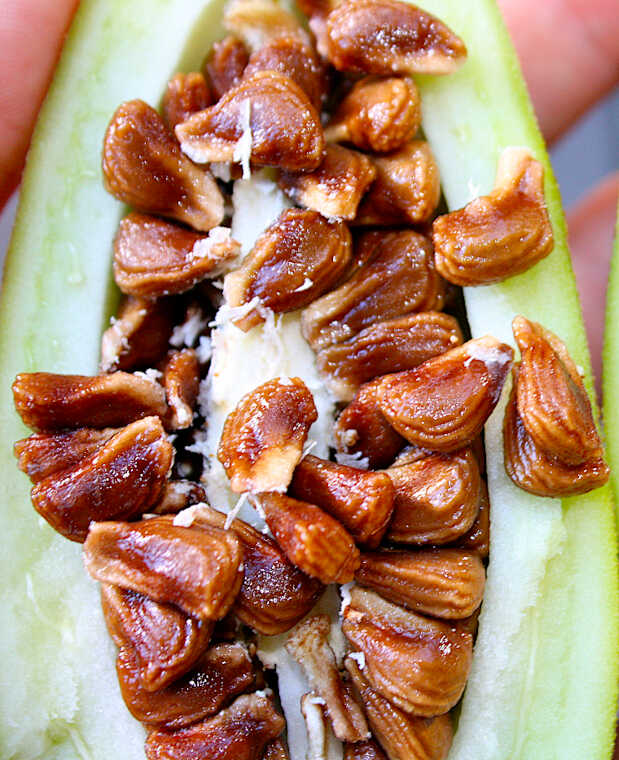
The fruit is a fleshy, multi-seeded capsule, spherical or oblong, indehiscent, with 4 valves, which opens from apex.
Seeds
The seeds are flattened, corky, angular in shape or similar to the English letter D. Their color is brown to black, and their length varies between 0.8 and 1.2 cm.
Genus Brugmansia – Taxonomy & Description
The Toxicity of Plants of the Genus Brugmansia Pers.
Despite their special beauty flowers, all species belonging to the genus Brugmansia have a dark, dangerous side: every plant part of them is extremely toxic.
The toxic action is due to the presence of significant quantities of alkaloids substances, such as atropine, scopolamine (hyoscine) and hyoscyamine.
These substances, the alkaloids of tropane, if they enter the human body antagonize the actions of acetylcholine and muscarinic, cholinergic receptors, and therefore have a profound effect on the autonomic nervous system, affecting, among other things, the function of the heart, stomach and eyes, as well as that of the central nervous system.
Ingestion and / or inhalation in any way of any plant part of Brugmansia results in milder versions dry mouth, muscle weakness, dilation of the pupil of the eyes and nausea, while in the worst cases, hallucinations, paralysis, and death.
References
The References of the article with the optimistic ending and the auspicious title Genus Brugmansia – Taxonomy & Description, are presented by the Reverend Gary Davis with his great song Death Don’t Have No Mercy.
- Barwick, M. (2004). Tropical and Subtropical Trees: An Encyclopedia. Timber Press (OR).
- Burrows, G. E., & Tyrl, R. J. (2013). Toxic Plants of North America. John Wiley & Sons.
- Hay, A., Gottschalk, M., & Holguín, A. (2012). Huanduj: Brugmansia. Royal Botanic Gardens Kew.
- Lockwood, T. E. (1973). A Taxonomic Revision of Brugmansia (Solanaceae). Boston, USA: Harvard University.
- Preissel, U., & Preissel, H. (2002). Brugmansia and Datura: Angel’s Trumpets and Thorn Apples. Willowdale, Ont.: Firefly Books.
- Rätsch, C. (2005). The Encyclopedia of Psychoactive Plants: Ethnopharmacology and its Applications. Simon & Schuster.
- Γκανιάτσας, Κ. (1982). Συστηματική Βοτανική – Μέρος Β [Systematic Botany – Part B]. Θεσσαλονίκη.
- Genus Brugmansia: iNaturalist.ca, Canada
Clarification
Of course, it is needless to say – but we will emphasize it – that in this handmade website, no article has been and will not be written with recourse to Artificial intelligence (AI). Natural Intelligence, that is, as much of it as we have and for as long as we are allowed to have it, is enough for us.
Sharing
The use of the material, where third-party rights are not mentioned or implied (such as photos or audiovisual files - with the exception of those belonging to "Kalliergeia"), is absolutely free. Its sharing, possibly, useful.