The Strelitzia reginae or Bird of Paradise, of South African origin, became known in the western world in the late 18th century.
Since then it has crossed all continents, thanks to its unique beauty flower, and today it is one of the most widespread indoor and outdoor plants – apart from its cultivation exclusively for cut flower.
But it is not only the literally exotic appearance of its flower that has helped to spread its popularity around the world, as well as the plant itself: it is also the ease of its cultivation due to its rather flexible adaptability.
But it is an adaptability that does not have invasive characteristics, since it does not turn into an invasive species, and therefore in no way poses a threat to any native flora.
Why and how does this happen?
This will be shown in the continuation of the extremely originality article that follows, in which the botanical description of this particular plant is also given, its undeniable virtues are strongly emphasized, while an effort is made to shed more light on its possible uses.
With the hope that in the meantime there will be no power outage, we deliver the present piece of writing, at the disposal of the reader.
Strelitzia reginae or Bird of Paradise – Description & Uses
Bird of Paradise Origin

Strelitzia reginae or Bird of Paradise – Description & Uses
Strelitzia reginae or Bird of Paradise - Brief Description
Family: Strelitziaceae
Genus: Strelitzia
Scientific Name: Strelitzia reginae Banks ex Aiton
Common Names: Bird of Paradise, Bird of Paradise Flower, Bird’s Tongue Flower, Canna-leaved Strelitzia, Crane Flower, Isigude
General Characteristics
Leaf Persistence
Evergreen
Form
Rhizomatous Herbaceous
Texture
Coarse
Growth Rate
Slow
Flowering Period (Tropics)
May – December
Fruiting Period
August – February
Height
1,50-2 m (5-6.5 ft) Ind/rs: 0,50-1,2 m (1.6-4 ft)
Diameter
0,60-1,20 m (1.9-4 ft) Ind/rs: 0,50-1 m (1.6-3.2 ft)
Shapes and Colours
Leaves Shape
Oblong Lanceolate
Foliage Colour
Green
Autumn Foliage Colour
Green
Flowers Shape
Spathe with Spike (Spadix)
Flowers Colour
Orange, Blue
Fruit
Capsule
Plantation
Soil Type: Well-drained, sand, loam, clay
Exposure: Sun, Half-Shade, Shade
Soil pH: 6-7.5
Watering: Low
Hardiness: −1.1 °C (30 °F – USDA Hardiness Zone 10a)
Uses
In parks, gardens, coastal areas, in pots and planters indoors and outdoors
Strelitzia reginae or Bird of Paradise – Description & Uses
Strelitzia reginae or Bird of Paradise - Etymology
Etymology of the Genus Name
The name of the genus Strelitzia is due to Charlotte, which is of course not at all strange, considering that in 1773 the plant was named after the peerage Sir Joseph Banks, the then unofficial director of the Royal Botanic Gardens at Kew and loyal subject of the Queen Charlotte, who bore the rich in content title of Queen consort of Great Britain and Ireland Electress/Queen consort of Hanover, more commonly known as Charlotte of Mecklenburg-Strelitz or queen consort of the enlightened monarch British king George III, King of the United Kingdom, Elector/King of Hanover etc., where in its days – and until he unintentionally developed a mental illness of unknown etiology – 1,600,000 slaves were transported from Africa to British possessions, filling the Royal Treasury with gold. [Continued in the next chapter]
Etymology of the Species Name
[Continued from previous chapter] … Of course – apart from the ultra profitable slave trade – almost none of the above would have happened if the then unofficial director of the Royal Botanic Gardens at Kew, Sir Joseph Banks, had not had the brilliant idea to send the Scottish under-gardener and later botanist Francis Masson (August 1741 – 23 December 1805) as a plant collector on the South African expedition under the famous James Cook, captain of the also famous Resolution ship.
And between 1772 and 1775, Francis Masson sent to England more than 500 species of plants, one of which was Strelitzia reginae (incorrectly originally identified as Heliconia bihai), and James Cook, using the Resolution to sailing down the Antarctic icy coast, gave the final and irrevocable assurance that there is no continent in that latitude.
Of course, this news did not deter Sir Joseph Banks, who also dedicated the name of the species to Queen Charlotte, since the word reginae actually means queen and comes from the Proto-Indo-European * h₃rēgnih₂ having the same meaning.
Strelitzia reginae or Bird of Paradise – Description & Uses
Strelitzia reginae or Bird of Paradise - Origin & Life Span
Origin
The Bird of Paradise originates in a relatively wide area of East South Africa, namely the provinces of Eastern Cape and Natal.
Its natural populations grow along the east coast, from the small town of Humansdorp in the south to the KwaZulu-Natal province in the north, also known as the “Garden Province“.
The natural habitats of the plants of Strelitzia reginae, are found in the clearings between the shrubs of the coastline, along the rivers, towards the sea, but also at the borders of the forests, and even in places that are shady to completely shaded where also blooms.
It is also worth noting that in its niches the Bird of Paradise is an important food for its winged colleagues, the birds of the sky, as the main source of nectar.
Life Span
Compared to the equally widespread relative Strelitzia nicolai, which lives about 150 years, Strelitzia reginae has a disadvantage, as it will rarely exceed 20 years.
However, dividing (one of the methods of propagation of the plant) can reach and surpass it – as long as the divider can withstand time.
Strelitzia reginae or Bird of Paradise – Description & Uses
Strelitzia reginae or Bird of Paradise - Landscape Attributes
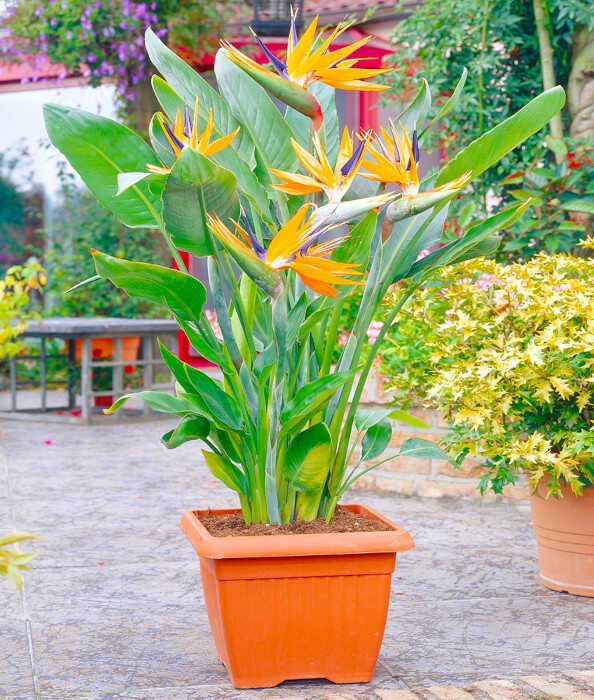
The Bird of Paradise is a rhizomatous evergreen clump-forming perennial plant, small in size and slow growth rate. When cultivated in the garden it reaches a height of 2 m, while as an indoor plant it does not exceed 1.20 m.
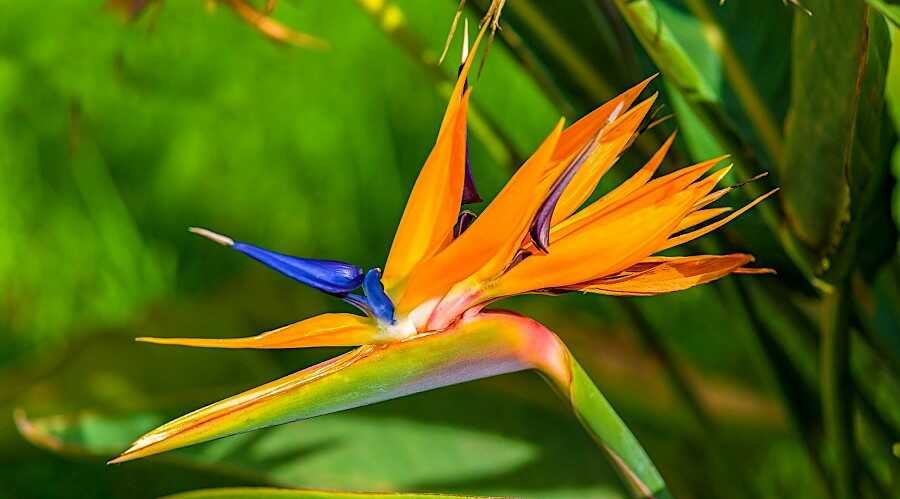
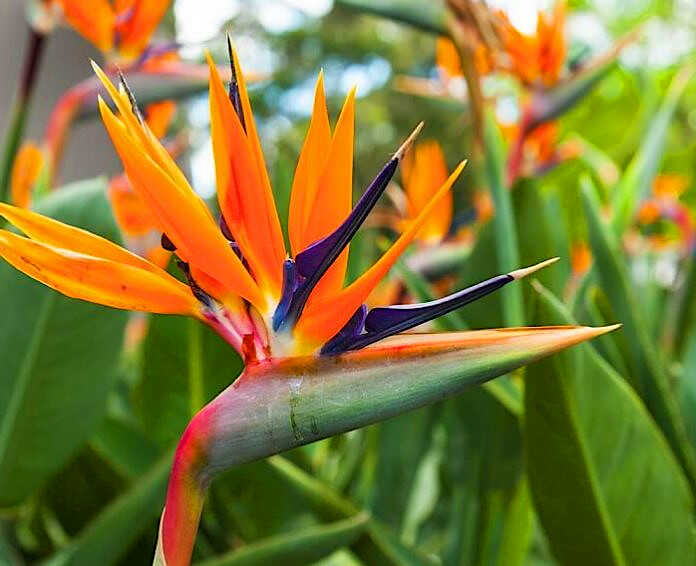
It has a cup shape, with characteristically large leaves grouped in clusters, and stunningly beautiful blue and orange flowers that look like a bird’s head. Besides, its common name is due to the great similarity of its flowers with certain species of birds of the same name, of the Paradisaeidae family.
Otherwise, it has a fragile but dense root system, a canopy of medium density and a rather irregular outline, while it has extremely coarse-textured foliage.
Strelitzia reginae or Bird of Paradise – Description & Uses
Strelitzia reginae or Bird of Paradise - Botanical Description
Roots
The roots of the plant are tuberous, fleshy, up to 2.5 cm in diameter, and brownish orange in color. They end in a blunt extremity, forming a dense lattice extensive root system, which is fragile due to their fleshy texture. If they do not find obstacles, they can grow horizontally, covering a large area.
Leaves
The waxy leaves are very similar to those of the banana, but are smaller in size, have an elongated lanceolate shape, and are glaucous green.
They are stiff, slightly concave, sometimes with red margins, while the midrib is distinct and light.
In terms of dimensions, their length is between 25 and 70 cm, and their width is between 8 and 30 cm.
They emerge directly from a crown at the rhizome, are arising alternately (located in rows opposite each other), and are joined by a long stalk to the lamina. The stalk of the leaves is strong, cylindrical in shape, and 30 to 100 cm long.
Flower Stalk & Spathe
The long flowering stalk (scape or scapus) grows directly from the rhizome by a leaf sheath, and rises a little above the level of the leaves.
It has equal thickness in almost all along the length, a length of about ± 70 cm, it is unbranched, strong, round and has a glaucus hue. It ends in a metamorphic leaf, which surrounds the inflorescence and is called spathe.
The spathe, ± 20 cm long, which grows almost horizontally, is due to the characteristic shape of Strelitsia bird’s beak, and is the one that supports the real birds – pollinators of the plant.
The spathe is usually greenish in color, however it is not uncommon to acquire purple, violet or even reddish hues.
Flowers
The Strelitzia reginae has monoecious and hermaphroditic flowers. They grow many together, 4 to 7, in axillary spadix (spike) inflorescence, appearing successively. Each flower appearance lasts about a week.
They consist of 3 bright orange sepals, and a corolla of 3 blue – violet petals. The sepals, about 15 cm long, which take an almost vertical position, are mainly due to the characteristic, bird-like, plume.
Of the petals, which bear the nectaries, one also takes an upright position, enriching the plume in color, while the other two joined together, presenting an arrow-shaped form, and take a position almost similar to that of the spathe.
This arrangement serves the reproductive strategy of Strelitzia, because when the birds – pollinators come to the flower to drink the nectar, they take with their breast the pollen, which in this way is transferred to another flower.
Each flower has 5 stamens, with long and linear anthers, whose short and distinct filaments adhere to the 2 inherent petals, as well as the pistil, whose white roundish stigma dominates at their sharp end.
Plants enter the reproductive stage after the 5th to 6th year of their age.
Pollination
The Strelitzia reginae belongs to the ornithophilous species, and in its natural habitats it is pollinated by the birds of the family Nectariniidae (Sunbirds). Its most common pollinator seems to be Ploceus capensis (Cape weaver), which also explains the fact that outside of South Africa, a Strelitzia plant with seeds will rarely be found.
In recent years, however, another plant pollinator, Geothlypis trichas, belonging to the Parulidae family, has been identified in Southern California.
Fruit & Seeds
The fruit is a dehiscent capsule, woody in texture and hard. Each capsule contains 60 to 80 seeds.
The seeds have an oval-spherical shape, diameter ± 4 mm, while part of the seed coat is aril. The color of the seeds is dark brown to black, while the arils are yellowish orange to orange.
Strelitzia reginae or Bird of Paradise – Description & Uses
Strelitzia reginae or Bird of Paradise - Climate and Soil
Temperature
The Bird of Paradise adapts perfectly to the tropical and many subtropical regions of the planet, where winters are mild.
Minimum tolerance temperatures range between 0 and -1.1 °C. However, before these values reflect its sensitivity to frost, it has been observed that fully established plants can withstand short-term low temperatures down to -4 °C (24 °F).
Of course in this case, the over ground part of the plant suffers small or large damage. Depending on the damage that will occur, the plant will recover after 1½ to 2 years.
With high temperatures the problems are minimal, as it can withstand high values ranging between 38 and 40 °C.
Soil and pH
The Strelitzia reginae is not at all demanding in terms of soil type and texture, as long as the planting site has excellent drainage.
However, its growth is favored in loamy soils, which are rich in organic matter, and are irrigated regularly. However, even in this case, and in these soils, fully established plants can withstand long periods of drought.
As for the reaction of the soil, the soil pH, it can range between 6 and 7.5, but the optimum range for the cultivation of the plant takes values between 6 and 6.5.
Exposure
The Strelitzia grows and blooms in places of full sun exposure to relatively shady. In areas with cool summers, it can be planted in sunny places, but where the summers are particularly hot, semi-shady or even shady places are recommended.
However, for normal flowering of the plant, it should receive direct sunlight for at least 2 to 6 hours per day.
Also, because it does not tolerand strong winds, care must be taken to plant it in sheltered places.
Strelitzia reginae or Bird of Paradise – Description & Uses

Strelitzia reginae or Bird of Paradise - Pests & Diseases
The Strelitzia reginae, with all the imperial displacement that bears its name, has only a few pests and a few diseases. How can achieved such a feat is something that the editorial team of “Kalliergeia” is looking for – and see no end in sight. Or rather, at sight, it records immediately below, to the glory of the plant.
Pests
Quod erat demonstrandum.
Various Insects
- Chaetanaphothrips signipennis– Banana thrips
- Pentalonia nigronervosa – Banana aphid
-
Rhabdoscelus obscurus – Cane weevil borer
Scales
- Aonidiella citrina– Yellow scale
Mealybags
- Rastrococcus invadens– Fruit tree mealybug
Acari
- Raoiella indica– Red palm mite
► By using the appropriate insecticides and acaricides, their treatment is from satisfactory to difficult.
Diseases
After the pests, the recording of the diseases follows.
Fungi
- Athelia rolfsii – Sclerotium rot
- Fusarium avenaceum– Foot rot of cereals
Bacteria
- Burkholderia cepacia– Sour skin of onion
- Pectobacterium carotovorum subsp. carotovorum ( Erwinia carotovora subsp. carotovora) – Bacterial ring rot of potato
- Ralstonia solanacearum (syn. Pseudomonas solanacearum) – Bacterial wilt of potato
► By using the appropriate fungicides the treatment of the former is from satisfactory to difficult, while the bacterium of the plant is extremely difficult to control.
Strelitzia reginae or Bird of Paradise – Description & Uses
Strelitzia reginae or Bird of Paradise - Toxicity & Allergenic Pollen
Toxicity
The plant is characterized as slightly toxic to humans, and toxic to cats, dogs, horses, and livestock.
The fruits and seeds contain toxic tannins, and the leaves contain minimal amounts of hydrocyanic acid. Clinical symptoms of poison occur after chewing or swallowing, and include gastrointestinal upset, diarrhea, mild nausea, drowsiness, and vomiting.
Allergenic Pollen
The Strelitzia, as an ornithophilous plant, does not produce wind-borne pollen, and therefore does not cause allergic reactions.
Strelitzia reginae or Bird of Paradise – Description & Uses
Strelitzia reginae or Bird of Paradise - Use
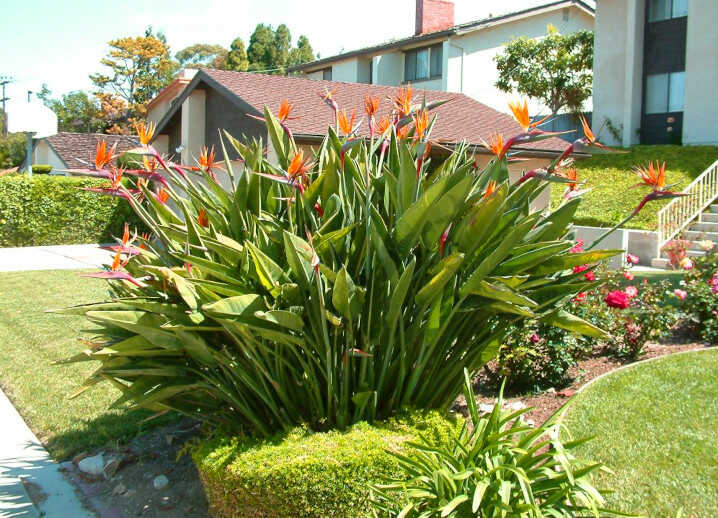
The Strelitzia reginae is a valuable and extremely popular ornamental plant. In colder climates it is grown in pots and indoors, while in milder climates, it decorates public and private outdoor green spaces.
Of course, the contribution of the plant to the cultivation of cut flowers is not negligible, where its impressive and long-lasting flower is offered either alone or in compositions, to give an exotic tone to any space or object placed.
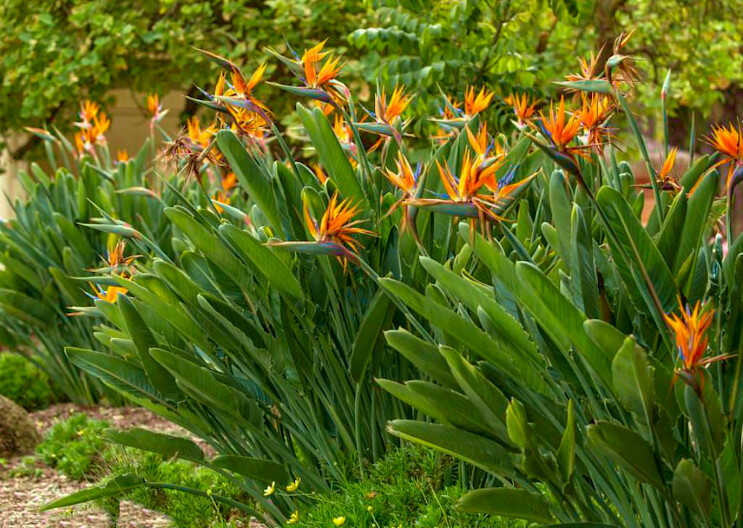
But especially in Gardening and Landscape Architecture, Strelitzia could be said to be utilized:
- Because of its resistance to sea spray droplets, planted in coastal gardens
- By mass planting in soil or in pots next to swimming pools
- By mass planting on the shores of artificial lakes or streams
- Placed in groups, in prominent areas of gardens or homes
- Under deciduous or evergreen trees
- Combined with other ornamental plants, such as Agave‘Blue Glow’, Cerastium tomentosum (Snow-In-Summer), Pittosporum tobira ‘Nanum’ (Japanese Mock Orange), and Berberis thunbergii ‘Atropurpurea’ (Purple Japanese Barberry)
References
The References of the birdy article entitled Strelitzia reginae or Bird of Paradise – Description & Uses are presented by a prominent South African jazz musician, the late Philip Tabane and the Malombo, with the song Ngwana O Ya Lela.
- Baijnath, H., & McCracken, P. A. (2018). Strelitzias of the World: A Historical & Contemporary Exploration.Durban Botanic Gardens.
- Beckett, K. A., & Royal Horticultural Society. (1990). The R.H.S. Encyclopedia of House Plants.
- Heywood, V. H. (1993). Flowering Plants of the World. Oxford University Press, USA.
- Hoffmann, F., Daniel, F., Fortier, A., & Hoffmann-Tsay, S. (2011). Efficient Avian Pollination of Strelitzia reginae Outside of South Africa. South African Journal of Botany, 77(2), 503-505.
- Kronestedt, E., & Walles, B. (1986). Anatomy of the Strelitzia reginae Flower (Strelitziaceae). Nordic Journal of Botany, 6(3), 307-320.
- Odenwald, N. G., & Turner, J. R. (2006). Identification, Selection, and Use of Southern Plants for Landscape Design. Claitor’s Law Books and Publishing.
- Singh, A. K. (2006). Flower Crops: Cultivation and Management. New India Publishing.
- Bird Of Paradise, Strelitzia reginae Banks: Encyclopedia of Life (EOL)
- Bird-of-Paradise Flower: Encyclopaedia Britannica
- About Strelitzia reginae: San Francisco Botanical Garden
Clarification
Of course, it is needless to say – but we will emphasize it – that in this handmade website, no article has been and will not be written with recourse to Artificial intelligence (AI). Natural Intelligence, that is, as much of it as we have and for as long as we are allowed to have it, is enough for us.
Sharing
The use of the material, where third-party rights are not mentioned or implied (such as photos or audiovisual files - with the exception of those belonging to "Kalliergeia"), is absolutely free. Its sharing, possibly, useful.