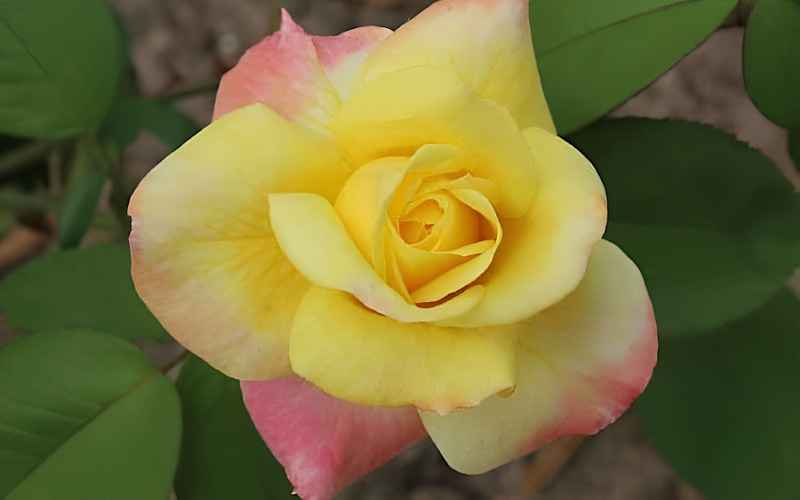
Rosa ‘Peace’ Hybrid Tea Rose is another historical variety of this wonderful shrub. And it is indeed a historical variety for three very well documented reasons:
-
It is the first Rose of Tea Hybrids that has shown vigor in growth and high resistance to diseases
-
It is the first rose that made the same blossom characteristically different in color during its development
-
It is a rose variety that developed in the years of honorable for the Homo sapiens Second World War of Each Other Extinction
It is therefore not surprising that it is currently estimated that there are more than fifty million ‘Peace’ roses across the globe, nor should one be surprised by the remarkable achievements of the human ape.
The Multicolour Rosa ‘Peace’ Hybrid Tea Rose
Rosa 'Peace' - General Information
The course of the creation of the ‘Peace’ or ‘Madame A. Meilland’ rose variety is given below, while here we provide some brief identifying details and its basic characteristics.
Facts in Short
Family: Rosaceae
Genus: Rosa
Scientific Name: Rosa ‘Madame A. Meilland’
Synonyms: Rosa ‘Peace’, Rosa ‘Gloria Dei’, Rosa ‘Gioia’
Common Names: Rose ‘Peace’, ‘Peace’ Rose, Gloria Dei Rose, ‘Madame A. Meilland’ Rose
Horticultural Group: Hybrid Tea Roses
Plant Breeder: Francis Meilland, France 1939
Awards: AARS (All-America Rose Selections) Gold Medal 1945, RHS Award of Garden Merit 1993
Uses In Brief
This Hybrid Tea Rose variety is suitable for:
- Specimen
- Mass plantings
- Informal hedges
- Urban plantings
- Pots & containers
- Cut flowers
The Multicolour Rosa ‘Peace’ Hybrid Tea Rose
Breeding & Landscape Attributes
Breeding
The Rosa ‘Peace’ Tea Hybrid is a tetraploid variety (2n = 18) that arose after a long trial and experimentation by Francis Meilland and his colleagues between 1935 and 1939. Botanically, it is the result of the synergy of five varieties attributed with the so simple name ((George Dickson x Souvenir de Claudius Pernet) x (Joanna Hill x Charles P. Kilham)) x Margaret McGredy – i.e. Rosa ‘Madame A. Meilland’.
Of these, the male parent was Rosa ‘Margaret McGredy’, while the female parent came from the cross between the unnamed plant R. ‘George Dickson’ x R. ‘Souvenir de Claudius Pernet’ and the also unnamed plant R. ‘Joanna Hill’ x R. ‘Charles P. Kilham’.
The result of this whole process was the promising and exceptionally flowering rose bush 3-35-40, later named Rosa ‘Madame A. Meilland’. The real Madame A. Meilland was the late Claudia Dubreuil, mother of Francis Meilland and wife of “Papa” Meilland, while the numbers on the plant signified, in order, the third cross generation, 35 the year of hybridization, and 40 the special number of the plant.
Landscape Attributes
This rose variety is a woody deciduous perennial shrub of medium growth, robust and extremely durable. In terms of size, the height of the plant reaches 1.2 to 2 m (4-6 ft) while its diameter varies between 0.9 and 1.3 m (3-4.2 ft). It has a hemispherical shape, an upright appearance and a dense and symmetrical canopy with rather irregular outline. It is characterized as a rough texture, while the dense foliage gives to the Rosa ‘Peace’ a compact appearance.
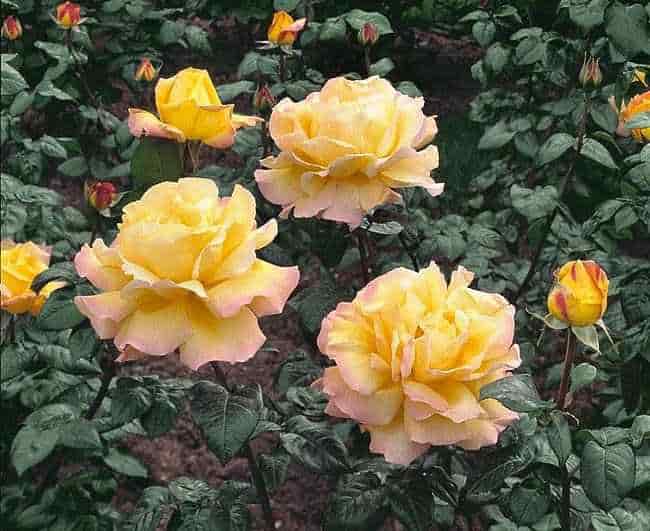
The dominant decorative element of the plant is the colorful yellow, creamy, pink roses that appear during its repeated and long-lasting flowering – flowering beginning at the end of spring and ending mid-late autumn. Its life span is over 25 years.

Rosa 'Peace' - Description
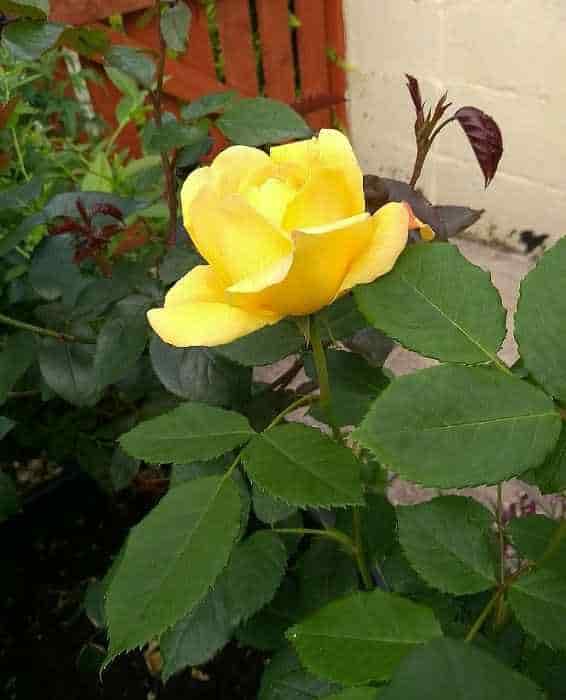
Rosa ‘Peace’ Hybrid Tea Rose is a multi-brunched shrub with medium thorny stems. Its glossy leaves are composite, consisting of 5 to 7 leaflets, oval in shape and serrated, whith nice deep green color.
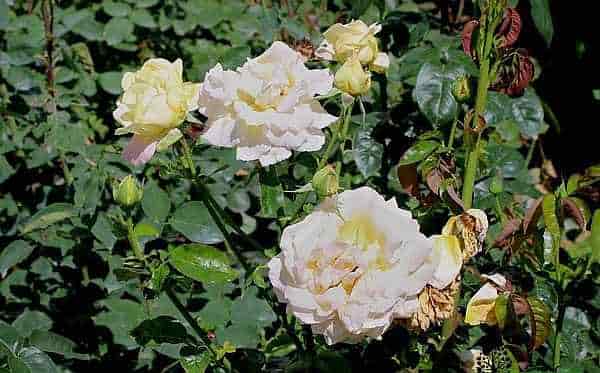
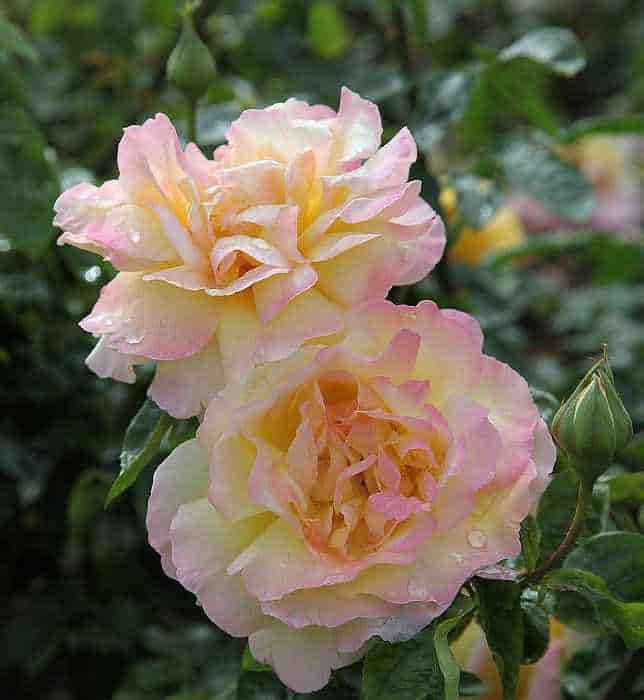
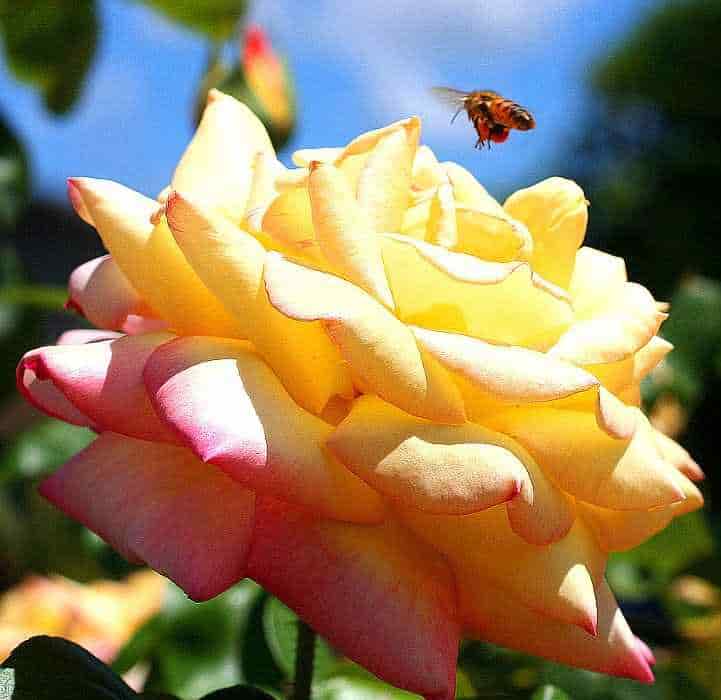
Roses are formed at the edge of their annual shoots, one per stem. They are fragrant, numbered, double, and very large in width with a diameter of 15 to 16 cm (6- 6.2 in). They consist of 26 to 45 petals of velvety texture and yellow, creamy and pink in color.
The color of the rose is influenced by three factors:
-
The growth stage of the rose flower
-
The temperature of the area where it is planted
-
The exposure
These three factors generally affect the coloring of most roses. But because we are referring to the Rose ‘Peace’, we will look at the effect they only exert on its own color – after making a little deviation by saying a few things about the fragrance.
Virtual Perfume
The Fragrance of Rosa 'Peace'
Rosa ‘Peace’ has mild to strong aroma. As experts say – and we have no reason to query them – it has a certain sweetness and is slightly fruity. The same experts claim that those who enjoy the most of their aroma are the morning guys – these mysteries that wake up just before dawn.
The editorial team of ‘Kalliergeia’ includes – unfortunately – such a mysterious guy. So this guy assures that the best time to someone enjoy the fragrance of Rosa ‘Peace’ is the dawn, from fully opened flowers, at a temperature close to 21 °C (69.8 °F), and after the previous night has taken care to water the plant.
We have – unfortunately – no reason to query him.
The Color of the Flowers
As mentioned above, the first factor affecting the color of the flowers in Rosa ‘Peace’ is the flower growth stage.
When the bud emerges, the colors have the maximum intensity and the predominant color is the orangish pink magenta. Just before the flower opens completely, the intensity subsides and the color becomes yellow. From then on, the colors progressively appear in a pale yellow on most of the petals and in a pale pink on their periphery, until at the end, the whole flower gets very light creamy and pink hues.
For the second factor that affects the color of flowers, the temperature generally applies that as lower these are – always within the limits of growth of the plant – as the colors take the darkest hues.
The third factor, the plant’s exposure, is also related to the climate: indeed, while in the colder areas of the temperate zone Rosa ‘Peace’ must be planted only in sunny places so roses have the typical colors for the variety, on the other hand as warmer is the climate, the more slightly shade planting sites should be preferred.
The Multicolour Rosa ‘Peace’ Hybrid Tea Rose
Rosa 'Peace' - Environment of Establishment
Generally, it could be said that Rosa ‘Peace’ is vulnerable to the cold as well as the spring frosts. The minimum temperature limit where plant can be safely planted ranges from -23 to -26 °C (−15 to −10 °F – USDA Hardiness zone 5b).
In relation to the soil, the Rosa ‘Peace’ is recommended to be planted in fertile and rich in organic matter loamy soils, which additionally have excellent drainage.
With respect to the soil pH, the appropriate range is relatively large, ranging between 5.5 and 7.8. However, it thrives on soils that have a slightly acidic reaction, ie at pH values ranging from 6 to 6.5.
The Multicolour Rosa ‘Peace’ Hybrid Tea Rose
Rosa 'Peace' - Uses
Rosa ‘Peace’ offers for many decades a lot in the gardening and landscape architecture. And it really offers, because it has an excellent aroma, repeated blooming and still vigor and high resistance to rose diseases as a plant.
Thus, it could generally be said that Rosa ‘Peace’:
-
It is cultivated for its flower, which as a cut flower can last in the vases from about 5 to 8 days
-
It is used in the garden planted in groups of at least three plants
-
It is used in the garden in combination with other plants such as Geranium pratense ‘Mrs Kendall Clark’ (Meadow Cranesbill), Agastache ‘Kudos Ambrosia’ (Hummingbird Mint), Thymus serpyllum (Breckland thyme) and Erigeron karvinskianus (Latin American fleabane)
-
It can be planted as a hedge plant
-
Finally, it is possible to plant it in large-sized pots and full-sun exposures
The Multicolour Rosa ‘Peace’ Hybrid Tea Rose
References
The References to the manifestly anti-war article titled The Multicolour Rosa ‘Peace’ Hybrid Tea Rose are presented alongside by the Bob Dylan, and its Masters of War song.
-
Brickell, C. (2019). RHS Encyclopedia of Plants and Flowers. Dorling Kindersley.
-
Csapody, V., & Tóth, I. (1982). A Colour Atlas of Flowering Trees and Shrubs. Budapest: Akadémiai Kiadó.
-
Hass, R., Olson, J., & Whitman, J. (2012). Growing Roses in Cold Climates. University of Minnesota Press.
-
Horwood, C. (2018). Rose. Reaktion Books.
-
Klein, C. (2024). Hortobiography. Random House.
-
Meilland, A., & Lambert, G. (1984). Meilland, a Life in Roses. Carbondale, IL: Southern Illinois University Press.
-
Schneider, P. (2009). Right Rose, Right Place. Storey Publishing.
-
Taylor, J. M. (2014). Visions of Loveliness: Great Flower Breeders of the Past. Swallow Press.
-
Winterrowd, W., & Stagg, P. (2003). Roses: A Celebration. Greystone Books.
- Rosa ‘Peace’: New Zealand Rose Society
With Pomp and Circumstance
VIDEO
Bob Dylan’s song ‘Masters of War‘ is greatly devoted to the everywhere and everyday ‘Monsters of War’.
Clarification
Of course, it is needless to say – but we will emphasize it – that in this handmade website, no article has been and will not be written with recourse to Artificial intelligence (AI). Natural Intelligence, that is, as much of it as we have and for as long as we are allowed to have it, is enough for us.
Sharing
The use of the material, where third-party rights are not mentioned or implied (such as photos or audiovisual files - with the exception of those belonging to "Kalliergeia"), is absolutely free. Its sharing, possibly, useful.