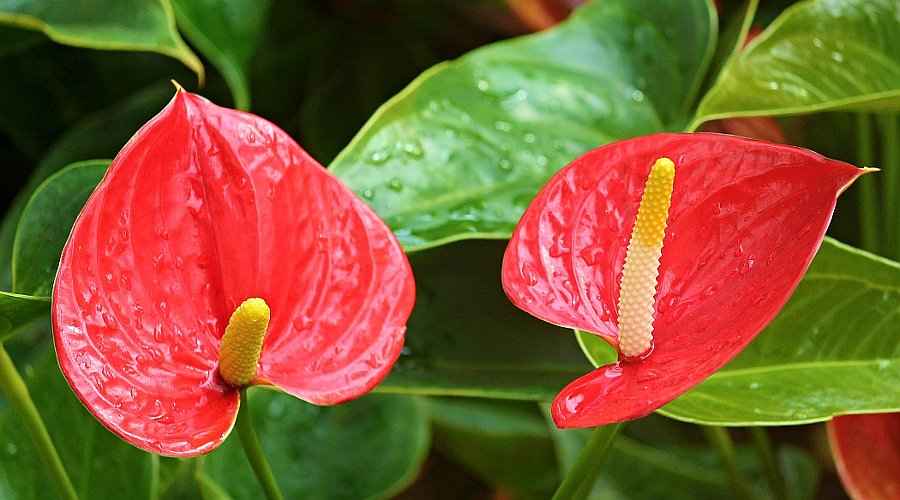
The Anthurium andraeanum (Flamingo Flower) is another gift of Latin America’s tropical forests to humanity.
Of course, it may not be eaten – like other Latin American gifts, that is, potato and tomato – but it adorns, groomes and decorates.
It is primarily used indoors, where it has the ability to filter the air from various dangerous substances, but if the conditions favor it, it can also be planted outdoors.
Its spread began more than a century ago, while the positive reception by flower lovers made it one of the most sought-after plants, both as a potted plant and – above all – for its cut flower.
Where the extraordinary beauty of its flower, both on the plant and as cut, attracts the gaze and overcomes or even annihilates the fact that it is not fragrance.
Now, of course, regarding the latter, anyone could reasonably wonder:
So what?
The editorial team of “Kalliergeia” says the same:
So what?
Mona Lisa is fragrant?
Anthurium andraeanum (Flamingo Flower) – Description and Uses
Flamingo Flower Origin
Anthurium andraeanum (Flamingo Flower) – Description and Uses
Anthurium andraeanum (Flamingo Flower) - Brief Description
Family: Araceae
Genus: Anthurium
Scientific Name: Anthurium andraeanum Linden ex André
Common Name: Flamingo Flower, Laceleaf, Tailflower, Flamingo Lily, Painter’s Palette
General Characteristics
Leaf Persistence
Evergreen
Form
Herbaceous
Texture
Coarse
Growth Rate
Slow
Flowering Period (Tropics)
Sporadically through the year
Fruiting Period
Sporadically through the year
Height
0.6-0.9 m (2-3 ft) Indoors: 0.5-0.6 m (1.7-2 ft)
Diameter
0.5-0.6 m (1.7-2 ft)
Shapes and Colours
Leaves Shape
Sagittate – Arrow
Foliage Colour
Green
Autumn Foliage Colour
Green
Flowers Shape
Spadix
Flowers Colour
White
Fruit
Berry
Plantation
Soil Type: Well-drained, sand, loam
Exposure: Half-shade
Soil pH: 5.5-7
Watering: Moderate
Hardiness: 1.7 °C (35 °F – USDA Hardiness Zone 10b)
Uses
Parks, gardens, pots and containers indoor and outdoor, cut flower
Anthurium andraeanum (Flamingo Flower) – Description and Uses
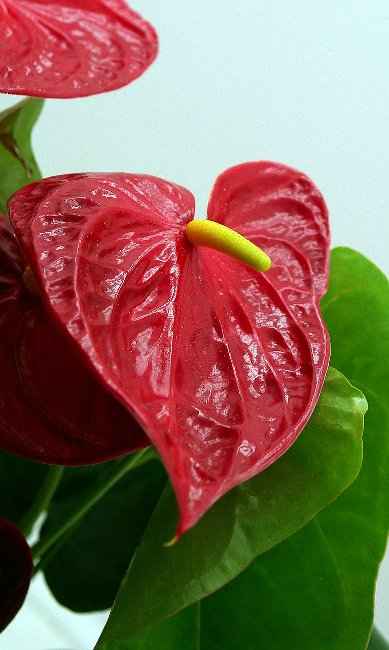
Anthurium andraeanum (Flamingo Flower) - Etymology
Etymology of the Genus Name
The name of the genus Anthurium is another imaginative Neo-Latin composite word, which consists of the Ancient Greek ‘ἄνθος’ (flower) και ‘ουρά’ (tail).
In turn they have Proto-Indo-European origin, the first by the word *h₂éndʰos (blossom, sprout, grass) and the second by the word *ors-ā- (tail).
So it could be said that thanks to this intelligent combination we can easily distinguish the ‘flower tail’ (the Anthuriums spadix) from the tail of the donkey or the fox – for example.
Etymology of the Species Name
The name of the species andraeanum has infinitely more clear origin: it is the Neo-Latin version of the last name of Édouard François André (17 July 1840 – 25 October 1911). Who was Édouard François André?
So, he was a French architect, a great landscape architect (designer amongst others of Sefton Park in England and Luxembourg Castle – the City of Luxembourg Castle) and botanist. Edouard François André, on a mission in the Colombian rainforest, discovered this species, which he sent to Belgium, from where it slowly spread to the rest of the world.
Since then, floriculture owes to him the growth of another dynamic sector.
Anthurium andraeanum (Flamingo Flower) – Description and Uses
Anthurium andraeanum (Flamingo Flower) - Origin & Life Span
Origin
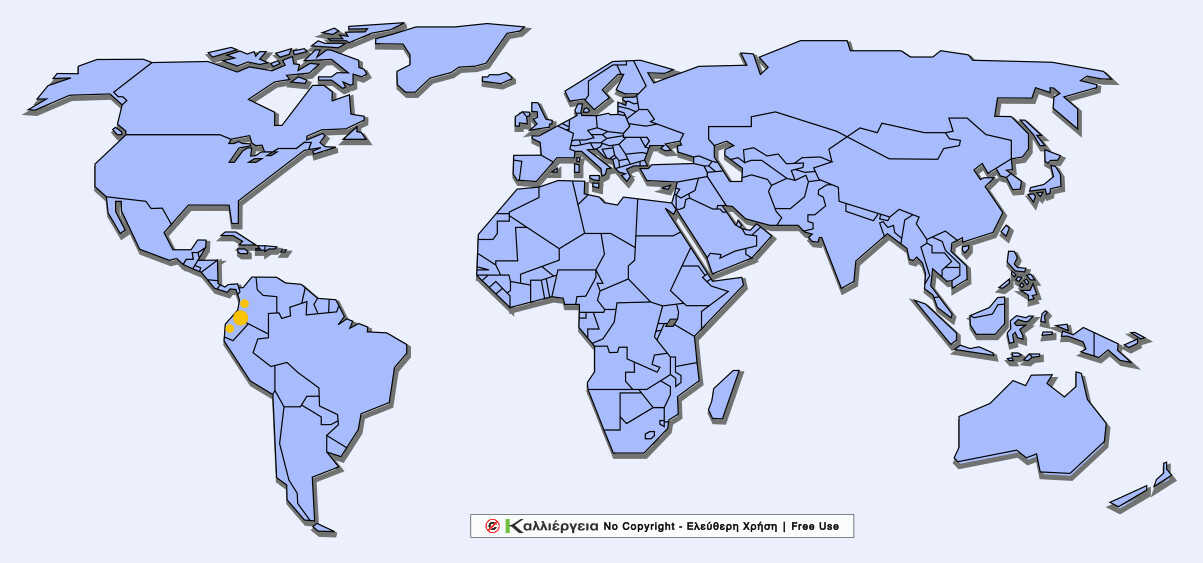
Unlike many other species, Anthurium andraeanum‘s origin is located in a relatively small area of tropical rainforests that are included between southwest Colombia and northwestern Ecuador.
In its natural niches, it grows as an epiphyte in shady places and in areas with high atmospheric humidity (> 70%) and temperatures ranging from 18 to 32 °C (64-90 °F).
Life Span
Flamingo Flower in cultivation lives from 5 to 10 years, but if it is divided to propagated lives for decades.
Anthurium andraeanum (Flamingo Flower) – Description and Uses
Anthurium andraeanum (Flamingo Flower) - Landscape Attributes
Anthurium andraeanum is a herbaceous, perennial and rhizomatous, evergreen plant of small height and slow annual growth rate. It is spherical in shape, upright in habit with open symmetrical foliage of coarse texture.
It is cultivated for its flowers, which are actually transformed leaves – bract, whose lifetime on the plant reaches 25 to 30 days (in tropical areas up to 40).
Anthurium andraeanum (Flamingo Flower) – Description and Uses
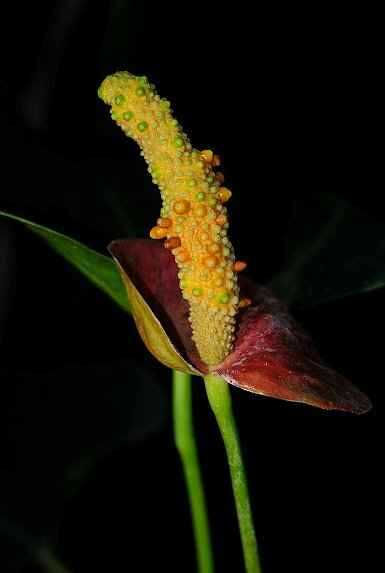
Anthurium andraeanum (Flamingo Flower) - Botanical Description
Roots
Anthurium andraeanum is a typical epiphyte which grows on the branches of various tropical trees. It has a dense root system with creamy textured tuberous rhizomes and small hairy lateral roots having yellow colored root tips.
Leaves
Flamingo Flower has simple, glossy, large, leathery leaves, of a beautiful dark green color, arranged spirally forming a rosette on a very short stem. They have long petioles of round cross section, whose diameter for the mature leaf is 0.3 to 0.4 cm (0.12-0.23 in) and the length is between 12 and 15 cm (4.7-6 in).
The shape of the leaves is ovate-sagittate, with acuminate apex and deeply cordate base which is composed of two lobes whose width is between 2.5 and 3.5 cm (1-1.3 in). The venation is conspicuous and pinnate veining, while the mid-vein protrude at the underside, as well as the primary veins of the leaf blade.
The lamina has a smooth periphery, is entire, its texture is shiny and thick and its length is between 12 and 20 cm (4.7-7.8 in) for a mature leaf.
Flowers
Flowers are monoecious (hermaphrodite) and grow on axillary inflorescence, the spadix. It is numerous (150 to 200), very small, with a length of between 0.05 cm and 0.10 cm (0.02-0.04 in) and a diameter of between 0.08 and 0.10 cm (0.03-0.04 in).
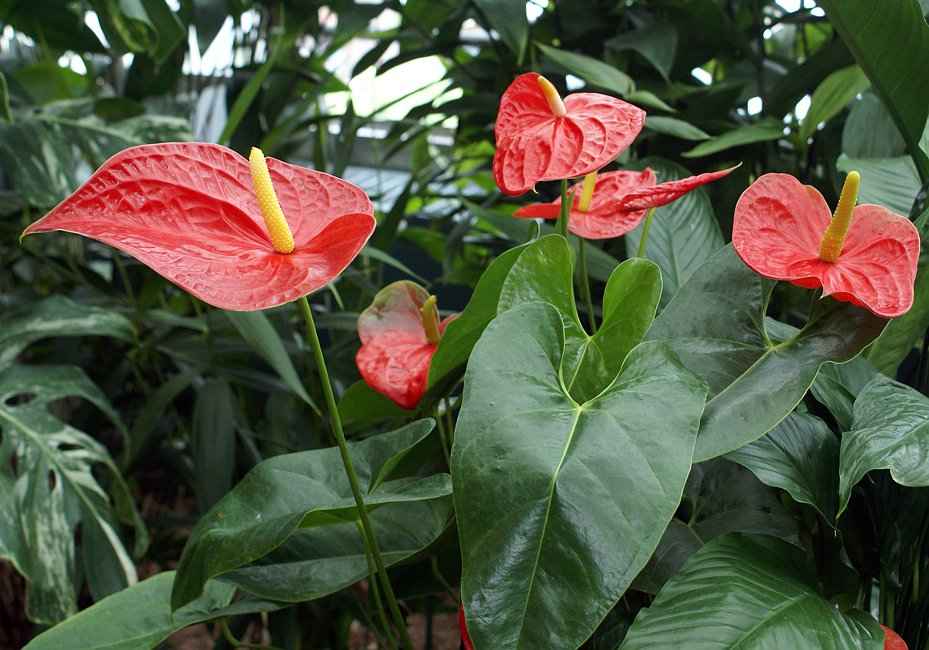
The spadix is erect and has a white color except the top that is yellow. Its length is between 8 and 12 cm (3.1-4.7 in) while its width at the upper part of the spadix is between 0.4 and 0.6 cm (0.15-0.23 in) and at the base from 0.6 to 0.9 cm (0.23-0.35 in).
Anthurium andraeanum flowers consist of 4 tepals. The male part of the flower has 4 stamens and anthers dehiscent by slit carried on strap-shaped filaments. The pistil is less than 0.01 cm (0.004 in), has a very short style and globose stigma and ovary which is two-loculed.
Spadix is surrounded by the spathe, which although it looks like a large ‘petal’ flower is nothing but a bract – a modified leaf. The spathe has an oval to spherical shape – cordate at the base – and is tapering to an apex. Its color is pink or red while its dimensions range from 8 to 15 cm (3.1-6 in) in length and 8 to 10 cm (3.1-4 in) in width.
Pollination
Characteristic of the flowering of Anthuriums is that they first mature female parts of them (protogynous flowers) and after 20 to 30 days is followed by the male part. Theses phases excludes the self-pollination of Anthuriums flower, with the result that are only cross-pollinated.
The pollination of the flowers, under natural conditions, is effected by insects – mainly bees, beetles and ants.
Fruit & Seeds
Five to six months after the flowers pollination, the plant’s fruits (berries) grow from the bottom to the top along of spadix. They are red in color, have one to two seeds per fruit and a length of between 0.08 and 0.15 cm (0.03-0.06 in).
Anthurium andraeanum (Flamingo Flower) – Description and Uses
Anthurium andraeanum (Flamingo Flower) - Climate and Soil
Temperature
Anthurium andraeanum, as plant of the tropical rainforests, is cold intolerance. The minimum temperatures, which are also the lowest tolerance limit, range between 4 and 1.7 °C (40-35 °F). With high temperatures its behavior is satisfactory as long as also the atmospheric humidity is high.
The AHS (American Horticultural Society), in terms of high temperatures, classifies the plant in zones 1 to 12 (12 = average annual number of days with temperatures above 30 °C [86 °F], 210). However, at very high temperatures it may cause burns in the leaves and fading of the flower color.
Soil and pH
Anthurium andraeanum can be grown in a variety of soil types – excluding clay soils – provided they drain well but at the same time retain the necessary moisture. In any case, without excellent soil porosity Flamingo Flower’s cultivation will fail.
In terms of pH, it grows in moderately acidic to neutral reaction soils ranging between 5.5 and 7, but thrives in moderately acidic soils with values ranging from 5.5 to 6.5.
Exposure
Anthurium andraeanum can be placed in half-shade or shady places – if cultivated in the garden. However, when used as an indoor plant, it is recommended that it is always placed in extremely bright places, which favor its abundant flowering.
Anthurium andraeanum (Flamingo Flower) – Description and Uses

Anthurium andraeanum (Flamingo Flower) - Pests & Diseases
Anthurium andraeanum does not count many problems with pests and diseases. On the contrary, it counts a few and sometimes serious.
Pests
Immediately below are recorded the most important pests of Flamingo Flower.
Various Insects
- Aleurotulus anthuricola
- Chaetanaphothrips orchidii (Anthurium Thrips)
-
Phyllophaga smithi (White Grub)
Scales
-
Ceroplastes rubens (Red Wax Scale)
-
Icerya seychellarum (Seychelles Scale)
-
Pinnaspis buxi
-
Pseudaonidia trilobitiformis (Trilobite Scale)
-
Vinsonia stellifera (Stellate Scale)
Mealybugs
-
Nipaecoccus nipae (Spiked Mealybug)
Acari
- Brevipalpus phoenicis (False Spider Mite)
- Eriophyes hibisci (Hibiscus Mite)
Nematodes
- Aphelenchoides fragariae (Strawberry Crimp Nematode)
- Radopholus similis (Burrowing Nematode)
► By using the appropriate insecticides and acaricides the treatment is satisfactory, except for nematodes whose populations are difficult to control.
Diseases
After the pests, the recording of the diseases follows.
Fungi
-
Calonectria ilicicola
-
Colletotrichum gloeosporioides – syn. Glomerella cingulata (Anthracnose)
-
Myrothecium roridum
-
Phytophthora nicotianae (Black Shank)
-
Phytophthora tropicalis
-
Sphaerobolus stellatus
Bacteria
-
Xanthomonas campestris pv. Dieffenbachiae (Anthurium Blight)
► By using the appropriate fungicides, the treatment of the former is satisfactory, while the latter, bacteria, are extremely difficult to control.
Anthurium andraeanum (Flamingo Flower) – Description and Uses
Anthurium andraeanum (Flamingo Flower) - Toxicity & Allergenic Pollen
Toxicity
Anthurium andraeanum is toxic to humans and pets because it contains calcium oxalate crystals in its tissues. If swallowed (chewing), a strong burning sensation and an inflammatory reaction, including blisters and edema, may occur. As for the toxicity it is classified in categories 2, 3.
It is also possible to cause an allergic reaction if the plant’s sap comes into contact with the skin.
Allergenic Pollen
No cases of respiratory allergies due to the plant’s pollen have been reported.
Anthurium andraeanum (Flamingo Flower) – Description and Uses
Anthurium andraeanum (Flamingo Flower) - Varieties & Cultivars
Because of its exceptional popularity, Anthurium andraeanum has attracted the interest of the breeders, resulting in the creation of dozens new varieties of the plant. The subject for both researchers and breeders is mainly the creation of more and most attractive hues and shapes of Anthurium flowers, with basic orientation the market of cut flowers. For these varieties, we promise – in a manner of speaking – a special tribute in the short future.
Of the varieties that can be planted in the garden, particularly noteworthy – among others – are Anthurium andraeanum ‘White Heart’ and Anthurium andraeanum ‘Purple Plum’.
Flamingo Flower Varieties
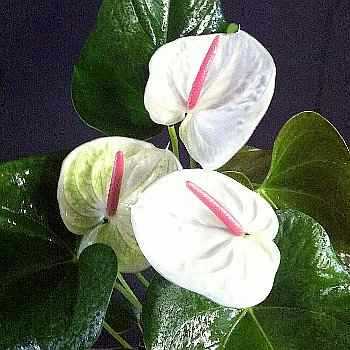
Anthurium andraeanum ‘White Heart’
It differs from the typical species as regards the appearance and size of the leaves and the flower.
The leaves are larger, have a stronger green color and are more acute, while the flower is white with a pink spadix.
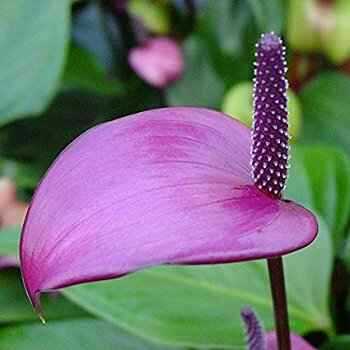
Anthurium andraeanum ‘Purple Plum’
Both the spath and the spadix have intense purple color while the leaves are of deep green color.
Anthurium andraeanum (Flamingo Flower) – Description and Uses
Anthurium andraeanum (Flamingo Flower) - Use
Use as an Indoor Plan
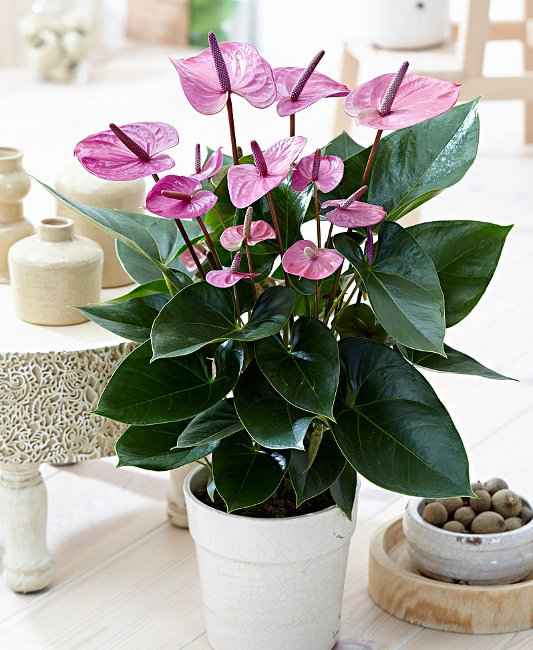
Flamingo Flower, without being one of the easiest to cultivate plants, can be grown in pots and decorate the interior of the houses.
On the other hand, Anthurium andraeanum belongs to the category of those plants that clean the air from dangerous toxic substances, such as formaldehyde, ammonia, xylene and toluene, and this is another reason for the plant lovers to try to incorporate it as houseplant.
In addition, the flowers, of course, are suitable for decorating vases or potteries.
Use in Garden and Landscape
In areas suitable for its growth, it can be planted both on the ground and in pots at shady or half-shade exposures.
Thus, it could be said that Anthurium andraeanum is being exploited:
-
As a plant of particular interest – mass planted or alone
-
As groundcover plant
-
In combination with other exotic plants such as Philodendron (Philodendron bipennifolium) and Garden Croton (Codiaeum variegatum)
References
The References of the almost equatorial article entitled Anthurium (Anthurium andraeanum) – Description and Use are presented by the Peruvian music ensemble Los Hijos del Sol with their song Cariñito.
- Allaway, Z., & Bailey, F. (2018). Practical House Plant Book: Choose Well; Display Creatively; Nurture and Maintain; 175 Plant Profiles. DK Publishing (Dorling Kindersley).
- Bailey, F., Alleyway, Z., & Young, C. (2018). Practical House Plant Book: Choose Well; Display Creatively; Nurture and Maintain; 175 Plant Profiles. Dorling Kindersley Limited.
- Clay, H. F., Hubbard, J. C., & Golt, R. (1987). Tropical Exotics. Honolulu, HI: University of Hawaii Press.
- French, J. C., & Mayo, S. J. (n.d.). The Genera of Araceae. Kew: Royal Botanic Gardens.
- Knight, A. (2007). A Guide to Poisonous House and Garden Plants. CRC Press.
- McGovern, R. J., & Elmer, W. H. (). (2018). Handbook of Florist’s Crops Diseases. Springer.
- Anthurium andraeanum: Anturio Rosado (EOL)
Clarification
Of course, it is needless to say – but we will emphasize it – that in this handmade website, no article has been and will not be written with recourse to Artificial intelligence (AI). Natural Intelligence, that is, as much of it as we have and for as long as we are allowed to have it, is enough for us.
Sharing
The use of the material, where third-party rights are not mentioned or implied (such as photos or audiovisual files - with the exception of those belonging to "Kalliergeia"), is absolutely free. Its sharing, possibly, useful.