Home » PLANTS & CROPS »
Apple Powdery Mildew (Podosphaera leucotricha)
CONTENTS ⌵
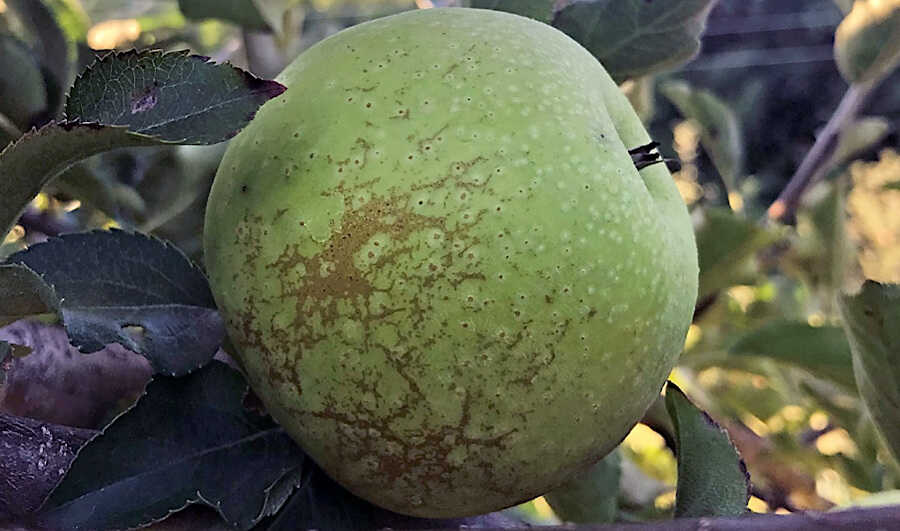
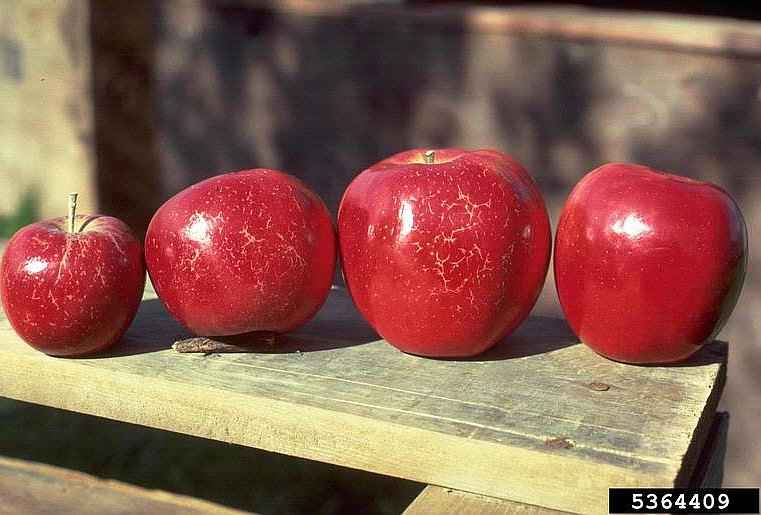
The Apple Powdery Mildew, which is caused by the ascomycete fungus Podosphaera leucotricha, represents an important disease of the tree and crop. But despite the name, it is not only one of the most serious diseases of Apple tree, but also of Pear, Quince, and of Peach tree – from stone fruit crops.
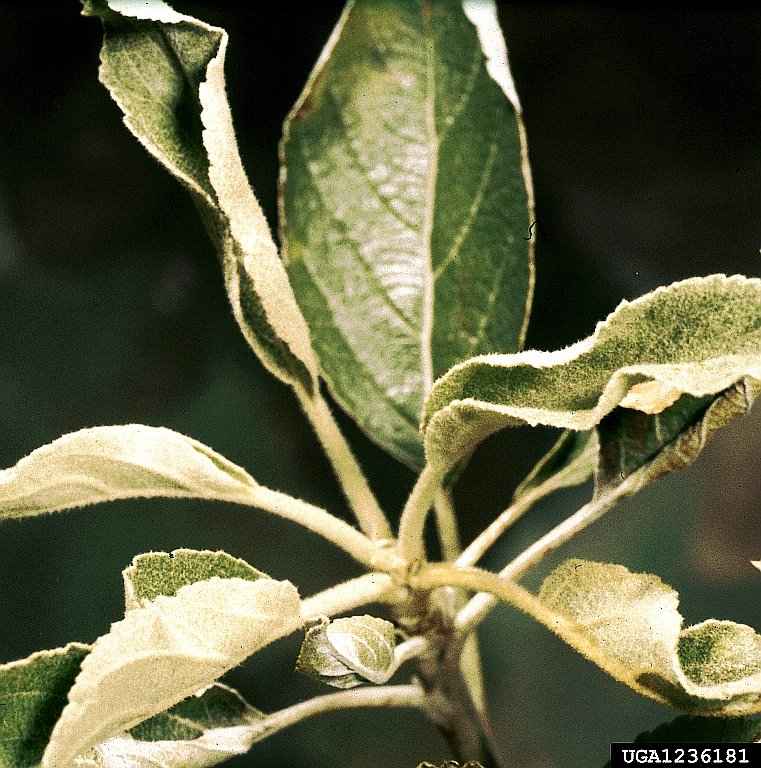
Although it rarely causes the death of its host, its permanent presence contributes to the debilitation of the plant, its reduced strength, as well as its considerable reduction in production capacity, but also to the qualitative degradation of the produced fruits.
Therefore, the headache that causes to the grower is, more or less, expected.
Of course, more or less, the – diametrically opposite – joy of the editorial team of “Kalliergeia” is to be expected, which in this article will present the classification, the biological cycle and the relationship of the ascomycete with the environment in which it moves and with which it interacts.
However, in a subsequent article, and much to the chagrin of that team, there will be an extensive reference of the means and methods of controlling and eradicating it from crops of agricultural interest.
Till then, and looking forward to a thorough understanding by the ascomycete, we hand over the present work to the reader.
Apple Powdery Mildew (Podosphaera leucotricha)
Classification of Podosphaera leucotricha
Apple Powdery Mildew is classified in the Kingdom of the Fungi and in the Subkingdom Dikarya. The complete taxon of the fungus is listed below.
Classification
- Domain: Eukaryota (Eukarya)
- Kingdom: Fungi
- Subkingdom: Dikarya (Higher Fungi)
- Phylum: Ascomycota (Sac Fungi)
- Subphylum: Pezizomycotina (Euascomycetes)
- Class: Leotiomycetes
- Subclass: Leotiomycetidae
- Order: Erysiphales (Powdery Mildews)
- Family: Erysiphaceae
- Genus: Podosphaera
- Species: P. leucotricha
Podosphaera leucotricha (Ellis & Everh.) E. S. Salmon, (1900)
➤ Teleomorph: Podosphaera leucotricha (Ellis & Everh.) E. S. Salmon, (1900)
➤ Anamorph: Oidium farinosum Cooke, (1887)
Synonyms
- Albigo leucotricha (Ellis & Everh.) Kuntze 1898
- Albugo leucotricha (Ellis & Everh.) Kuntze 1892
- Oidium farinosum Cooke 1887
- Oidium mespili Cooke 1887
- Sphaerotheca leucotricha Ellis & Everh. 1888
- Sphaerotheca mali Burrill 1892
Common Names
- Greek: Ωίδιο της Μηλιάς
- English: Powdery Mildew of Apple, Apple Powdery Mildew
- Spanish: Cenicilla Polvorienta Del Manzano, Mal Blanco Del Manzano, Oídio Del Manzano
- French: Blanc du Cognassier, Blanc du Poirier, Blanc du Pommier, Oïdium du Cognassier, Oïdium du Poirier, Oïdium du Pommier
- German: Apfelmehltau
- Chinese: 白叉丝单囊壳
- Persian: پودوسفرا لوکوتریکا
Apple Powdery Mildew (Podosphaera leucotricha)
Description of the Apple Powdery Mildew
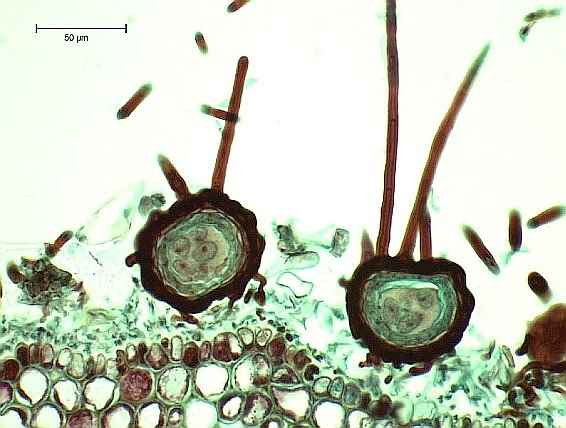
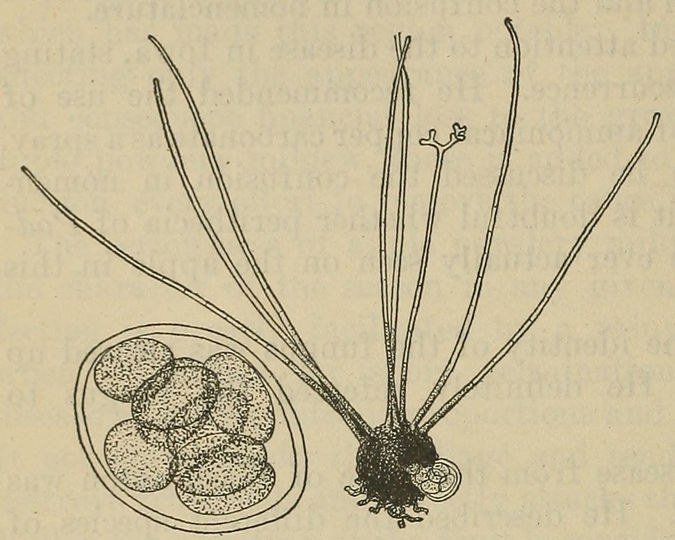
The main biological forms of the Apple Powdery Mildew are described, such as the the mycelium, conidiophores, conidia, as well as cleistothecia with asci.
Mycelium
Mycelium of Podosphaera leucotricha is white in color and is formed from branched mycelial hyphae, straight or curved, with a diameter of 4 to 6 μm. The mycelium appressoria (bulbous formations attached to cuticle of the host) and haustoria (the fungus ‘roots’) have a nipple shape.
Conidiophores
Conidiophores are produced at the terminal of mycelial hyphae. They are erect and straight with cylindric foot cells. The dimensions of conidiophores range in length between 41 and 185 μm and in the diameter between 9 and 12.5 μm.
Conidia
Conidia of Apple Powdery Mildew are unicellular, colorless and hyaline. They contain distinct fibrosin bodiesand are carried as a chain on conidiophores, which consists of 2 to 6 conidia. Their shape is ellipsoid to rarely slightly ovoid, with dimensions of 20 to 38 μm in length and 11 to 20 μm in diameter.
Cleistothecia & Asci
The cleistothecia are black, 75 to 100 μm in diameter. Within them are formed the asci, whose dimensions range in length between 55 to 70 μm and in the diameter between 45 to 50 μm. The asci contain 8 spores, of 20 to 36 μm in length and 12 to 15 μm in diameter each ascospore.
Apple Powdery Mildew (Podosphaera leucotricha)
Biology & Ecology of Podosphaera leucotricha
The Podosphaera leucotricha knows no borders. In this sense, it is a cosmopolitan plant pathogen, which is additionally characterized as polycyclic due to the successive secondary infections it causes through its genetic reproduction.
On the infected parts of the plant lives by absorbing its food from the host cells. As soon as mycelial mat develops enough, the fruiting bodies appear within the mycelium.
These basic biological reproduction functions, as well as its overwintering, are summarized briefly below.
Sexual Reproduction
Apple Powdery Mildew sexual propagate with the ascospores, which are produced at the end of the summer and early autumn. The spores of the fungus are contained in the bag-like asci, while the asci are carried one in the ascocarps compound fruiting bodies called also cleistothecia (or chasmothecia). Cleistothecia are presented as distinct black dots on mycelium.
Asexual Reproduction
Asexual reproduction of Podosphaera leucotricha occurs with conidia. The conidia are the asexual spores of this fungal obligate parasite, which are produced on conidiophores – specific short stalk organs. Conidia are dispersed by the wind and transported to other parts of the tree, from tree to tree and/or adjacent orchards.
During the growing period, conidia reproduction is continuous up to 30 °C (86 °F), causing repeated secondary infections.
Overwintering
The overwintering of Podosphaera leucotricha is done with cleistothecia and the mycelium. However, primary infections of the fungus are not due to cleistothecia, but to mycelium. Mycelium is mainly found in the dormant buds, that infected the previous year, but sometimes also in the shoots or branches, in areas with mild winters.
Mycelium is gradually destroyed when low temperatures are at -11 °C (12.2 °F) and below, while infected buds are destroyed at extremely low winter temperatures ranging from -20 to -23 °C (-4 to -9.4 °F).
However, even below -27 °C (-16.6 °F), a very small percentage of the pathogen can survive on infected plant parts and organs.
Apple Powdery Mildew (Podosphaera leucotricha)

Hosts of Podosphaera leucotricha Fungus
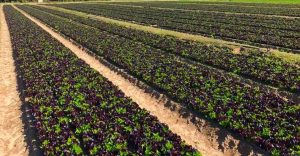
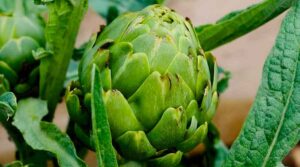
Apple Powdery Mildew infects numerous plants, both fruitful and ornamental. The most important hosts of this phytopathogenic fungi are listed below.
Hosts
Fruit Trees
-
Cydonia oblonga (Quince)
-
Malus domestica (Apple)
-
Mespilus germanica (Medlar)
-
Prunus persica (Peach)
-
Prunus domestica (Plum)
-
Pyrus calleryana (Bradford Pear)
-
Pyrus communis (European Pear)
Ornamental Plants
-
Malus spp. (Ornamental Apple Species)
-
Photinia fraseri (Photinia)
-
Photinia serratifolia (Japanese Photinia)
-
Photinia serrulata (Chinese Photinia)
-
Spiraea bumalda (Bumalda Spiraea)
Apple Powdery Mildew (Podosphaera leucotricha)
Geographical Distribution of Apple Powdery Mildew
It would be much easier to refer the countries where there is no Apple Powdery Mildew rather than the opposite. Indeed, it would be infinitely easier if someone remarked in advance that Podosphaera leucotricha is absent only from the Poles.
…. And the Sahara.
Apple Powdery Mildew (Podosphaera leucotricha)
References
The References of another insightful article from “Kalliergia,” such as the one on Apple Powdery Mildew (Podosphaera leucotricha), are presented by Bloodywood in their lyrical song Gaddaar.
- Devasahayam, H. L. (2009). Illustrated Plant Pathology: Basic Concepts. New India Publishing.
- Liang, C., Xing, H. H., Cho, S. E., & Shin, H. D. (2012). First Report of Powdery Mildew Caused by Podosphaera leucotrichaon Photinia serrulata in China. Plant Disease, 96(11), 1695-1695.
- Lind, K., Lafer, G., Schloffer, K., Innerhofer, G., & Meister, H. (2003). Organic Fruit Growing. CABI.
- Miletich, N., Tamas, O., Vuksa, P., Pfaf-Dolovac, E., & Dolovac, N. (2012). The Influence of Shading on the Development of Podosphaera leucotricha Under Field Conditions. Bulgarian Journal of Agricultural Science, 18(2), 178-184.
- Naqvi, S. (Ed.).(2007). Diseases of Fruits and Vegetables: Volume I Diagnosis and Management. Berlin, Germany: Springer Science & Business Media.
- Pollock, M. (Ed.). (2012). Fruit & Vegetable Gardening. DK.
- Westcott, C. (2008). Westcott’s Plant Disease Handbook. Springer Science & Business Media.
- Wurms, K. V., & Ah Chee, A. (2011). Control of Powdery Mildew (Podosphaera leucotricha) on Apple Seedlings Using Anhydrous Milk Fat and Soybean Oil Emulsions. New Zealand Plant Protection, (64), 201-208.
- Podosphaera leucotricha (Ellis & Everhart) Salmon, 1900: Plant Parasites of Europe
- Podosphaera leucotricha (Ellis & Everhart) Salmon, 1900: The Encyclopedia of Life (EOL)
With Pomp and Circumstance
VIDEO
From the appearance of the Indian band Bloodywood at the Bloodstock festival (Derbyshire – August 27, 2022), we see, hear, and musingly enjoy their song Gaddaar.
Clarification
Of course, it is needless to say – but we will emphasize it – that in this handmade website, no article has been and will not be written with recourse to Artificial intelligence (AI). Natural Intelligence, that is, as much of it as we have and for as long as we are allowed to have it, is enough for us.
Sharing
The use of the material, where third-party rights are not mentioned or implied (such as photos or audiovisual files - with the exception of those belonging to "Kalliergeia"), is absolutely free. Its sharing, possibly, useful.