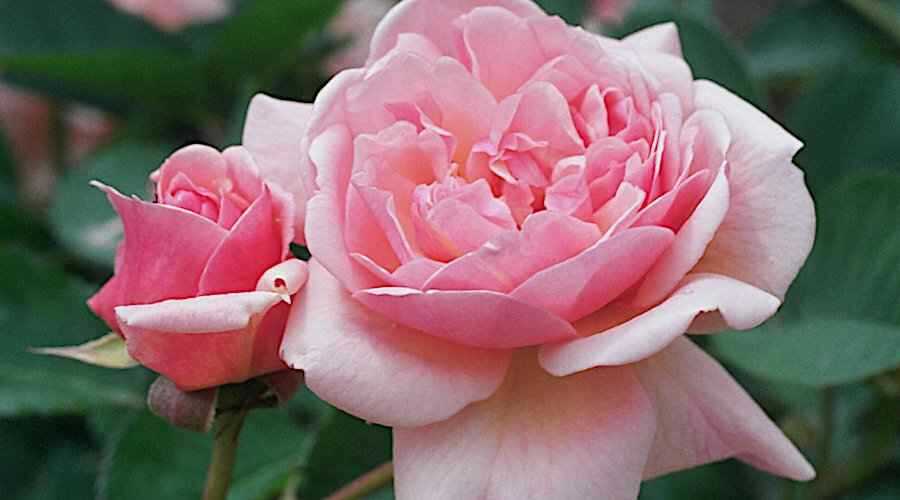
Rosa ‘Felicia’ is included in Hybrid Musk Roses, which was raised by the outstanding Joseph Hardwick Pemberton, Reverend by profession and Englishman by birth.
The Hybrid Musk Roses – which were the crown of the breeding work of this passionate with roses nobleman – have the following features:
-
The long-lasting aromatic flowering
-
The abundance of roses produced in gigantic clusters – abundance comparable to that of Polyanthas
-
And the robustness along with the beautiful appearance of the plants themshelves
The breeding strategy of the Reverend Pemberton was based on the successive crosses of the climber rose Rosa multiflora cv. ‘Trier‘ (Hybrid Multiflora) and Musk Rose Rosa moschata cv. ‘Aglaia‘ with selected roses of the groups Tea Roses, Hybrid Tea Roses and Hybrid Perpetual Roses.
The happy result of his efforts – which includes, of course, the Rosa Felicia – still adorns the gardens, charming our vision and skyrocketing the olfactory enjoyment.
(Note: This is not a preface of an article devoted to a rose variety but a description of the launch of Apollo 11 from the Kennedy Space Center.)
Rosa ‘Felicia’ Shrub (Hybrid Musk Roses)
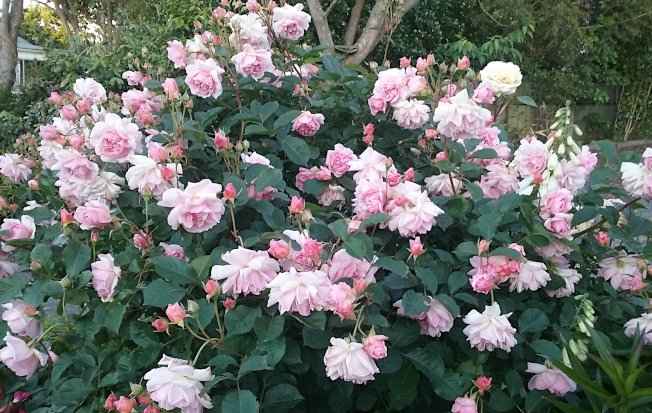
Rosa 'Felicia' Shrub - General Information
The course of the creation of the Felicia rose variety is given below, while here we provide some brief identifying details and its basic characteristics.
Facts in Short
Family: Rosaceae
Genus: Rosa
Scientific Name: Rosa ‘Felicia’
Common Names: Rose Felicia, Felicia Shrub Rose
Horticultural Group: Hybrid Musk – Modern Roses
Plant Breeder: Joseph Hardwick Pemberton, England before 1926 – 28
Awards: RHS Award of Garden Merit 1993
Uses In Brief
This Hybrid Musk Rose variety is suitable for:
- Specimen
- Mass plantings
- Informal hedges
- Urban plantings
- Pots & containers
- Cut flowers
Rosa ‘Felicia’ Shrub (Hybrid Musk Roses)
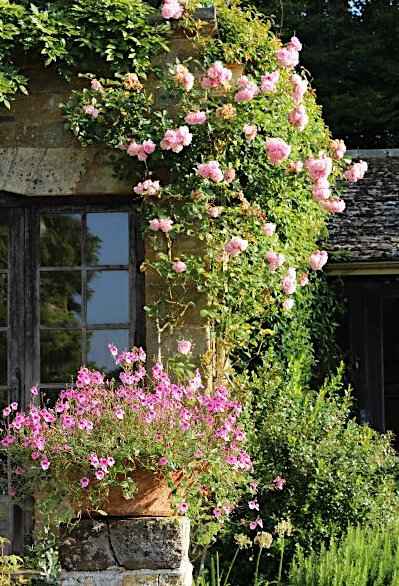
Breeding & Landscape Attributes
Breeding
The Hybrid Musk Rosa Felicia is a triploid variety of 2n = 21 (3×7) and arose by the cross of Rosa multiflora cv. ‘Trier’ with the Hybrid Tea Rose variety Rosa ‘Ophelia’. The exact time of its creation is not known, but certainly before 1926 – the year that its breader has shuffled off this mortal coil – while it was Introduced in United Kingdom by John Bentall – continuator of Pemberton’s work – in 1928.
From one parent, Rosa ‘Trier’, took the strength, vigor and durability, and Rosa ‘Ophelia’ from the other, the shape of the very beautiful double flower, the delicate pink color that varied yellow stamens, as well as the medium to strong intense sweet fragrance.
Landscape Attributes
Rosa Felicia is a perennial, woody deciduous medium-sized shrub.In terms of size, the height of the plant varies between 1.2 and 3 m while its diameter is between 1.2 and 1.5 m. Its shape is hemispherical, has upright to arched habit and a dense, rather asymmetrical canopy with an irregular outline. It is characterized as a coarse texture plant, while the dense foliage gives the Rosa Felicia a compact appearance.
Its flowering is abundant and repetitive, starting from mid-spring to the end of summer – but under favorable conditions it can be prolonged. Regarding life span, its duration exceeds 25 years.



Rosa 'Felicia' Shrub - Description
Rosa ‘Felicia’ is a multi-branched shrub, with a few spiny and lengthy, slightly arching shoots. Its leaves are composite, consisting of 5 to 7 leaflets, glossy, oval-shaped and toothed, with nice middle tone green color.
The profuse roses are formed on the edge of its annual shoots, in clusters – flat, rosette. They are semi-double, aromatic, and large, with a diameter of up to 7 cm. They consist of 16 to 41+ petals, of moderately velvety texture, pink in color with salmon shadings to the center, which pale with age, varied by yellow stamens.
Although Rosa Felicia is characterized as a repeat bloomer rose shrub, it is not unusual during its long period of blooming not to totally lack flowers. If conditions favor it, it most often behaves like a continuous flowering rose.
The fragrance of its flowers is moderately strong to strong. The escalation of its intensity appears to be more or less related to the soil-climatic factors of the planting area. In addition, for the olfactory ‘tint’ of the aroma, the experts claim that is somewhat reminiscent of that of roll-your-own tobacco.
Without wishing to disagree, the editorial team of ‘Kalliergeia’ supports – with the exception of its permanently disagreeable member, and with the sensitivity of the nasal cavity of the other members, permanently smoothed by cigarettes smoke – that the fragance of Rosa ‘Felicia’ reminds the aroma of just a musk rose.
Rosa ‘Felicia’ Shrub (Hybrid Musk Roses)

Rosa 'Felicia' Shrub - Environment of Establishment
Rosa Felicia grows in those areas where the temperature in the winter does not drop below -9 °C / 15 °F (USDA Hardiness Zone 8b) – a temperature that defines its lower tolerance. Of course fully established, acclimatized and protected plants can withstand minimal temperatures up to -29 °C (−20 °F) without being damaged.
In any case, however, the plant needs protection from spring frosts, or avoid planting where they are prevalent, especially late ones.
In relation to the soil, Rosa Felicia can be grown on sandy loam to clay loam soils, which are fertile and rich in organic matter and additionally have excellent drainage but at the same time maintain the necessary soil moisture.
With respect to the soil pH, the appropriate range is quite large, ranging from 5.5 to 7.8. However, it thrives in soils with a slightly acidic reaction, ie at pH values ranging from 6 to 6.5.
For its exposure, are recommended sites of fully sunny or partial shade. The former are preferred in the colder areas, the latter in the warmer ones, however, it is also true that in partial shade conditions, Rosa ‘Felicia’, but also and the other roses of the Hybrid Musk group in general, are extremely satisfying adapted.
Rosa ‘Felicia’ Shrub (Hybrid Musk Roses)
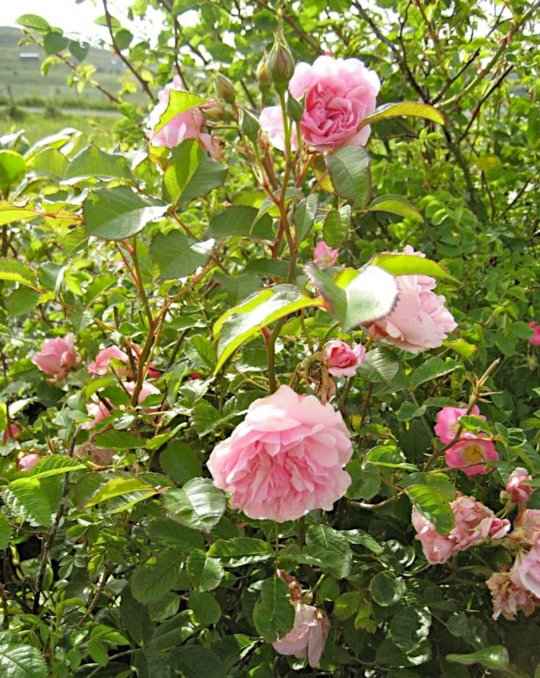
Rosa 'Felicia' Shrub - Use
Rose ‘Felicia’ is undoubtedly one of the most attractive rose shrubs, in relation both to the natural form of the plant and its rich and extremely fragrant flowering.
If we add to it the possibility of its utilization even in relatively poor soils, but also its vigor and its highly robustness, then we have a historical variety of rose that looks by an extremely optimistic view the future.
And sees it optimistic because in the present:
-
It is cultivated for its roses, which as cut flowers last in the vases from about 7 to 10 days
-
With the appropriate support, it is easily formed in a climbing
-
Used as a specimen plant placed on its own in a prominent position in the garden, or planting in groups
-
Creates excellent hedges – especially informal
-
It is used in the garden in conmpanion with other plants such as Heuchera ‘Chocolate Rues’, Lavandula angustifolia ‘Rosea’, Salvia nemorosa ‘Blaukonigin’ and Digitalis purpurea
-
Finally, it is planted in large-sized pots and containers, in sunny places
Rosa ‘Felicia’ Shrub (Hybrid Musk Roses)
References
The References to the near-space article entitled Rosa ‘Felicia’ Shrub (Hybrid Musk Roses), are presented by Giannis Haroulis, with the song Little Rose (Triantafyllaki), in lyrics and music by Apostolis Valaroutsos.
-
Bhattacharjee, S. K., & Banerji, B. K. (2010). The Complete Book of Roses. Jaipur: Aavishkar Publishers, Distributors.
-
Brickell, C. (2010). RHS Encyclopedia of Plants and Flowers. Dorling Kindersley.
-
Green, D. (2000). Roses for Canadians. CDG Books Canada.
-
Hass, R., Olson, J., & Whitman, J. (2012). Growing Roses in Cold Climates. University of Minnesota Press.
-
Palmstierna, I. (2015). Practical Rose Gardening: How to Place, Plant, and Grow More Than Fifty Easy-Care Varieties. Skyhorse.
-
Pemberton, J. (2008). Roses: Their History, Development, and Cultivation. Carlisle, MA: Applewood Books.
-
Taylor, P. (1995). Gardening with Roses: A Practical and Inspirational Guide. Timber Press (OR).
- Rosa ‘Felicia’, Pemberton 1928 – 02: Wikimedia Commons
- Rosa ‘Felicia’, Pemberton 1928 – 03: Wikimedia Commons
With Pomp and Circumstance
VIDEO
The song Triantafyllaki (Little Rose), in lyrics and music by Apostolis Valaroutsos, is performed by Giannis Haroulis, at a concert he gave at Gazi of Athens in the summer of 2016.
Clarification
Of course, it is needless to say – but we will emphasize it – that in this handmade website, no article has been and will not be written with recourse to Artificial intelligence (AI). Natural Intelligence, that is, as much of it as we have and for as long as we are allowed to have it, is enough for us.
Sharing
The use of the material, where third-party rights are not mentioned or implied (such as photos or audiovisual files - with the exception of those belonging to "Kalliergeia"), is absolutely free. Its sharing, possibly, useful.