The Deodar Cedar against the Cedar of Lebanon? Or somewhat differently, the Cedar of Gods vs. the Cedar of God?
Of course not, because despite the fact that so many gods are concentrated on these two trees, the divine interests of both gods are common, and as gods as they are, they know better the saying of Heraclitus of Ephesus that ‘This universe, which is the same for all, has not been made by any god or man (…)’.
Also as gods as they are, they know that the universe, as small as it may be, always keeps, includes and accommodates everyone and forever, and therefore, even these two magnificent coniferous trees.
… The editorial team of ‘Kalliergeia’ with the immense – as the small universe – pride, joins the ranks of its articles, after the Cedar of Lebanon, the peer Himalayan Cedar, proving that which a greek proverb says ‘Only mountains never meet’.
The trees, yes.
Deodar Cedar (Cedrus deodara) – Description and Uses
Deodar Cedar Origin
Deodar Cedar (Cedrus deodara) – Description and Uses
Deodar Cedar (Cedrus deodara) - Brief Description
Family: Pinaceae
Genus: Cedrus
Scientific Name: Cedrus deodara (Roxb.) G.Don
Common Name: Deodar Cedar, Deodar Tree, Himalayan Cedar
General Characteristics
Leaf Persistence
Evergreen
Form
Coniferous Tree Pyramidal Shape
Texture
Fine
Growth Rate
Fast
Flowering Period
August – November
Fruiting Period
Autumn – Winter (12.5 – 24 months after)
Height
15 – 20 m (up to 60 m) • 50 – 60 ft (up to 196 ft)
Diameter
6 – 10 m (up to 20 m) • 20 – 30 ft (up to 65 ft)
Shapes and Colours
Leaves Shape
Needle-like, Acute
Foliage Colour
Bluish Green
Autumn Foliage Colour
Bluish Green
Flowers Shape
Catkins (M.), Cones (F.)
Flowers Colour
Reddish Brown
Seeds
Brown, Winged Shape
Plantation
Soil Type: Well-drained, sand, loam, clay
Exposure: Sun
Soil pH: 5.3 – 7.5
Watering: Moderate
Hardiness: -17 °C (0 °F – USDA Hardiness Zone 7a)
Uses
In parks, squares, gardens
Deodar Cedar (Cedrus deodara) – Description and Uses
Deodar Cedar (Cedrus deodara) - Etymology
Etymology of the Genus Name
For the etymology of the Cedrus name, the reader is invited to travel, if not to Lebanon, at least to Cedar of Lebanon.
Etymology of the Species Name
After he/she has done that, the reader will find here, the almost certain etymology of the name of the species.
The name of the species deodara, therefore, is the Neo-Latin version of an ancient word, Sanskrit देवदारु ‘deva-dāru, which translates as ‘divine tree ‘(deva = god, dāru = wood, tree), ‘tree of gods‘ and / or ‘timber of gods‘.
The ‘tree of gods‘, through the adventures of the language, was initially देवदारु ‘devdāru‘ and then, in the colloquial Hindustani देओदार ‘deodār’, which in colloquial English is intelligently translated as deodar.
There is another opinion for the origin of the word: according to this, its ultimate origin should be sought in a historical Indian state – which probably does not negate its utmost etymology.
Deodar Cedar (Cedrus deodara) – Description and Uses
Deodar Cedar (Cedrus deodara) - Origin, Conservation Status & Life Span
Origin
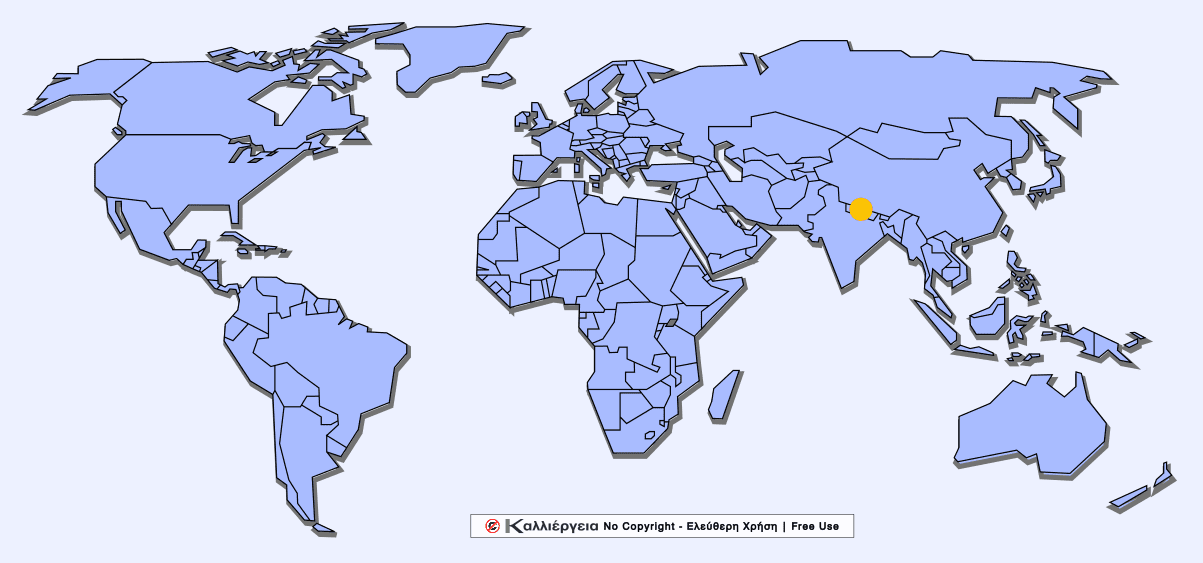
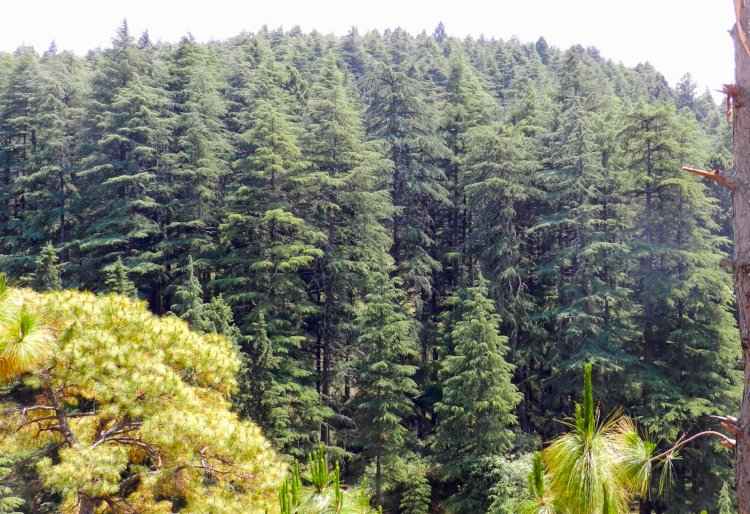
Compared to the estimated extent of the universe, the Deodar Cedar originates from a rather relatively small area in southern Asia. More specifically, the cradle and birthplace of this magnificent conifer are the western and southern Himalayas.
Even more specifically, the cradle of the Deodar Cedar includes western Nepal, southwest most Tibet, northern India, northern Pakistan, and eastern Afghanistan.
Its populations are located in the mountains of the temperate zone, and at altitudes between 1000 and 3500 m. There forms pure and mixed conifer forests with species included among others in the genera:
-
Juglans (Juglans regia)
-
Quercus (Quercus ilex, Q. baloot, Q. incana, Q. dilitata)
-
Taxus (Taxus baccata)
-
Picea (Picea smithiana)
-
Abies (Abies pindrow, A. villosum, A. spectabilis)
-
Pinus (Pinus gerardiana, P. wallichiana)
-
Rhododendron
-
Populus (Populus caspica)
-
Acer
-
Corylus
-
and Juniperus (Juniperus excelsa)
Deodar Cedar forests are located in areas, which parent material is metamorphic and clastic sedimentary rocks – mainly slates and carbonate sedimentary rocks. They occur on moderate to precipitous slopes on rocky precipitous slopes, usually at north exposure.
Conservation Status
Fortunately, without classified the conifer tree as a threatened species, the estimate for the natural populations of the Deodar Cedar is that in the last four decades, they have decreased to 30-40%.
And in this case, it seems to be the main liable, none other than excessive grazing.
Life Span
Compared to the estimated age of the universe, the Deodar Cedar lives remarkably less: 200 and / or more years – without counting frequent references for trees aged 550 to 600 years and even more rare for trees 745 to 900 years.
Deodar Cedar (Cedrus deodara) – Description and Uses
Deodar Cedar (Cedrus deodara) - Landscape Attributes
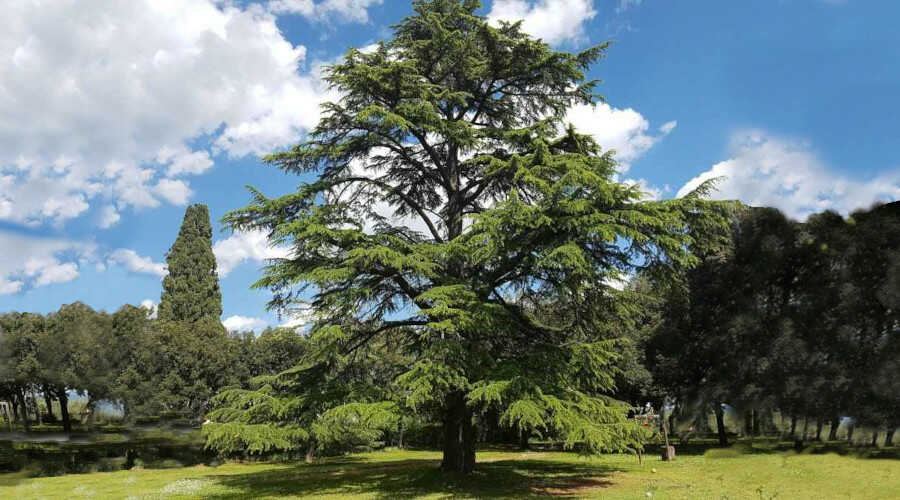
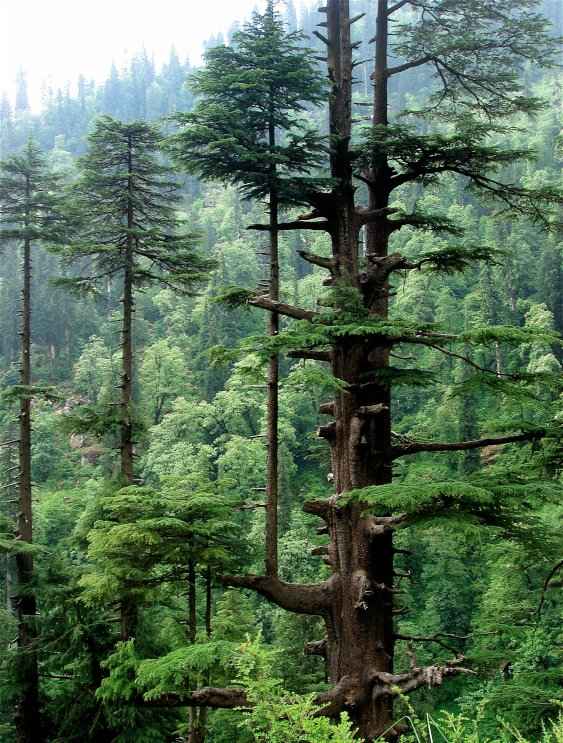
Deodar Cedar is an evergreen coniferous large tree of impressive habit. It has a fast growth rate (0.70 – 0.90 m / year) and actually is considered as the faster among all Cedar species.
Its height at the age of 20 usually reaches up to 10 m, while at full maturity it reaches 20 m, and sometimes, in its natural niches, 30 to 60 m.
It has mainly monopodial growth form, bearing a single, straight trunk, and a drooping central leader.
The branches of the tree are slightly ascending, while the branchlets have an arcuate shape, the top of the curve to the ground, and the tips – as well as the main branches – are hanging downward.
However, as the tree grows, the branches become mainly horizontall, resulting in a change of its shape, which is initially pyramidal, and through the passage of time takes a cylindrical – flattened form, as the crown become rounded or broad and flat.
The Deodar Cedar canopy is rather symmetrical, has medium density, is mostly normal outlined, and of fine texture.
The cones produced by the conifer, at all stages of their development, add a decorative element to the plant, while both the bark and the foliage are fragrant.
Deodar Cedar (Cedrus deodara) – Description and Uses
Deodar Cedar (Cedrus deodara) - Botanical Description
Trunk
The Deodar Cedar develops a strong, thick trunk that branched in a spiral arrangement. It has a diameter of 1 to 3 m and a circumference that sometimes reaches up to 5.50 to 6 m. The bark is initially smooth, but over time it becomes rough with grooves, forming irregular scales of gray or dark gray color.
Branches
The branches of Himalayan Cedar are dimorphic and they differentiate in the growth into two types of branchlets, forming the long branchlets and the short branchlets.
The long branchlets, which are usually pendulus, have a pale grayish yellow color in the first year, and they are densely pubescent with some white powder. While mature, they get greyish color.
The short branchlets are are bearing from lateral, axillary buds, grow slowly, and produce few wood.
Leaves
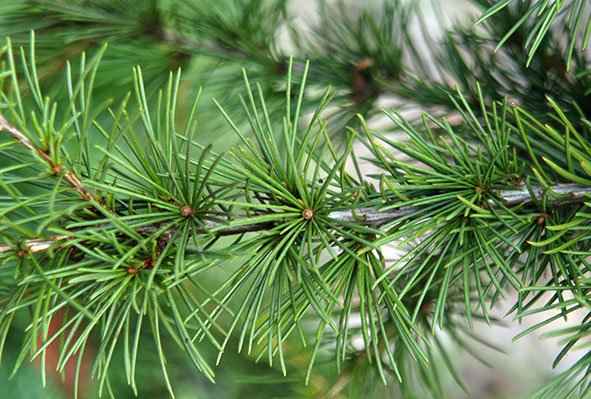
The leaves of Deodar Cedar are needle-shaped, narrow and rigid, resulting in an acuminate apex. They have a wide triangular cross section, and each separate leave has two elongated resin canals.
Although they are amphistomatous, the majority of the stomata are found on the two upper sides. The adaxially stomatal lines are 2 to 3, while those abaxially are 4 to 6.
The leaves are single and are arranged spirally, on the shoots, both in the long branchlets and in the short branchlets. However, because the insertion of the leaves on the short branchlets is dense (20-30) on them, they seem as that they are arranged as in fascicles.
The leaf length is between 2.5 and 5 cm (up to 7 cm) while their thickness is between 0.9 and 1 mm.
The predominant color of the leaves is glaucous, but other shades between light and dark green are observed. The leaves remain in the tree for 3 to 6 years, while the aged, the Himalayan Cedar throws them in the warm season, which is usually the summer.
Cones
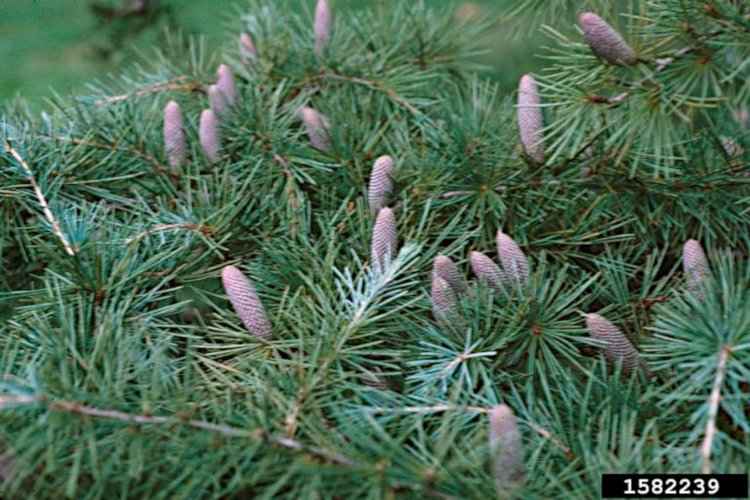
The Deodar Cedar is a monoecious species – that means it has male and female flowers (cones or strobili) on the same tree. Male cones are mainly bearing on the lower branches, while the female cones are at the ends of the highest.
Male cones (microstrobilus or pollen cones) are solitary erect catkins, elongated – oval shaped, and grow at the tip of the short branchlets. Their color is purplish green to yellowish green while in the phase of the opening and release of pollen they seems yellow.
Their dimensions are 4 to 7.5 cm in length and 1 to 1.5 in diameter.
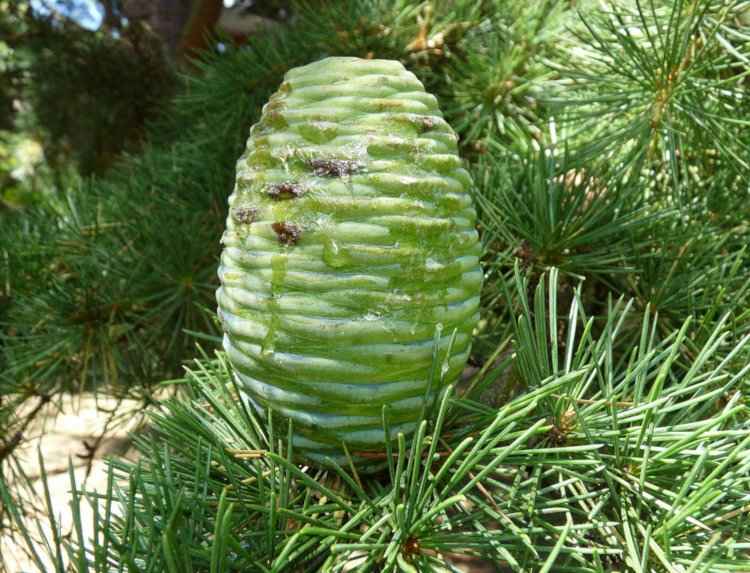
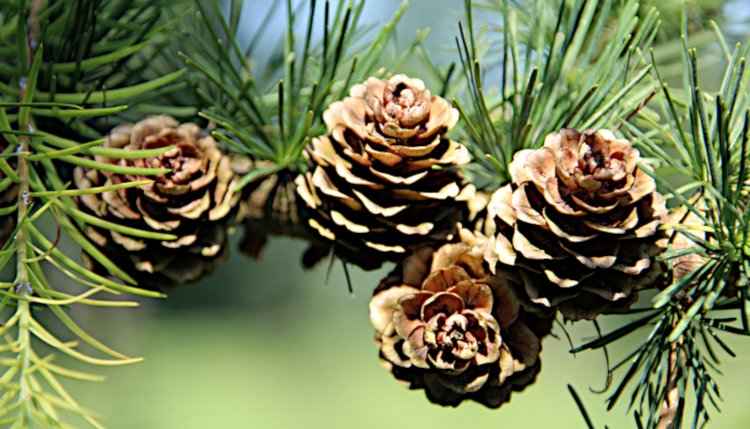
The female cones (megastrobilus or seed cones) grow on the peripheral branches of the crown. They are single or in pairs, erect, shortly pedunculate, and are ovoid or broadly ellipsoid.
The color of the cones is initially bluish green, initially with some white powder, which in the ripening becomes light purple to pale brown. Their length ranges between 7 and 13 cm, while their diameter is from 5 to 8.7 cm.
Seed scales, which are leathery and thin, are spirally arranged around the cone axis and resemble the tile arrangement. They are flabellate-obtriangular, incurved distally, and have dimensions of 4 to 6 cm in length and 2.5 to 4 in width.
Female cones need about 12.5 to 24 months to ripe. After ripening the seed scales are falling off, the cones disintegrating, but the cone axis remains in the trees.
Pollination
Both male and female cones mature in the autumn, from about mid-September to mid-October. Male cones release pollen, which is transported by the wind – so pollen grains have air bladders (sacci).
However, successful pollination does not mean direct fertilization of the female flower. Indeed, to fertilize the female flower it takes a while, usually until the following spring.
Seeds
The ovuliferous scales of the female cones contain two seeds. The seeds are oily, irregular triangular shaped with rounded corners, and covered by a membrane.
The membrane ends in a broad wing, thus giving the seeds a winged shape, which facilitates their transport by the wind.
The color of the seeds is light-brown, while in size, their length varies between 2.5 and 3.7 cm, and their width is between 2 and 2.5 cm.
The seeds overwintering in the soil, and if the conditions are favorable, they will germinate and grow in the late spring.
Abundant seed production is observed almost every third year, however, seed viability is low and can not be stored for a long time.
The rate of seed germination varies between 65 and 80%, while in one kilogram there are about 7800 to 8000 seeds.
The Himalayan Cedar enter the reproductive phase after their 40th to 45th birthday – and no one can blame them that they are completely immature to bring into being their offspring.
Deodar Cedar (Cedrus deodara) – Description and Uses
Deodar Cedar (Cedrus deodara) - Climate and Soil
Temperature
In the natural niches of the conifer, average annual temperatures range between 12 °C minimum and 17 °C maximum.
With regard to absolute minimum values, it has been shown that the Deodar Cedar cope with temperatures reaching up to -23 °C, while in terms of absolute maximum values, it does not encounter problems up to 40 °C – sometimes higher.
In crops and as ornamental, however, it is not recommended to plant in areas where the minimum value falls below -17 °C and the maximum exceeds frequently and for a long time 36 to 38 °C.
Rainfall & Snow
The Deodar Cedar in its natural niches grows in those areas where average annual rainfall varies between 200 and 1,800 mm (although in reality the incoming quantities of water are mainly snow).
The existence of water favors the growth of the tree, however its tolerance to drought is high, as research has shown.
As an example, the cedar forests in the state of Himachal Pradesh in northern India, where the meteorological data from the city Shimla (altitude 2,276 m – 7,467 ft), capital of the state, are characteristic: in October, November, and December, the mean monthly rainfall between 1876-1982 varied, respectively, to 350, 110, and 270 mm.
Despite the tolerance of the Himalayan Cedar to drought, it is true that the conifer can not cope with long dry periods. In addition, its seedlings and require sufficient amounts of water, otherwise they dry and die.
Frost
The Deodar Cedar is tolerant to frost. On the other hand, for its uninterrupted development, it requires those climatic conditions where the frost phenomenon is not observed, at least for 160 days per year.
Wind
The Deodar Cedar is fairly wind-tolerant tree – even at a storm level. This feature of the conifer is exploited by planting it to create shelterbelts.
Soil and pH
The soil type is not a problem for the Deodar Cedar as it develops on any form of soil, provided it has excellent drainage and low salinity.
In this sense, it can be exploited even in poor soils, although cultivation of the conifer is favored when planted in deep soil, which will additionally be rich in organic matter, humic and potassium, while the available Phosphorus are low.
With respect to soil pH, the range is remarkably large, since it can grow without problems in both acidic and slightly alkaline environments and at values ranging from 5.3 to 7.5. However, here too, the cultivation of the conifer is favored more in acidic soils.
Exposure
Although the young plants tolerate the half-shade exposure, the mature Deodar Cedar needs places that are full sunny.
Deodar Cedar (Cedrus deodara) – Description and Uses
Deodar Cedar (Cedrus deodara) - Pests & Diseases
The Deodar Cedar, as a tree and dwelling of the gods, does not face serious problems from pests and diseases. However, when the gods were away on business, some unholy parasites find the opportunity to attack.
Pests
Immediately below are recorded the most important pests of Cedrus deodara.
Various Insects
-
Ectropis deodarae
-
Dendrolimus pini (Pine-Tree Lappet)
-
Megastigmus pinsapinis (Atlas Cedar Seed Chalcid)
-
Monochamus alternatus (Japanese Pine Sawyer)
-
Orthotomicus erosus (Mediterranean Pine Beetle)
-
Pandemis cerasana (Common Twist Moth)
-
Pissodes nemorensis (Northern Pine Weevil)
Nematodes
- Bursaphelenchus xylophilus (Pine Wilt Nematode)
► By the use of appropriate pesticides their treatment is satisfactory – except for the nematode which is difficult to control.
Diseases
After the pests, the recording of the diseases follows.
Fungi
- Armillaria tabescens (Armillaria Root Rot)
- Botryosphaeria obtusa (Black Rot of Apple)
- Heterobasidion annosum
- Heterobasidion insulare
- Lophodermium cedrinum
- Macrophomina phaseolina (Charcoal Rot of Bean/Tobacco)
- Phytophthora cinnamomi (Phytophthora Dieback)
- Phytophthora cryptogea (Tomato Foot Rot)
-
Phytophthora drechsleri (Watermelon Fruit Rot)
-
Sirococcus conigenus (Sirococcus Blight of Conifers)
-
Sphaeropsis sapinea (Diplodia Tip Blight or Sphaeropsis Blight)
► Even by the use of appropriate fungicides, the control some of these fungi is extremely difficult.
Deodar Cedar (Cedrus deodara) – Description and Uses
Deodar Cedar (Cedrus deodara) - Toxicity & Allergenic Pollen
Toxicity
The Deodar Cedar is not toxic to humans or pets, however, contact with the tree or its pollen may cause skin irritation.
Allergenic Pollen
Himalayan Cedar pollen can cause allergic respiratory reactions in people with sensitivity. It is a relatively new allergen in the West, which has been recognized as such in recent years.
Deodar Cedar (Cedrus deodara) – Description and Uses
Deodar Cedar (Cedrus deodara) - Use
Both the tree itself and the Himalayan Cedar derivatives have been used and still exploited in a variety of ways. Below, reference is made to their broad field of use.
Ethnobotany
The ethnobotany use of the Deodar Cedar is closely linked to the peoples of its cradle.
The aromatic oil of the plant is traditionally used in many local Indian societies to relieve tension, eliminate fear and eradicate anger.
It is also used for spiritual reasons, such as for awakening consciousness, but also for psychological ones, such as for the elimination of mental instability.
In the Kangra district of the northern Indian state of Himachal Pradesh, the inhabitants ground the wood and work it with water, making a kind of paste, which is used to treat the headache.
In the Western Himalayas, the tree itself is considered sacred – the residence of the gods. Especially in the Kumaon Hills and the Kullu Valley, inhabitants leave pieces of iron as an offer to the gods living in the trees.
Traditional Medicine
In the traditional Ayurveda therapeutic system, all plant parts of the Deodar Cedar are used against various diseases.
Among others, they are used to treat inflammation, dyspepsia, insomnia, cough and cold. They are also given against fever, urinary discharges, bronchitis, leucoderma, elephantiasi, tuberculosis glands, mind disorder, and skin and blood diseases.
In the Persian – Arabic traditional Yunani therapeutic system, both Cedar wood and the bark with the essential oil are utilized.
Wood is used as a diuretic, expectorant, for relieving rheumatism, as well as for treating epilepsy and urinary tract diseases.
The bark is used in formulations that are administered as astringents, antipyretics and anti-diarrheals.
Finally, Cedar oleoresin is applied for the healing of wounds and the treatment of skin rashes.
Pharmaceutical
The Deodar Cedar has many medicinal properties. Among other things, it is stated that:
-
The extract of essential oil from tree wood has a significant anti-inflammatory effect
-
Essential oil from tree wood presents severe analgesic and anticonvulsant action
-
The Cedrus deodara wood ethanol extract shows antihyperglycaemic activity
-
The alcoholic extract of heartwood has a significant anxiolytic and anticonvulsant effect
-
The Cedrus deodara branch’s bark air-dried aqueous extract has an antiarthritic activity
-
Petroleum ether extract of the heart wood presents severe diuretic and anti-urolithiatic effect
Environmental
Deodar Cedar planting in soils that are at risk of erosion works safely. Still positive is the contribution of the conifer to restoring degraded forests.
Agricultural
From the oil of Deodar Cedar, with the participation of oil from the seeds of the Azadirachta indica tree (Indian lilac) and seed powder of the Embelia ribes (False black pepper), the biopesticide preparation Pestoban is produced with a strong molluscicidal action (primarily against the snails of Lymnaea acuminata and Indoplanorbis exustus).
Also, Himalayan Cedar essential oil has fungicidal activity against storage moulds of Capsicum annuum L.
Timber
The Deodar Cedar is desirable for its timber. The wood is yellowish – brown, aromatic and oily. Additionally, it is strong, it is not easily affected by pests, it has a fine texture, close-grain, and when it is treated, it gets an attractive polishing.
Beams, floors, window frames, railway sleepers, pillars, pencils, as well as high quality plywood are produced from wood.
It is used in the construction industry, in the vehicle industry, in the furniture industry and in transport, and a few centuries ago it was used in the mummified industry – unfortunately now disappeared – for the construction of the Egyptian kings and nobles beautiful and durable sarcophagi.
Use in Garden and Landscape
The Deodar Cedar is an emblematic plant for gardening and landscape architecture. It could be said that where space and environmental conditions allow it, its use is almost imperative. On the contrary, it is absoletuly not imperative to plant it in areas where the risk of fires is high because it is highly flammable.
For the rest, the Deodar Cedar can be used:
-
As a specimen conifer tree
-
In mass plantings to create outstanding beauty conifer stands
-
As a shade plant, providing shade at up to 91%
-
In row plantings, to create hedges and windbreaks
-
In urban plantings, in cities where the the atmospheric pollution is moderate
-
As a conifer tree in seaside areas and gardens of the temperate zone
-
Combined with other ornamental plants, such as the dwarf conifers Pinus heldreichii ‘Smidtii’ (Bosnian Pine) and Juniperus x pfitzeriana (Pfitzer Juniper), along with the herbaceous perennial Eupatorium maculatum (Joe-Pye Weed), and the grasses Carex buchananii (Buchanan’s Sedge) and Molinia caerulea ‘Variegata’ (Variegated Purple Moor-Grass)
References
The References of the Deodar Cedar (Cedrus deodara) – Description and Uses article – an article that is not at all downcast by its extent – are inadvertently presented by:
-
A Polish who plays guitar, Miguel Czachowski
-
Another Polish who plays cajon, Dobroslaw Filip
-
An Indian who plays tabla, Sandesh Popatkar
-
And another Indian who plays sitar, Avaneendra Sheolikar
All these distinguished gentlemen join together as Indialucia, offering the outstanding Kyabathe (Bulerias) musical piece – a typical Spanish flamenco with its usual Indian colours of sound.
- Bhatnagar, S. P., & Moitra, A. (1996). Gymnosperms. New Delhi, India: New Age International.
- Bhattacharyya, A., La Marche, V. C., & Telewski, F. W. (1988). Dendrochronological Reconnaissance of the Conifers of Northwest India. Tree-Ring Bulletin, (48), 21-30.
- Bitner, R. L. (2011). Designing with Conifers: The Best Choices for Year-Round Interest in Your Garden. Timber Press.
- Dirr, M. A. (2016). Dirr’s Encyclopedia of Trees and Shrubs. Timber Press.
- Mani, M. (1974).Ecology and Biogeography in India. Basingstoke, England: Springer.
- Negi, S. S. (1992). Himalayan Wildlife, Habitat and Conservation. Indus Publishing.
- Tewari, D. N. (1994). A Monograph on Deodar: Cedrus deodara (Roxb.) G. Don.
- Cedrus deodara: NC State University Extension
- Cedrus deodara: Encyclopedia of Life (EOL) – Media
Clarification
Of course, it is needless to say – but we will emphasize it – that in this handmade website, no article has been and will not be written with recourse to Artificial intelligence (AI). Natural Intelligence, that is, as much of it as we have and for as long as we are allowed to have it, is enough for us.
Sharing
The use of the material, where third-party rights are not mentioned or implied (such as photos or audiovisual files - with the exception of those belonging to "Kalliergeia"), is absolutely free. Its sharing, possibly, useful.