Introduction
He had not passed completely on the opposite bank of abstract painting. And he was still painting trees. Gray trees, red trees, numbered trees and blossoming trees. The eve of World War I was a great time to paint trees. Even horizontal. Not for painting horizontal, but for painting horizontal trees. Horizontal was painted Michelangelo, but horizontal trees Piet Mondrian. It had also not appeared The Style (De Stijl), a magazine that would express an artistic demand and movement. The Style, which when issued in 1917 by Piet Mondrian and Theo van Doesburg, filled a major aesthetic and intellectual gap of the era: with its release, World War I would acquire Style.
Contents
The Artwork
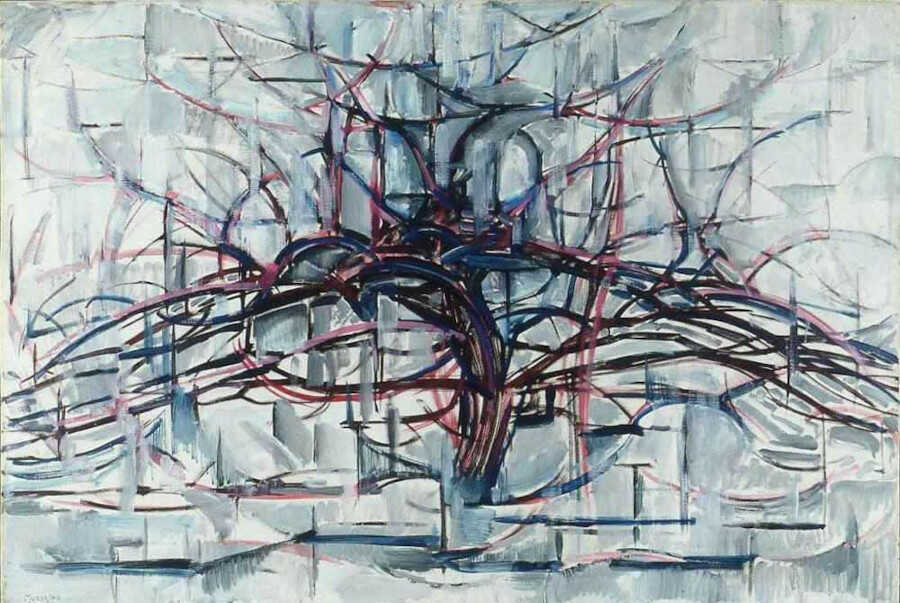
Piet Mondrian – Horizontal Tree, 1911. Munson Williams Proctor Arts Institute, USA. Oil on Canvas. Size: 75.9 x 112.2 cm.
Piet Mondrian – Horizontal Tree, 1911
Contents
The Artwork of Piet Mondrian Horizontal Tree
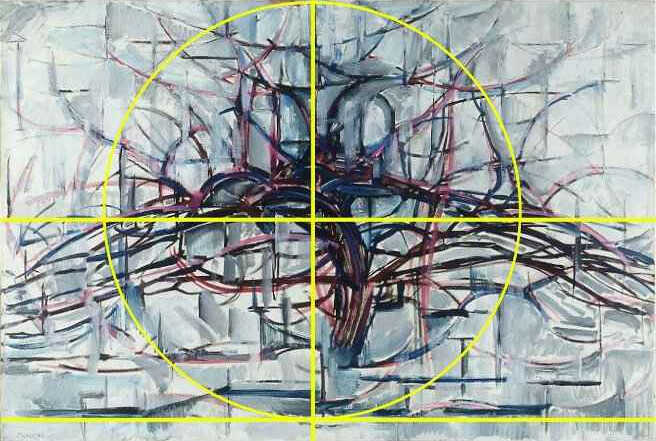
The composition of the artwork, in its simplest approach, is attributed to the characteristic shape of the target: a circle, and two vertical axes intersecting the center, encompass the main thematic area. In this sense its composition is a great hit. The painting is initially implemented with wide and fast brush strokes that form the background, which at the base of the artwork, visually give the sense of horizon. Above them, shorter brush strokes, to a greater or lesser extent orthonormal and rather warm gray, form the spatial grid and intensify a certain sense of depth. And above them begins the dance of the curved brush strokes, which yield a strongly inclined trunk as well as the limb and branches of the tree. The dominant colors are violetish blue and red and redish or bluish purple, light, medium and dark tones – pure primary colors, since earthy have long since disappeared from Piet Mondrian’s palette. And though the tree inclined to the left, leaving to its right a large ’empty’ space, the color power of the work offers the composition an enviable balance.
Contents
For the Evolution of His Art
Of all the abstractionists (Kandinsky and the Futurists) I felt that only the Cubists had discovered the right path; and, for a time, I was much influenced by them.
Piet Mondrian – Horizontal Tree, 1911
Contents
The Concise Statement of the Artwork
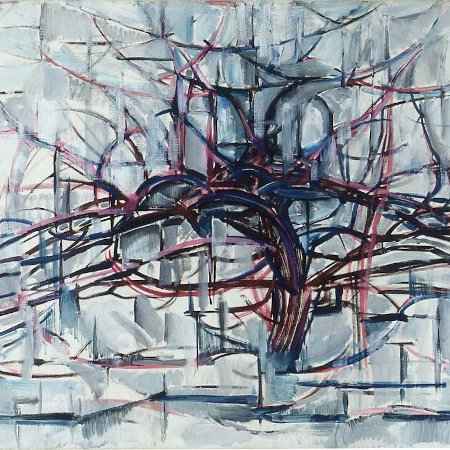
High volume artwork, offers to the viewer almost everything except reverie, tranquility and serenity. The tree could be a neuron, a dendrite with synapses that are ignited by the speed of information.
What information?
One that sums up Mondrian’s artistic background and its course from academic Realism to Impressionism, and from Favism to Cubism and abstraction.
But why does the tree incline?
It does not incline but it bows.
The representativeness is final bowed and withdrawn from the stage.
Contents
For Modern Art
The principle of this art is not a negation of matter, but a great love of matter, whereby it is seen in the highest, most intense manner possible, and depicted in the artistic creation.
Piet Mondrian – Horizontal Tree, 1911
Contents
- Blotkamp, C. (2001). Mondrian: The Art of Destruction. London, England: Reaktion Books.
- Fauchereau, S., & Mondrian, P. (1994). Mondrian and the Neo-Plasticist Utopia. Rizzoli Intl Pubns.
- Jong, C. W. (2015). Piet Mondrian: The Studios: Amsterdam, Laren, Paris, London, New York. Thames & Hudson.
- Mondrian, P., & Russell, P. (2018). Delphi Complete Works of Piet Mondrian. Delphi Classics.
- Ρηντ, Χ. (1977). Ιστορία της Μοντέρνας Ζωγραφικής [A Concise History of Modern Painting]. Αθήνα: Υποδομή.
- Piet Mondrian: The Museum of Modern Art (MOMA)
- Piet Mondrian (1872-1944): New Netherland Institute
Clarification
Of course, it is needless to say – but we will emphasize it – that in this handmade website, no article has been and will not be written with recourse to Artificial intelligence (AI). Natural Intelligence, that is, as much of it as we have and for as long as we are allowed to have it, is enough for us.
Sharing
The use of the material, where third-party rights are not mentioned or implied (such as photos or audiovisual files - with the exception of those belonging to "Kalliergeia"), is absolutely free. Its sharing, possibly, useful.